Revolutionary integration makes professional editing tools available to 800 million ChatGPT users through simple conversational commands
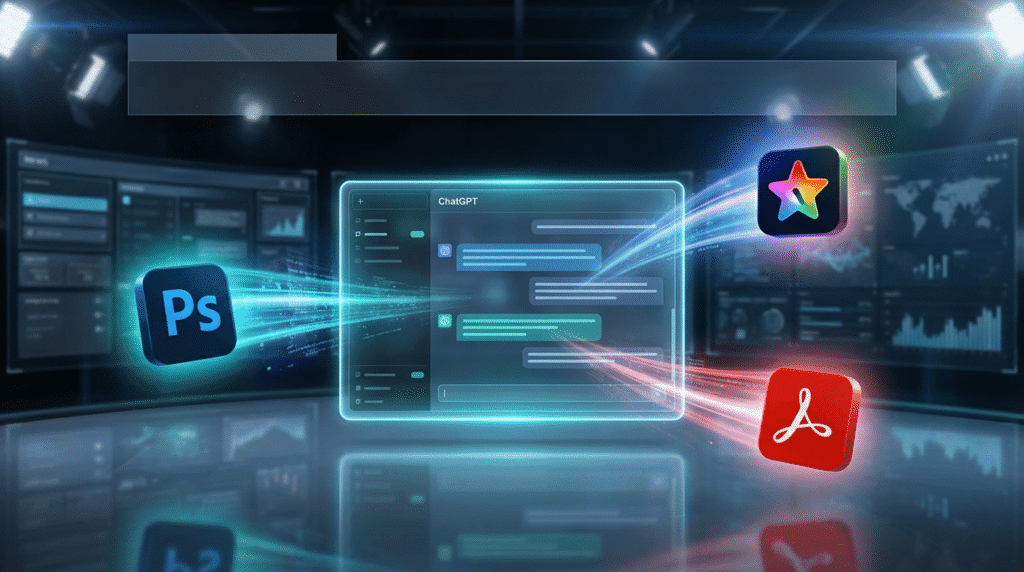
In a groundbreaking move that promises to democratize creative technology, Adobe has launched three of its flagship applications Photoshop, Adobe Express, and Acrobat directly within ChatGPT’s interface. This integration, announced today, represents a significant shift in how millions of people will interact with professional-grade creative tools, eliminating traditional barriers to entry and making sophisticated editing capabilities accessible through simple conversation.
The launch brings Adobe’s industry-leading creative and productivity applications to ChatGPT’s massive user base of 800 million weekly active users, fundamentally changing the landscape of digital creativity and document management. By combining Adobe’s decades of creative innovation with ChatGPT’s intuitive conversational interface, the partnership creates an unprecedented opportunity for users who may have never considered themselves capable of professional-level photo editing or design work.
The Power of Conversational Creativity
At the heart of this integration lies a deceptively simple concept: users can now accomplish complex creative tasks simply by describing what they want in plain language. Gone are the days when mastering Photoshop required hours of tutorial videos and extensive technical knowledge. Instead, users can type commands like “Adobe Photoshop, help me blur the background of this image,” and watch as the application automatically surfaces within ChatGPT and executes the requested action.
David Wadhwani, president of digital media at Adobe, emphasized the transformative nature of this launch: “We’re thrilled to bring Photoshop, Adobe Express and Acrobat directly into ChatGPT, combining our creative innovations with the ease of ChatGPT to make creativity accessible for everyone. Now hundreds of millions of people can edit with Photoshop simply by using their own words, right inside a platform that’s already part of their day-to-day.”
This approach represents Adobe’s ongoing commitment to what the company calls “agentic AI” artificial intelligence systems that can understand context, anticipate user needs, and guide people through complex workflows without requiring specialized knowledge. The integration builds upon Adobe’s earlier innovations, including the launch of Acrobat Studio and AI Assistants for Photoshop and Adobe Express introduced at Adobe MAX.
What Users Can Actually Do
The three Adobe applications available in ChatGPT each bring distinct capabilities that address different creative and productivity needs:
Adobe Photoshop in ChatGPT
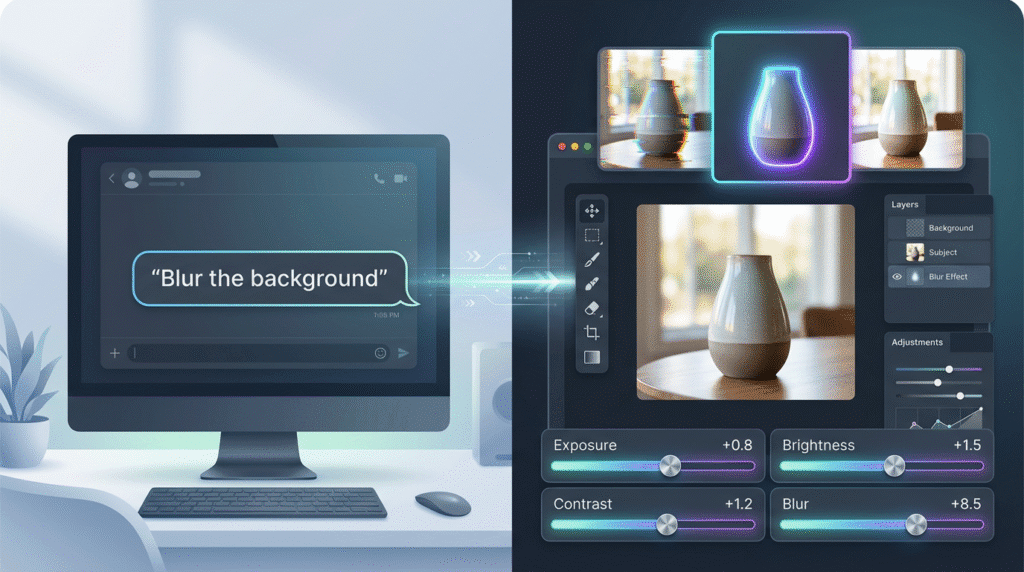
The Photoshop integration focuses on making image editing accessible and intuitive. Users can adjust specific sections of images, apply creative effects like Glitch and Glow, and fine-tune fundamental image settings including brightness, contrast, and exposure—all while preserving image quality. The application can remove or blur backgrounds, a task that traditionally required significant skill and patience in the full desktop version.
What makes this implementation particularly clever is the hybrid approach to user control. For some editing requests, ChatGPT will present multiple results for users to choose from. For others, it provides interactive UI elements like sliders that allow users to manually adjust the intensity of effects. This combination of automated assistance and manual control addresses one of the most common frustrations with AI image editing: the lack of fine-tuned control over the final result.
According to CNET’s coverage, this feature “fixes a big AI image editing pet peeve” by giving users the ability to make precise adjustments rather than relying entirely on AI interpretation. The slider controls for adjusting brightness, contrast, and effect intensity provide a middle ground between fully automated AI editing and the complexity of traditional photo editing software.
Adobe Express in ChatGPT
Adobe Express brings design capabilities directly into the chat interface, enabling users to create professional-looking graphics, social media posts, invitations, and other visual content without leaving ChatGPT. Users can browse Adobe Express’s extensive library of professional templates, customize text and images, animate design elements, and iterate on edits all through conversational commands.
The application allows for comprehensive design work, from selecting the perfect template for a specific occasion to replacing images, adjusting colors, and adding animations to specific sections. This functionality positions Adobe Express as a direct competitor to Canva, which was among the first design platforms to integrate with ChatGPT when OpenAI launched third-party app support in October.
Adobe Acrobat in ChatGPT
The Acrobat integration addresses the universal need for PDF management and editing. Users can edit existing PDFs directly within the chat, extract text or tables from documents, organize and merge multiple files, compress large documents, and convert various file formats to PDF while maintaining formatting and quality.
Additionally, Acrobat for ChatGPT includes the ability to redact sensitive information a crucial feature for professionals handling confidential documents. The conversational interface makes these tasks significantly more accessible than traditional PDF editing software, which often requires users to navigate complex menu systems to accomplish relatively simple tasks.
Seamless Transition to Full Applications
Recognizing that conversational interfaces have limitations, Adobe has built in a seamless pathway for users who need more advanced capabilities. At any point during the editing process, users can choose to open their project in Adobe’s native desktop applications, picking up exactly where they left off in ChatGPT.
This design philosophy acknowledges that while conversational AI can handle many common tasks, professional users may eventually need access to the full power and precision of Adobe’s complete toolset. The integration serves as both a standalone solution for simple tasks and an on-ramp to Adobe’s more comprehensive applications for users who discover they need additional capabilities.
Availability and Platform Support
The Adobe apps for ChatGPT are available free of charge to all ChatGPT users globally, representing a significant value proposition for the platform’s massive user base. The integration launched today across ChatGPT’s desktop, web, and iOS applications.
Platform support varies slightly by application: Adobe Express is available on all platforms including Android, while Photoshop and Acrobat support for ChatGPT on Android is listed as “coming soon.” This staggered rollout suggests Adobe is prioritizing the platforms with the largest user bases while working to achieve feature parity across all devices.
Strategic Implications and Competitive Landscape
This partnership represents a strategic bet by both companies on the future of AI-assisted creativity. For Adobe, the integration provides access to hundreds of millions of potential new customers who might never have considered purchasing Creative Cloud subscriptions. By offering a taste of what Adobe’s tools can accomplish through an accessible, free interface, the company hopes to convert casual users into paying customers who eventually need more advanced features.
For OpenAI, the Adobe integration strengthens ChatGPT’s position as a comprehensive productivity platform rather than just a chatbot. As TechCrunch notes, OpenAI began supporting third-party apps in October with partners including Canva, Spotify, Expedia, and Figma. However, the addition of Adobe’s industry-standard creative tools represents a significant upgrade in capability and credibility.
The integration also intensifies competition in the AI-assisted creativity space. Google’s Gemini AI introduced its own image editing capabilities in May, while numerous startups are developing AI-powered creative tools. The challenge for all these platforms, as TechCrunch observes, is differentiation: “If you don’t use either of these apps, you might not have a preference” between competing options like Canva and Photoshop within ChatGPT.
The Broader Context of Agentic AI
Adobe’s integration with ChatGPT represents the latest step in the company’s broader strategy around agentic AI systems that can work alongside users, understanding context and guiding them through complex workflows. Earlier this year, Adobe launched Acrobat Studio, which transforms static PDFs into interactive, AI-powered workspaces. At Adobe MAX, the company introduced AI Assistants for both Photoshop and Adobe Express, and previewed an upcoming AI Assistant for Adobe Firefly that will work across multiple Adobe applications.
This approach reflects a fundamental shift in how software companies think about user interfaces. Rather than requiring users to learn where specific features are located in complex menu systems, agentic AI allows users to simply describe what they want to accomplish and let the software figure out how to do it. This paradigm shift has profound implications for accessibility, potentially opening professional-grade tools to users who previously found them too intimidating or complex to learn.
The integration also leverages the Model Context Protocol (MCP), a framework that allows AI systems to maintain context across different applications and conversations. This means ChatGPT can understand the full context of a user’s creative project, making intelligent suggestions and maintaining consistency across multiple editing sessions.
Addressing the Skill Barrier
One of the most significant implications of this integration is its potential to eliminate the skill barrier that has traditionally separated amateur and professional creators. Photoshop has long been synonymous with professional image editing, but its complexity has also made it inaccessible to many potential users. By allowing people to accomplish sophisticated edits through simple conversational commands, Adobe is betting that millions of people who never considered themselves “Photoshop users” will discover they can create professional-quality work.
This democratization of creative tools aligns with broader trends in technology toward making powerful capabilities accessible to non-technical users. Just as smartphone cameras have enabled millions of people to take professional-quality photos without understanding aperture and shutter speed, conversational interfaces for creative software could enable a new generation of creators who never learned traditional editing techniques.
Questions and Considerations
While the integration represents an exciting development, several questions remain unanswered. Neither Adobe nor OpenAI has disclosed whether they have a revenue-sharing arrangement, leaving the business model somewhat unclear. It’s also uncertain how Adobe will balance making powerful features available for free in ChatGPT while maintaining the value proposition of its paid Creative Cloud subscriptions.
Privacy and data security considerations are also relevant, particularly for Acrobat’s document editing capabilities. Users working with sensitive documents will need to understand how their data is handled when processed through ChatGPT’s interface, and whether the same security standards apply as in Adobe’s native applications.
The Future of Creative Software
The Adobe-ChatGPT integration may represent a glimpse into the future of creative software more broadly. As AI capabilities continue to advance, the traditional model of complex applications with steep learning curves may give way to more conversational, intuitive interfaces that understand user intent and guide them toward their creative goals.
Adobe has already previewed “Project Moonlight,” a cross-app AI assistant that will work across multiple Adobe applications, suggesting the company envisions a future where users can accomplish complex creative workflows spanning multiple tools through simple conversational commands. The ChatGPT integration serves as a proof of concept for this vision, demonstrating that conversational interfaces can successfully handle real-world creative tasks.
Conclusion

The launch of Adobe Photoshop, Express, and Acrobat within ChatGPT represents more than just a new feature it signals a fundamental shift in how creative tools are accessed and used. By combining Adobe’s decades of expertise in creative software with ChatGPT’s intuitive conversational interface, the partnership has the potential to unlock creative capabilities for hundreds of millions of people who previously found professional editing tools too complex or intimidating.
Whether this integration will successfully convert casual users into paying Adobe customers remains to be seen, but the immediate impact is clear: professional-grade photo editing, design, and document management capabilities are now available to anyone with access to ChatGPT, no subscription or specialized knowledge required. In an era where visual communication has become increasingly important across all aspects of work and life, this democratization of creative tools could have far-reaching implications for how we all create, communicate, and express ourselves digitally.
As the technology continues to evolve and more companies integrate their tools with AI platforms, the line between “professional” and “amateur” creators may continue to blur, ushering in a new era where creative capability is limited not by technical skill, but only by imagination.
Sources
Adobe Makes Creativity Accessible for Everyone with Adobe Photoshop, Adobe Express and Adobe Acrobat in ChatGPT – Adobe News
ChatGPT can now use Adobe apps to edit your photos and PDFs for free – The Verge
Adobe brings Photoshop, Express and Acrobat features to ChatGPT – TechCrunch
Photoshop in ChatGPT Fixes a Big AI Image Editing Pet Peeve – CNET