Four compute roles
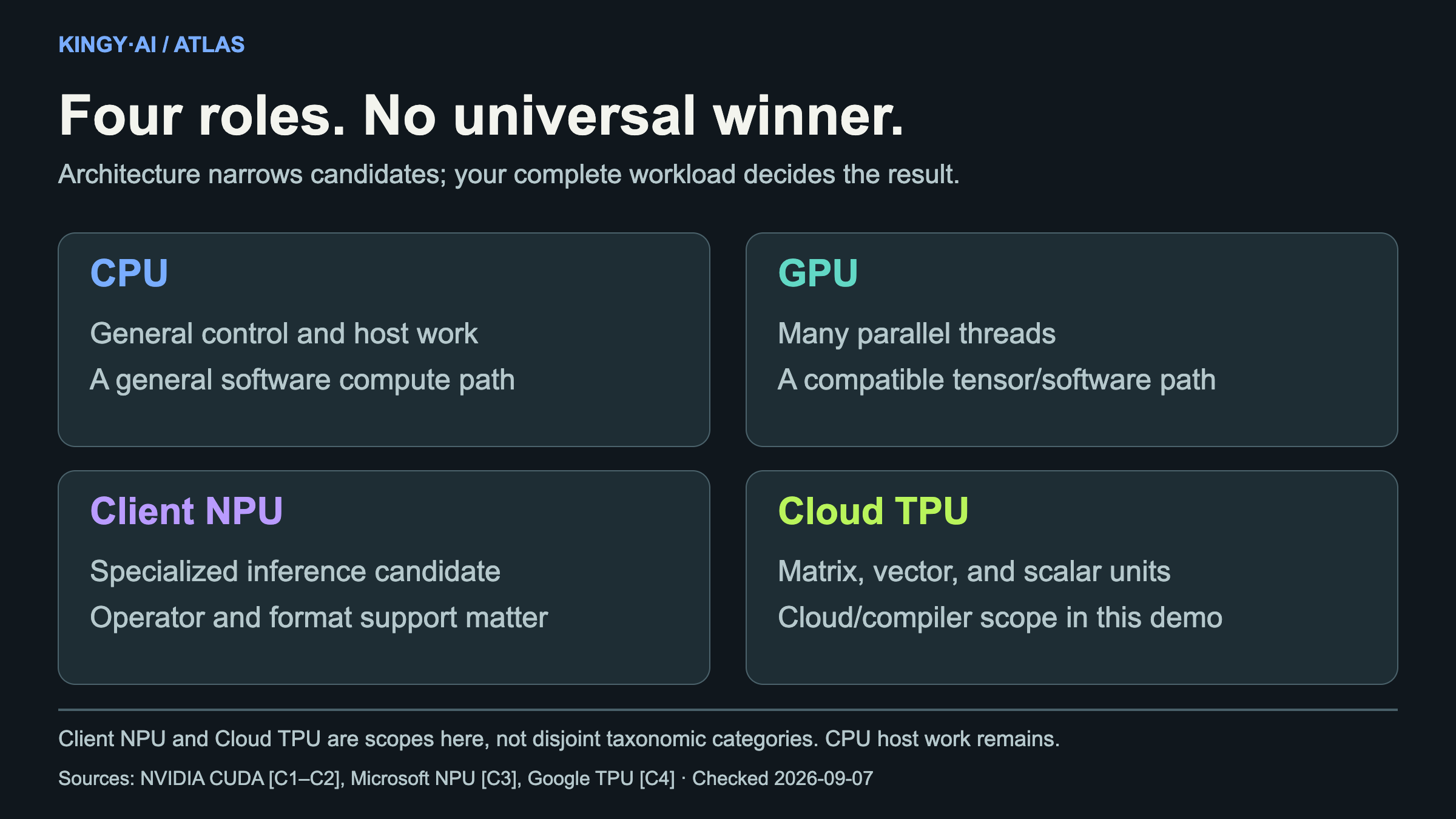
Scope and architectural emphasis without winner claims.
GPU vs NPU vs TPU vs CPU
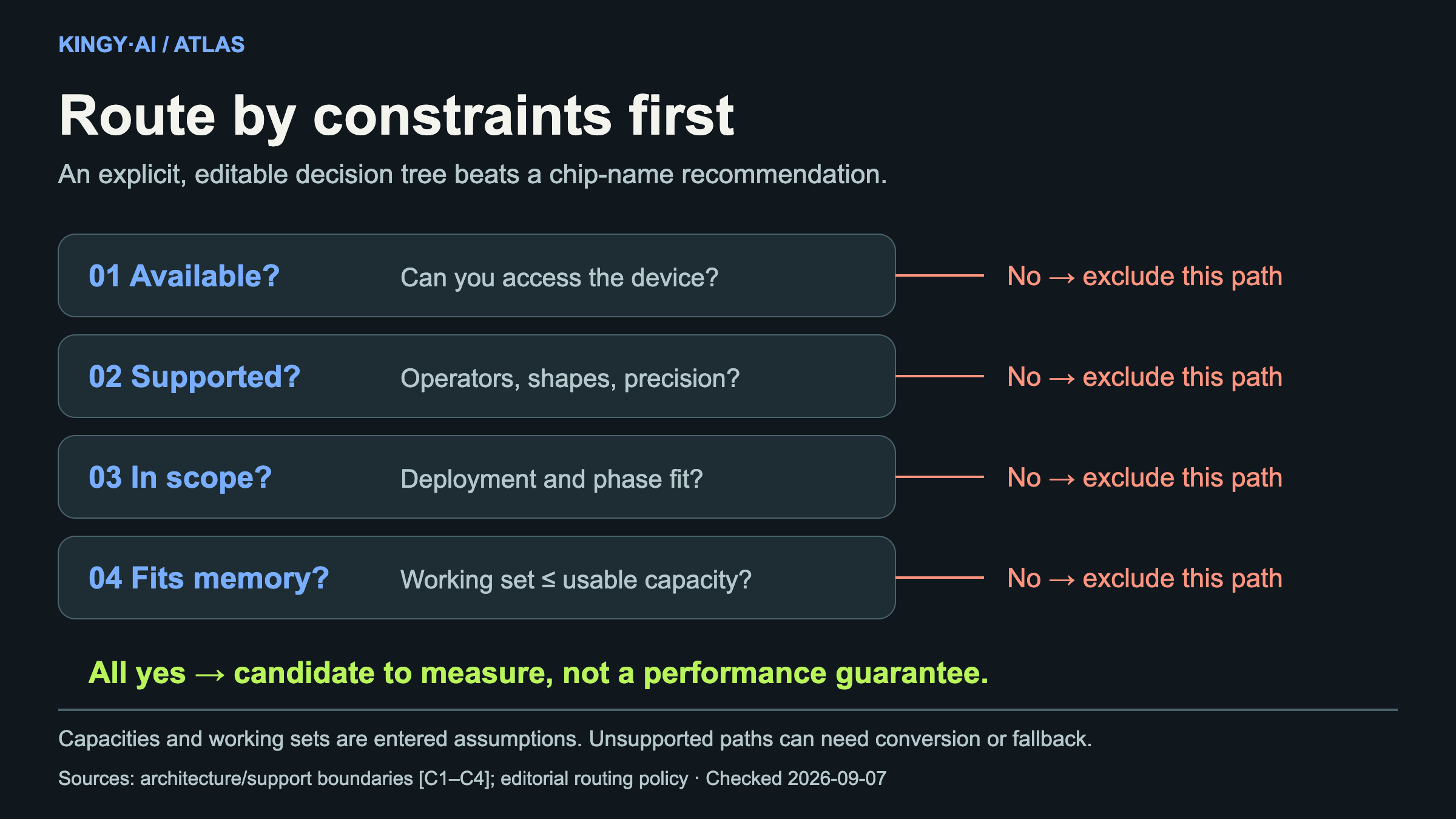
Trace a workload through device availability, software support, memory, and power constraints. See why a chip label cannot choose a system.
Live result
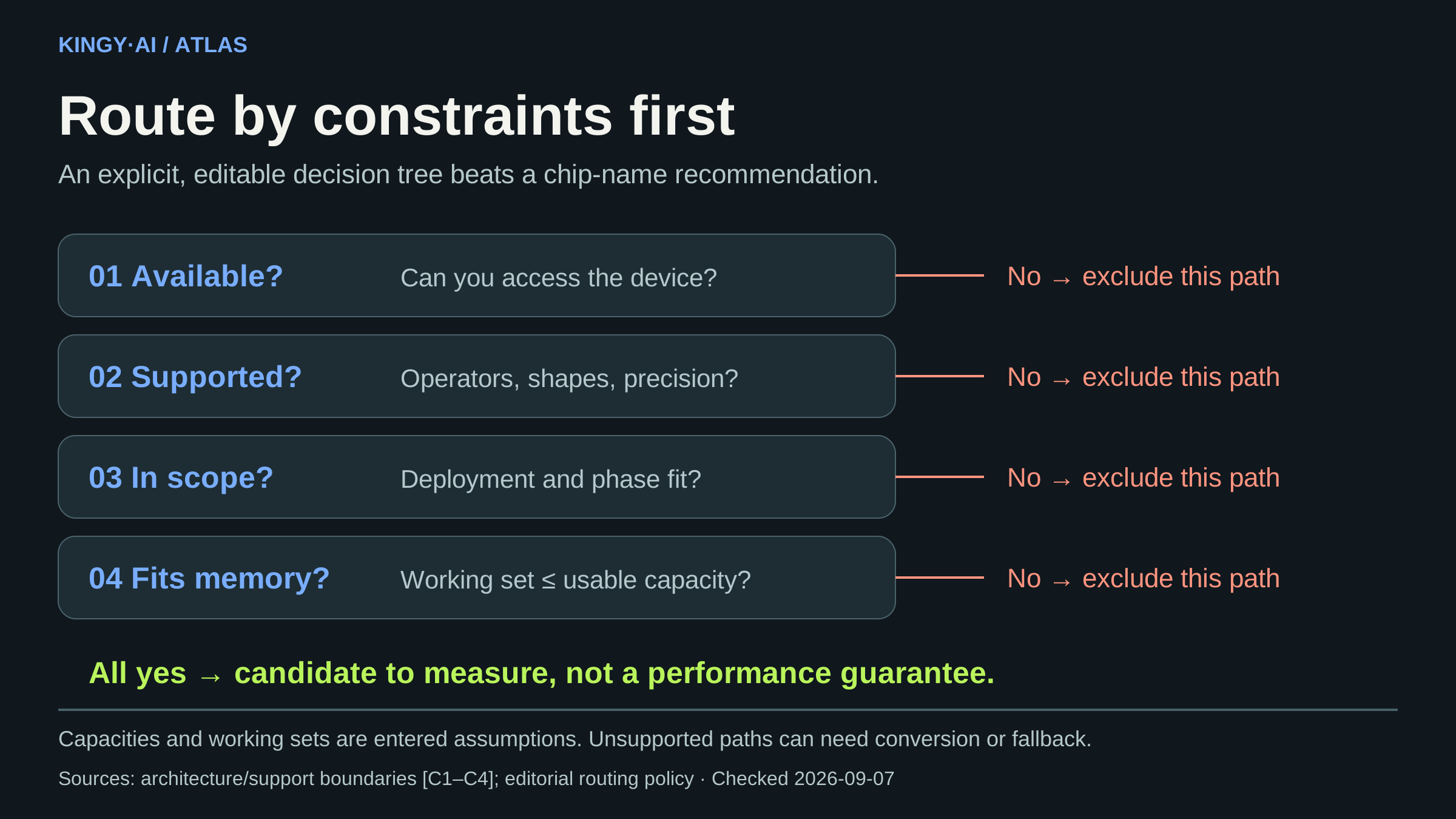
An editorial constraint tree, not a benchmark or compatibility certificate. “NPU” means a client inference NPU; “TPU” means Google Cloud TPU here. Those labels are not mutually exclusive architectural categories. CPU host work remains even when tensor work is offloaded.
The explanation
CPU cores handle general program control; GPU execution exposes many parallel threads. Neither label alone reveals whether your particular operator, memory footprint, or latency target is well served. [C1]
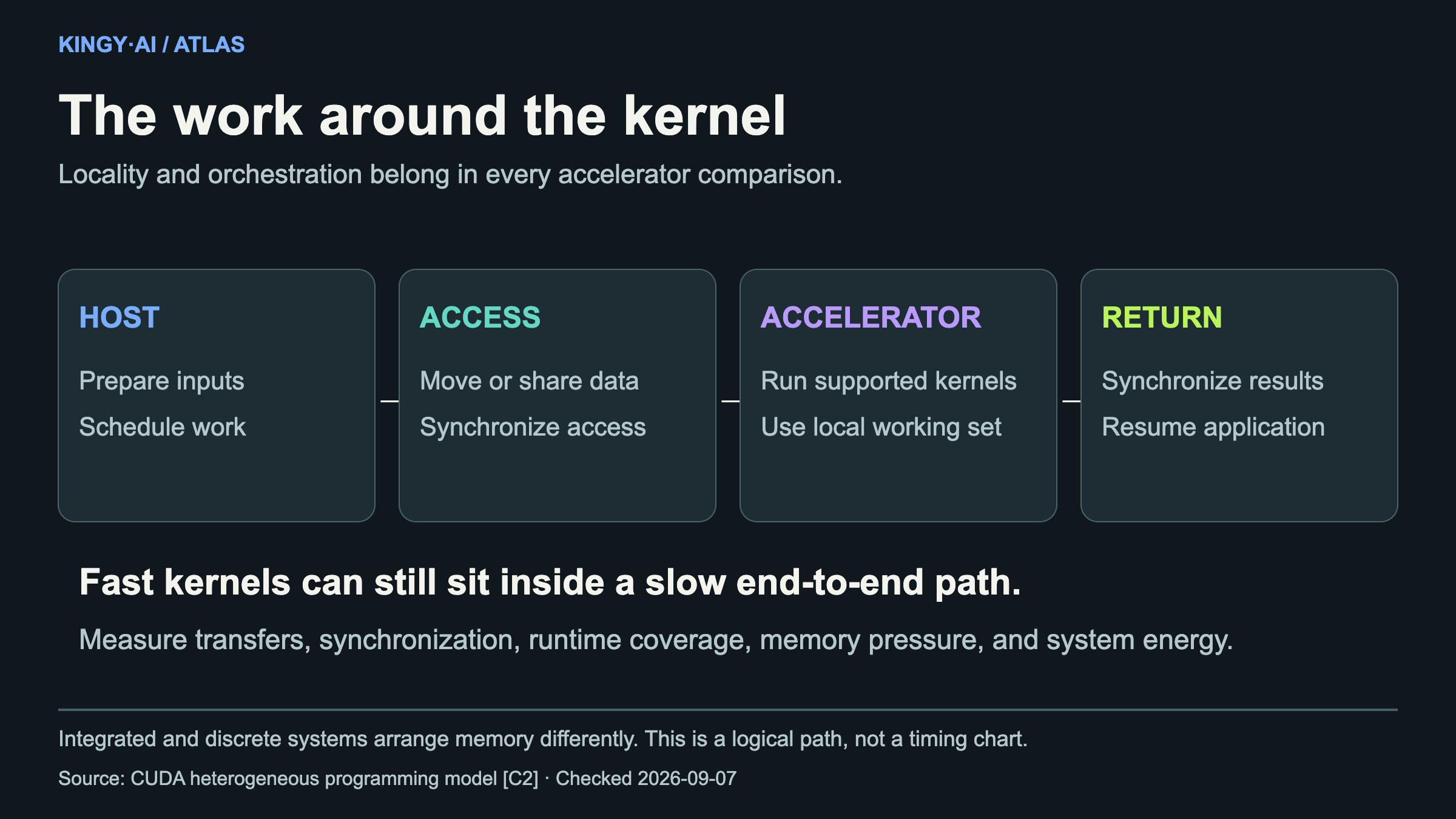
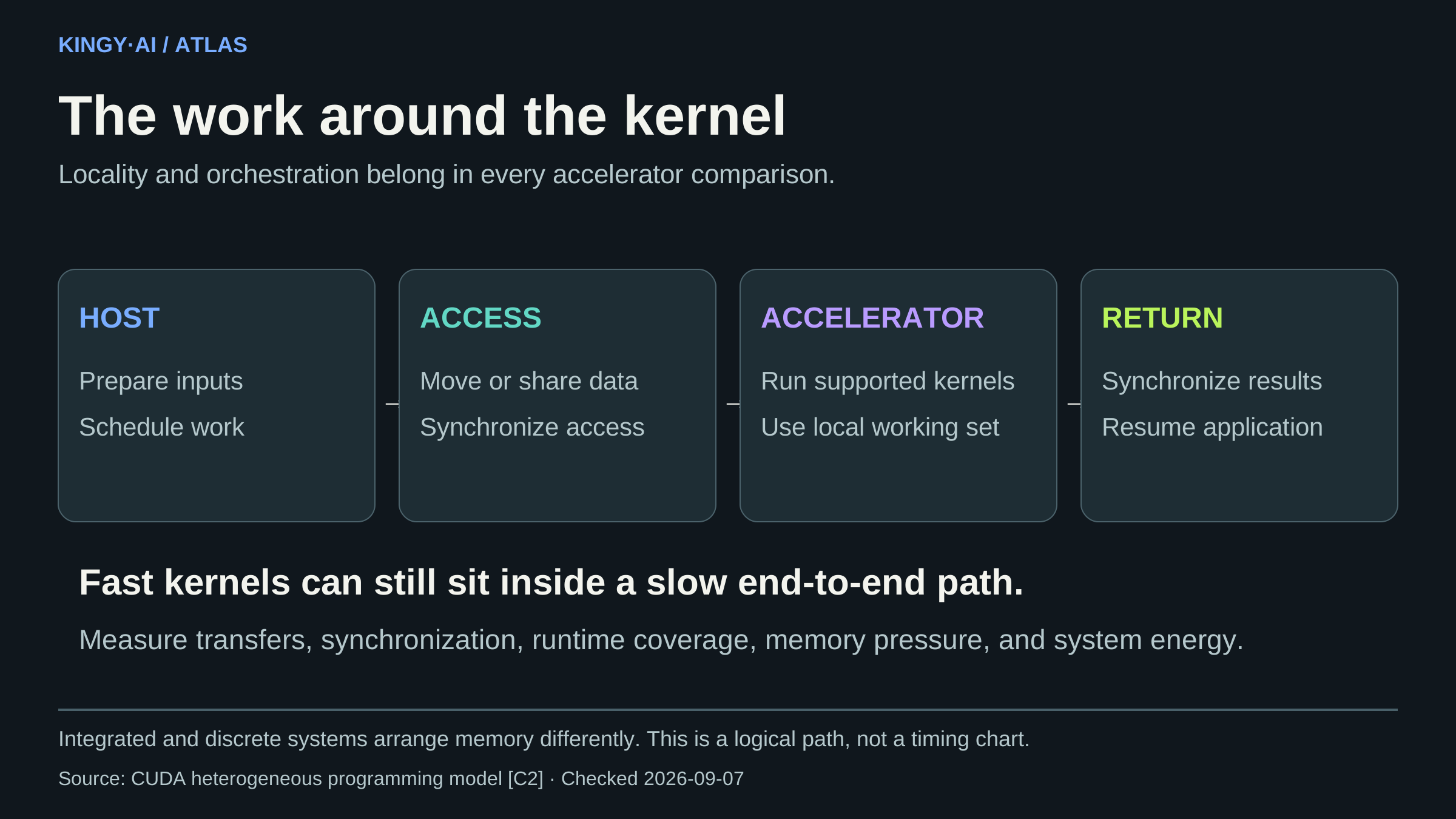
The CPU prepares and schedules work, data must be accessible to the accelerator, and results must return to the application. Repeated transfers, synchronization, or memory pressure can dominate a fast kernel. Shared-memory systems change the path but do not remove the need to reason about locality. [C2]
A client NPU can be an energy-efficiency candidate for a supported inference graph. Unsupported operators, shapes, or formats may require conversion or fallback. This router asks you to enter support explicitly; it cannot infer compatibility from a file or device name. [C3]
Cloud TPUs organize substantial computation around matrix operations with associated vector and scalar processing. They remain a cloud path in this teaching model. Real procurement requires the exact generation, compiler, topology, measured workload, and full service cost. [C4]
Open Asset Factory
Three independent diagrams. Editable source and high-resolution PNGs, with assumptions printed on the image.
Scope and architectural emphasis without winner claims.
Sources checked 2026-09-07
Formula derivations and teaching assumptions are documented separately.
Download claim ledgerNVIDIA describes CPU latency-oriented control and GPU parallel throughput as different design priorities.
Primary source ↗Qualitative architecture distinction; no universal speed ratio.
CUDA’s heterogeneous model uses CPU host code to launch GPU work and coordinate data, with memory arrangements varying by system.
Primary source ↗Integrated and discrete memory systems differ.
Microsoft documents execution providers, model-format requirements, and fallback when preferred hardware cannot execute the model.
Primary source ↗Client inference NPUs only; model support and energy efficiency require actual verification.
Google describes matrix-multiply units and systolic arrays within Cloud TPUs, alongside vector and scalar units.
Primary source ↗Generation-specific sizes and performance are not modeled.