Should You Sponsor YouTube?
Calculate your potential ROI from YouTube creator sponsorships in 60 seconds
📊 Your Business Details
🎯 Key Metrics
📈 ROI Scenarios (for $10K sponsorship)
✨ Our Recommendation
Should You Sponsor a YouTube Creator? A Framework for Making the Decision With Actual Math
There’s a meeting that happens in marketing teams everywhere. Someone proposes a YouTube creator sponsorship. The CFO asks for the ROI projection. Nobody in the room has a good answer. So the budget gets reallocated back to Meta — because at least Meta produces dashboards that look like accountability, even when the underlying economics are quietly deteriorating.
That’s almost always the wrong call. And the data is increasingly unambiguous about why.
Sponsored videos on YouTube jumped 54% year-over-year in the first half of 2025, generating 19.1 billion total views across 65,759 tracked sponsorships. These aren’t YouTube’s own ad products — they’re direct brand-to-creator deals that don’t appear in the platform’s official revenue figures. Companies running this kind of budget shift tend to have already done the math. The question worth asking is what math they ran, and whether it applies to your situation.
That’s what this article is actually about. Not “is YouTube sponsorship good?” — but rather, is it good for your specific product, funnel, and stage of growth? Those are different questions, and conflating them is how marketing teams make expensive mistakes in both directions.
Why budget is migrating to creator-direct deals
The creator economy has crossed into institutional territory. Goldman Sachs projects it will reach $500 billion by 2027, up from roughly $250 billion in 2024. eMarketer puts creator ad spending in the US at $43.9 billion in 2026. These aren’t niche figures. They describe a structural reallocation of media budget toward where audiences actually spend intentional time — not scrolling passively between algorithm-served distractions, but actively choosing to watch a specific person for 10, 20, or 40 minutes at a time.
YouTube sits at the center of that shift for a reason that TikTok and Instagram can’t fully replicate: longevity. A TikTok video has an effective lifespan measured in days. A YouTube video is indexed by Google, surfaces in search results, and can generate views, clicks, and conversions for months or years after publication. Open an incognito browser and search any common how-to query — you’ll find videos from 2021 and 2022 ranking prominently in results. Products mentioned in those videos are still converting. That’s a structural advantage that changes the ROI math in ways that aren’t immediately obvious from a single-campaign analysis.
YouTube’s global ad revenues hit $8.92 billion in Q1 2025 alone, up 10% year-over-year — and that number excludes the direct creator sponsorship market entirely. The platform simultaneously hosts one of the world’s largest advertising ecosystems and a parallel, brand-direct sponsorship economy growing faster than its official ad business. For brands, the implication is practical: the creator inventory you want access to today is going to cost more in 2026.
The earliest movers in any niche tend to establish preferred relationships and negotiated rates before general market demand drives pricing up. That’s not a speculative argument — it’s how every maturing media channel has worked, from podcast advertising in 2017 to newsletter sponsorships in 2020.
The 2.3X number that should change how you think about attribution
If you’ve run paid social at scale, the math is familiar. Strong targeting, manageable CPCs, and the moment you stop spending, the traffic stops. You’re renting visibility on a treadmill that never gets slower, and your cost-per-acquisition tends to drift upward over time as audience saturation sets in. The platforms themselves acknowledge this dynamic every time they recommend you increase your budget to maintain reach.
YouTube creator sponsorships compound rather than decay, and the performance data is sharper than most media buyers expect. A Google and Kantar marketing mix modeling study across 20 CPG brands over two years found that YouTube drives 2.3X higher long-term ROAS than paid social on average.
The methodology here matters: this isn’t last-click attribution, which systematically undercredits upper-funnel touchpoints and makes awareness channels look weak by design. It measures YouTube’s effect on brand equity and that equity’s downstream contribution to revenue — the full compounding picture, not just the last step before purchase.
The trust dynamic is equally significant. The same research found that 79% of Gen Z viewers in the US trust recommendations from YouTube creators, with 74% saying creator content provides enough context to support a confident purchase decision. This isn’t passive awareness. It’s an audience actively using creator content as decision-support infrastructure — moving from consideration to action without being pushed, because someone they already trust walked them through the product in their own voice, on their own timeline, without the artifice of a polished brand ad.
Then there’s the evergreen data point that consistently surprises brands running their first sponsorship analysis. According to Agentio, approximately 40% of views and 30% of clicks on sponsored YouTube videos occur more than 30 days after the video publishes. Your paid social campaign has generated zero organic yield at day 31. A well-matched YouTube sponsorship is still sending traffic, still converting, still building brand familiarity — with no additional spend attached. The video lives in search results, in the creator’s back catalog, in recommended feeds. The spend was a one-time event. The distribution continues indefinitely.
Paid social is a lever. YouTube creator content is an asset. That distinction is the core of why the ROI math looks different over any horizon longer than 30 days, and why brands that evaluate YouTube on a 30-day attribution window are systematically undervaluing what they’re buying.
The five variables that actually determine your ROI
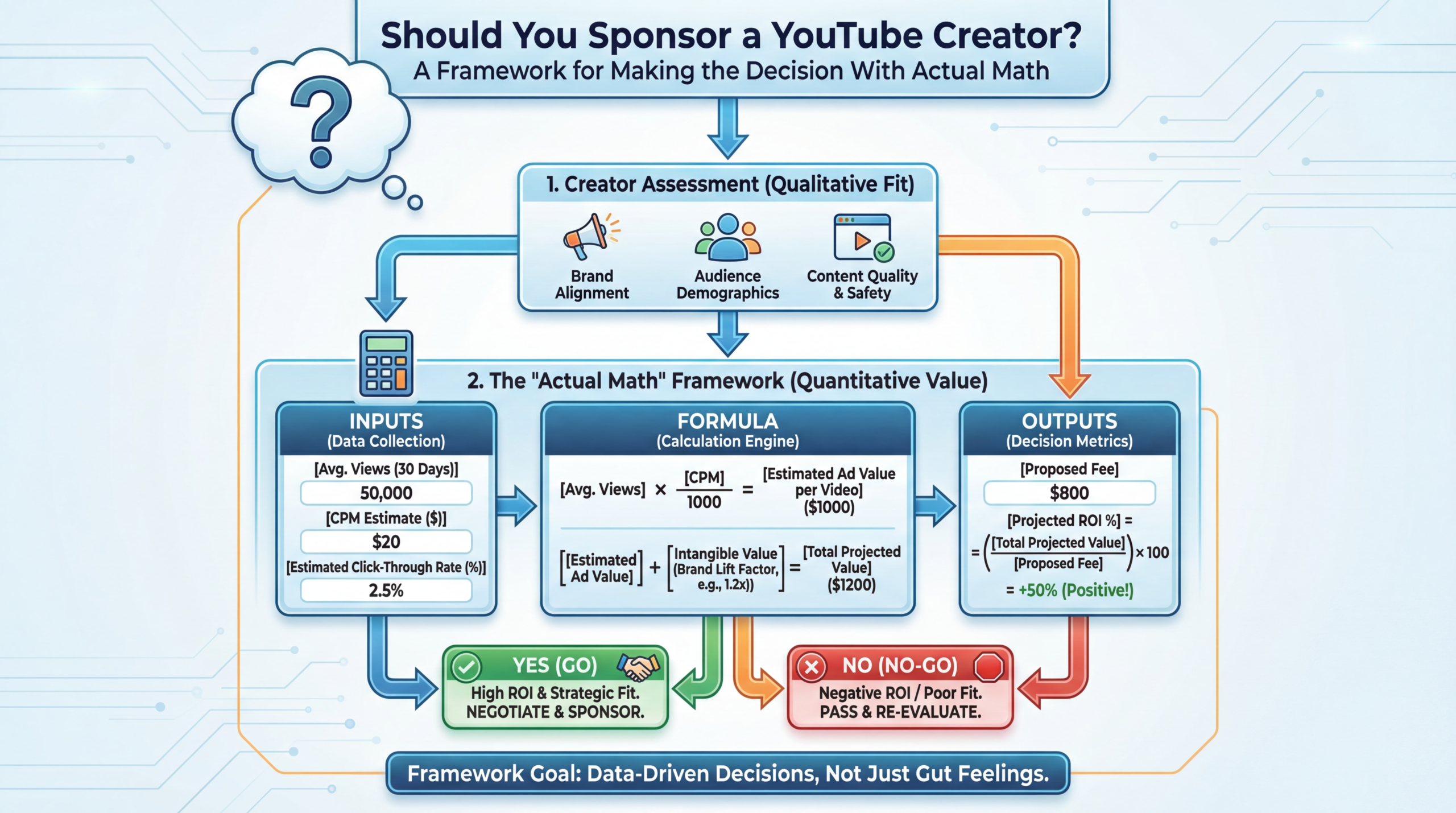
This is where most sponsorship conversations go wrong. People focus on the creator’s subscriber count when the variables that actually drive ROI are almost entirely separate from that number.
The first is your ACV or average order value — the foundational number in any break-even model. A $10/month subscription has a completely different ROI equation than a $2,400/year SaaS contract or a $300 e-commerce order. Higher ACV gives you more margin to absorb the inevitable inefficiency of any top-of-funnel channel. As a practical rule: products with ACV above $500 can typically justify YouTube sponsorships at modest conversion rates. Products under $50 AOV need exceptional funnel performance to break even, and the math often doesn’t clear at typical sponsorship pricing. This isn’t a judgment about YouTube’s quality as a channel — it’s arithmetic about whether the unit economics can support the minimum deal size.
The second is your website conversion rate. YouTube sends traffic. What you do with it determines your ROI. Industry benchmarks for SaaS and software sit between 2–5% on cold traffic. If you’re below 2%, fixing the funnel should come before funding distribution. No sponsorship budget on any channel compensates for a landing page that doesn’t work — that’s a product-market-fit or messaging problem, not a distribution problem.
The corollary: if you already convert cold traffic at 4–5%, you’re in an unusually strong position to get good ROI from any top-of-funnel spend, YouTube included.
The third, for any product with a free trial or freemium tier, is your trial-to-paid conversion rate. This is the variable most frequently omitted from back-of-napkin sponsorship projections, and its omission makes the model look approximately five to ten times better than reality. SaaS trial-to-paid benchmarks typically range from 15–25%, though this varies enormously by product complexity and onboarding quality. Build it into your model explicitly, at the beginning, not as an afterthought when the post-campaign numbers are disappointing.
The fourth is geography — specifically, the geographic composition of the creator’s actual audience. A creator with 200,000 subscribers can have wildly different commercial value depending on where those subscribers are located. A creator with 80,000 subscribers and 72% US audience in the AI/tech niche frequently outperforms a creator with 400,000 subscribers and globally distributed viewership.
Before any deal, request the creator’s audience demographics directly. The percentage of viewers in your actual target market is more predictive of campaign performance than total subscriber count, yet it’s the variable most commonly omitted from upfront conversations.
The fifth is campaign goal clarity. There’s a mismatch that destroys many YouTube campaigns: the brand expects last-click revenue attribution, but they’ve funded a channel optimized for upper-funnel awareness. The result is declared failure for a channel that was doing its job correctly. Choose your success metric before the campaign launches, hold it consistently, and account for the longer attribution window YouTube requires. Brands that do this — tracking 60 or 90-day conversions tied to the specific landing page or promo code from the sponsorship — tend to view the channel very differently than those who cut the analysis at 30 days and move on.
Dedicated video or integration: what the format decision actually costs you
YouTube creator sponsorships come in two primary commercial formats: dedicated videos, where the entire video is built around your product, and integrations, where your brand gets a 60–90 second read within the creator’s regular content. Dedicated videos typically command a 1.5–2x price premium over integrations — and for complex products, that premium is often worth paying.
A creator with 10–15 minutes to demo, contextualize, and editorialize about your product in their own voice can move purchase intent in ways a brief integration simply cannot replicate. For B2B SaaS, AI tools, and professional services — products that require explanation before conversion — a dedicated video frequently outperforms integrations on a cost-per-customer basis, even at higher upfront cost, because the conversion rate difference more than compensates for the pricing delta.
The viewer arrives at your landing page already understanding what the product does and why the creator finds it useful. That’s a fundamentally different kind of visitor than someone who saw a 90-second read in a video about something else entirely.
Integrations work best for products with existing name recognition or a compelling, simple offer that doesn’t require setup: a VPN, a productivity tool, a limited-time promotional offer. The brands running the highest volume of sponsorships — Squarespace, NordVPN, BetterHelp — rely primarily on integrations at scale because they’ve already built the brand recognition that makes the format efficient.
That shortcut doesn’t exist for a newer or more technical product. If your product requires any explanation or demonstration to drive conversion, start with a dedicated video, even if the budget is harder to justify upfront.
The break-even math your agency probably isn’t showing you
The calculation is simpler than most pitches make it sound. Break-even customers equals sponsorship cost divided by ACV. A $12,000 dedicated video for a $1,200/year product requires 10 new customers to break even. At a 3% website conversion rate, that requires approximately 333 website visitors from the video. At a 2% click-through rate on the sponsored content, that requires roughly 16,700 views.
Now layer in your trial-to-paid rate. If only 20% of free signups convert to paid, your effective conversion rate drops from 3% to 0.6%, and you now need 1,667 visitors and approximately 83,000 views to break even on that same $12,000 investment. That view count is entirely achievable for many mid-tier creators in relevant niches — but you can see exactly why each variable matters independently. A two-percentage-point shift in your website conversion rate can move you from profitable to loss-making before the campaign even launches.
Customer acquisition cost — not views, not clicks, not impressions — is the only output metric that matters for the business case. A $12,000 video that generates 20 new customers produces a CAC of $600. Whether that’s good or bad depends entirely on your LTV. For a product with $6,000 lifetime value, it’s excellent economics. For a product with $800 ACV and 10-month average retention, you’re underwater before churn catches up with you.
One more data point worth building into your multi-video model: Agentio data shows that brands running repeated integrations with the same creator typically double their conversion rates by the sixth integration. Your first video is learning budget. The audience needs to see your product mentioned more than once before familiarity generates action. If your first video breaks even, the structural case for a series is strong. If it comes close to breaking even, the argument for a second video is still defensible — because your second video starts with residual awareness that the first one built.
Why you need three scenarios, not one projection
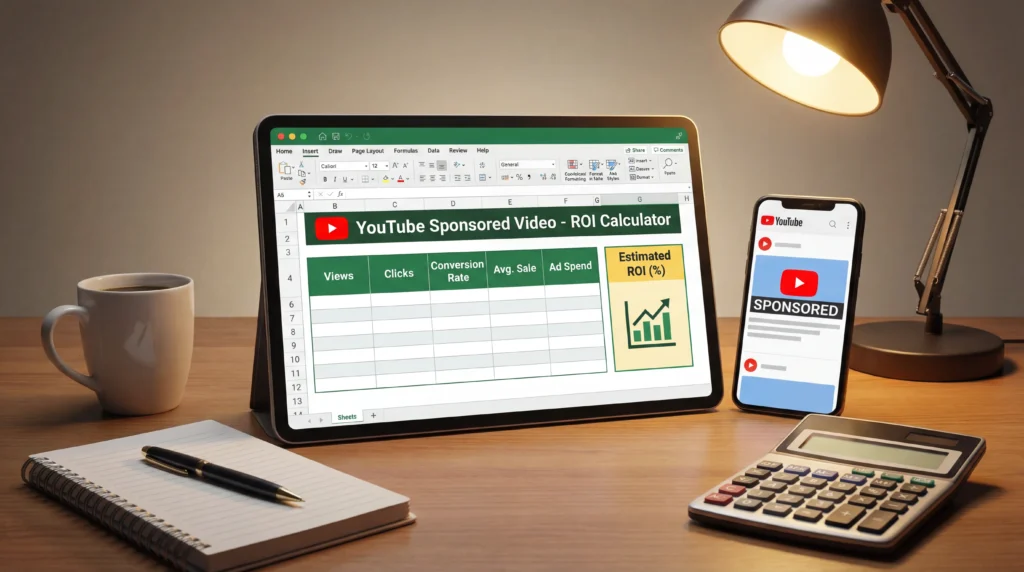
Before you commit budget, build three honest scenarios. Not because you’ll predict the outcome accurately — you won’t — but because the exercise forces you to identify which variable creates the most risk before you spend, rather than discover it in the post-campaign debrief.
Best case assumes strong niche alignment between the creator’s audience and your ICP, a landing page that converts creator traffic well, and view counts at the high end of the creator’s recent per-video average. In best case, a dedicated video typically sees 2.5–4% CTR and 5–8% website conversion on engaged traffic. This isn’t wishful thinking — it’s what a genuinely well-matched campaign with excellent execution looks like when the product solves a real problem for the specific audience watching. It happens. It requires deliberate creator selection and serious landing page work to get there.
Base case is a competently run campaign with average execution and no unusual tailwinds. CTR of 1.5–2.5% on a dedicated video, website conversion of 3–5%, trial-to-paid of 15–20%, views at the creator’s median per-video average over their last 15–20 uploads. This is your planning number. It is the outcome you need to be genuinely comfortable with before committing the budget — not the number you use to make the spreadsheet look good for the approval meeting.
Conservative case models a suboptimal creator-product fit, an underperforming landing page, or views at the lower quartile of the creator’s recent history. CTR below 1%, website conversion of 1–3%, trial-to-paid at 10–15%. If your conservative scenario still produces an acceptable CAC at your budget level, the sponsorship is worth testing. If conservative case represents a significant loss, you’ve just identified the variable that needs fixing first — and you’ve saved yourself a budget mistake in the process.
The single variable that most frequently drives the gap between best case and conservative case is the landing page. A dedicated page built specifically for creator traffic — with messaging that references the creator, reinforces what they said, and guides visitors toward a single action — can close the gap substantially. Build it before you launch, not after your first video disappoints. It’s a $500–$2,000 investment that can make the difference between a campaign that works and one that teaches an expensive lesson.
When YouTube is the wrong bet
Credibility requires saying this clearly. YouTube creator sponsorships underperform — sometimes significantly — in specific scenarios, and pretending otherwise wastes people’s money.
If your product only serves customers in a specific city or region, YouTube’s audience distribution makes efficient targeting nearly impossible. You’re paying for national or global reach to acquire hyper-local customers. Paid search or geotargeted Google Ads are substantially more appropriate for location-dependent campaigns. The economics of YouTube sponsorship only work when you can convert a broad, national or global audience — not when you need someone within 15 miles of a specific zip code.
If your AOV is very low and the purchase decision is essentially impulse-driven, the unit economics don’t work. The 30–90 day attribution window and the $5,000+ minimum entry point for any credible sponsorship require ACV or AOV that can sustain the model. A $25 product needs extraordinary volume — thousands of conversions — to justify even a modest sponsorship budget. That volume is theoretically possible at scale, but it requires creator selection and audience targeting precision that most brands aren’t positioned to execute on a first campaign.
If your landing page converts below 1% on any traffic source, the problem is not distribution. No sponsorship budget — on any channel — compensates for a broken funnel. Run conversion rate optimization first. Fund distribution into a broken funnel and you’re pouring water into a cracked bucket. You’ll get traffic, see low conversions, conclude that YouTube doesn’t work, and miss the fact that the same traffic would have underperformed on Meta, Google, or anywhere else.
And if you don’t have clear evidence of product-market fit — meaning real, evidence-backed signals of why people buy and why they stay — creator sponsorships will generate noise, not signal. Get to 20–30 genuinely happy customers through organic channels before spending on any paid distribution. YouTube is a scaling channel, not a product validation mechanism. Using it to find out whether people want your product is an expensive way to run an experiment you could have conducted for free.
Audience quality is the variable everyone underestimates
Not all YouTube audiences carry equal commercial value, and this gap is substantially larger than most brands realize until they see actual campaign data side by side.
Finance and business channels in the US command CPMs of $40–200, while gaming or general entertainment channels run $3–15 CPM. That’s not just a difference in what you pay — it’s a difference in what the audience is commercially worth. High-CPM niches command premium rates because those audiences have higher purchasing power, stronger purchase intent, and demonstrated willingness to act on creator recommendations. The CPM is a proxy for audience quality, not vanity. When a finance channel charges you $50 CPM and a gaming channel charges $8, the finance channel isn’t overpriced — it’s delivering an audience that’s been trained to spend money on financial products and has the income to do it.
Before finalizing any deal, ask specifically for three numbers: the percentage of audience from your primary target market, the age and gender breakdown relative to your ICP, and average views per video over the creator’s last 15–20 uploads — not career highlights, not single outlier performances, but recent median performance. These three data points predict campaign ROI more reliably than subscriber count.
The broader market trend confirms this direction: brands are actively moving budgets away from mega-star generalists toward niche creators with highly engaged, purchase-ready audiences. A creator with 80,000 subscribers and 72% US audience in the AI/tech niche is frequently a stronger investment than a creator with 400,000 subscribers and globally distributed viewership in a general interest category. The audience composition is the asset, not the follower count — and the brands that understand this early are consistently out-performing those who still equate bigger numbers with better results.
Building the internal business case
Getting a YouTube sponsorship approved internally is often harder than running the actual campaign. Here’s how to frame it for a skeptical CFO who defaults to attributable paid social metrics.
Lead with CAC comparison. Pull your current blended CAC from paid social and compare it to the base-case CAC from your model. If YouTube’s base case is competitive — even if not best-in-class on the first test — the argument for a test budget is defensible on pure unit economics, without requiring anyone to trust the brand-building argument. You’re not asking for faith; you’re asking for a test at a CAC you’ve already demonstrated is survivable.
Then emphasize the compounding effect. 40% of views and 30% of clicks on sponsored YouTube videos arrive more than 30 days post-publish. A paid social campaign with identical upfront spend has generated zero organic yield at day 31. Over a 12-month cost-per-impression horizon, that structural difference makes YouTube look substantially more favorable than a 30-day attribution window suggests. The video you sponsor in March is still sending traffic in September. Your Meta campaign from March ended when the budget ran out.
Sell the test, not a channel commitment. A single dedicated video is a data acquisition investment. You’ll learn your actual CTR on creator traffic, your landing page conversion rate from a warm but unfamiliar audience, and your trial-to-paid rate from creator-sourced signups. That operational data is worth acquiring regardless of the first video’s direct ROI — because it lets you model every subsequent decision with real numbers instead of industry benchmarks. The first video buys you information. The second video uses it.
And reference the competitive signal. With sponsored video volume up 54% year-over-year, the creators and niche audiences you want access to today are going to cost more in 2026. The brands already running creator-direct deals are establishing preferred relationships and negotiated rates before general market demand moves pricing. That’s a time-value argument that tends to resonate with growth-focused leadership teams: the question isn’t just whether YouTube works, it’s whether you can afford to find out a year from now at higher prices.
What the model actually tells you
The math for your specific product — your ACV, your funnel conversion rate, your geography, your campaign goal — is available without a spreadsheet or a three-hour media planning meeting. The output gives you a break-even customer count, a CAC range across three scenarios, and a clear read on whether creator sponsorship is an appropriate fit for your specific inputs.
If the base-case CAC is competitive with your current blended CAC from paid social, you have a defensible argument for a test budget. If the conservative-case CAC is catastrophic, you now know which variable to address first — whether that’s ACV, landing page conversion, trial-to-paid rate, or creator audience match. That diagnosis is worth running before spending, not after.
YouTube creator sponsorships are not a media buy. They are a business model question — one whose answer depends on your product economics, your funnel health, your audience geography, and your willingness to attribute results on the right timeline. The brands winning on this channel right now are the ones who modeled the business case honestly before they spent, set realistic expectations across three scenarios, and gave the channel enough runway to compound.
If the base case looks interesting and the conservative case is survivable, you have your answer. If neither scenario makes financial sense at your current ACV or funnel conversion rate, you’ve just identified exactly what needs to change first — and that’s a more valuable outcome than a sponsorship campaign that teaches you the same lesson at $15,000 a video.
The math is available. The question is whether you run it before you spend.
Have questions about the ROI model or want to talk through how these variables apply to your specific product? Drop a comment below.