If you’re building a generative AI company right now, you’ve probably felt this weird contradiction:
- People are obsessed with AI.
- Everyone is “testing tools.”
- Your category is moving at warp speed.
…and yet, buyers still hesitate.
Not because they don’t care.
Because they don’t believe.
- They don’t believe the demo will hold up when they try it.
- They don’t believe the pricing won’t get weird.
- They don’t believe security won’t be a fight.
- They don’t believe their team will actually adopt it.
- They don’t believe your “agent” is anything more than prompt-wrapping.
So the real product you’re selling—before you sell software—is certainty.
That’s why sponsored YouTube videos by credible AI influencers (channels like Kingy AI, and other creators who live and breathe AI workflows) can be one of the highest-leverage distribution buys you make.
Not because “influencer marketing is hot.”
Because YouTube is where modern buyers go to learn, compare, and validate—and creators are the people they trust to do the testing for them.
Google’s own B2B marketing research has referenced a Gartner finding that 65% of B2B buyers were influenced by YouTube when making a recent purchase decision. And Gartner has also reported that 61% of B2B buyers prefer a rep-free buying experience, meaning they want to do the learning on their own—through digital self-service—before they ever talk to sales.
Put those together and the implication is blunt:
If buyers want to research without you…
then whoever teaches them wins the early mindshare.
Creators teach them.
And a great sponsored YouTube video doesn’t feel like an ad.
It feels like a shortcut through uncertainty.

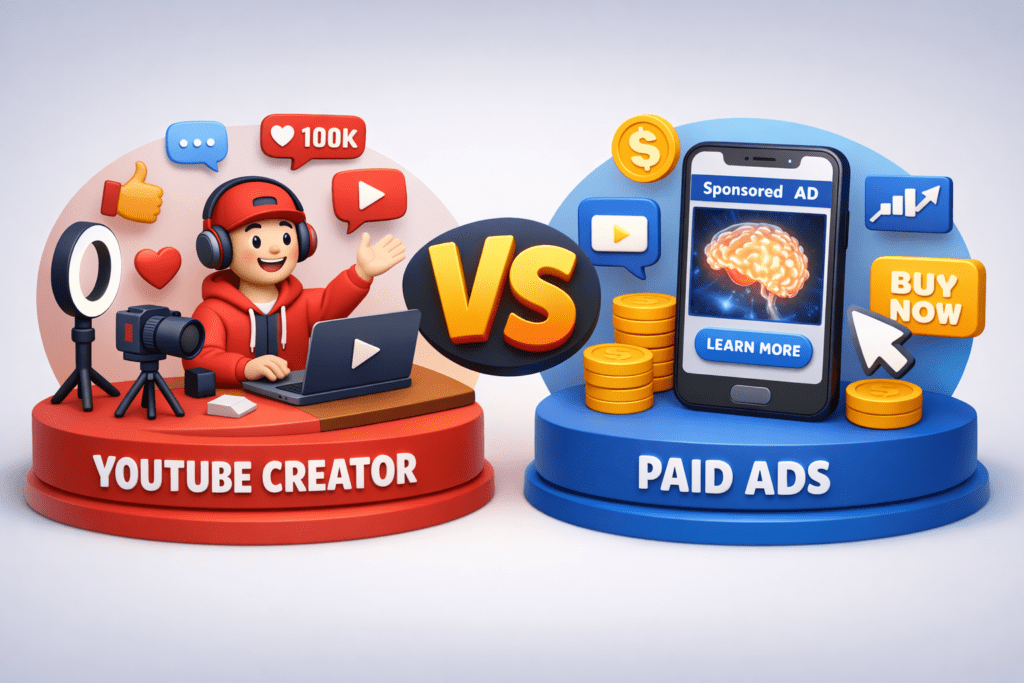
Sponsored YouTube videos aren’t “ads.” They’re trust assets.
A paid ad is typically trying to do one thing fast: get the click.
A creator video does something different (and more valuable in GenAI): it helps someone think.
It gives them a mental model.
It shows them the workflow.
It surfaces the trade-offs.
It gives them language they can repeat internally.
That matters because GenAI buying is rarely a solo decision. Even when one person is excited, they still have to convince:
- a skeptical manager
- a security person
- a teammate who hates new tools
- procurement
- a CFO who heard “AI tools are a waste”
In other words: you’re not selling one person.
You’re selling a buying committee that is allergic to risk.
So what do they do? They look for external validation. And increasingly, that validation lives on YouTube.
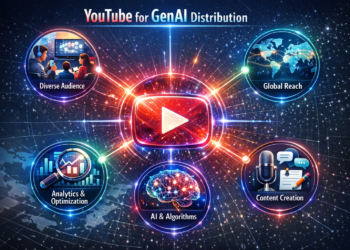
Why YouTube is uniquely powerful for GenAI companies
1) YouTube is where trust concentrates
YouTube has been leaning into a simple truth: creators aren’t just entertainers. They’re advisors.
Google/Kantar research highlighted in Think with Google found that 82% of U.S. viewers say YouTube has the most trusted creators.
That is not a cute brand stat. It’s a distribution advantage.
Because in GenAI, trust is not branding. It is the core buying constraint.
2) YouTube is not a feed—it’s a searchable library
Most social content dies in 24–48 hours.
YouTube content doesn’t. It compounds.
A good video continues to surface through:
- YouTube search (“best AI agent builder”, “RAG tools”, “AI video generator comparison”)
- Google video results
- Suggested videos
- “Watch next” recommendations
So instead of renting attention for a week, you’re buying an asset that keeps converting new demand into belief.
3) YouTube is eating TV time—and that changes how serious you should take it
YouTube’s own press page states YouTube has been #1 in streaming watch time in the U.S. for nearly three years (as of January 2026), according to Nielsen.
Also on that same page: over 20 million videos are uploaded daily on average.
That “new TV” reality matters because it reframes YouTube from “content marketing” into what it actually is:
A modern media channel with compounding discovery, where creators are the new programming layer.
4) The buyer journey is more self-directed than most teams admit
Gartner’s press release is extremely clear: 61% of B2B buyers prefer a rep-free buying experience, and most want to carry out independent research through digital channels.
So even if your sales team is incredible, they’re often entering the conversation late.
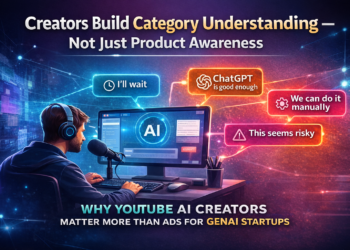
That means your real competition early on isn’t another startup—it’s:
- confusion
- skepticism
- “we’ll wait”
- “we’ll build it”
- “ChatGPT is enough”
- “this feels risky”
Creators reduce that friction by doing the one thing most startups struggle to do at scale:
They make complex products feel understandable.
The real reason creator sponsorships work: they create a “trust dividend”
Think with Google describes a “trust dividend” from creator content—people make more confident decisions, faster.
And there’s a particularly useful stat buried in their creator marketing coverage: based on an Ipsos survey, users were reported to be 98% more likely to trust recommendations from creators on YouTube vs. other social sites/apps, and 68% agreed YouTube creators are more trustworthy than traditional celebrities.
Again, for GenAI companies, this is everything.
Because the product category is noisy, hype-heavy, and full of overpromises. So buyers seek out people who will “tell them what’s real.”
That’s what AI YouTubers do when they’re good.
And that’s why sponsorships can work so well—not because the creator is persuasive, but because the creator is expected to evaluate.
What you’re actually buying when you sponsor an AI influencer video
If you think you’re buying “a YouTube video,” you’ll measure it like an ad and you’ll be disappointed.
If you understand what you’re really buying, it starts to make sense:
You’re buying:
- Borrowed credibility (trust transfer)
- A public proof-of-work demo (show, don’t tell)
- Category education (how people learn what matters)
- A comparison framework (the checklist buyers adopt)
- A durable sales asset (something your champions share internally)
- Long-tail discovery (search + suggested + evergreen views)
- Better leads (more educated, higher intent)
- Market feedback (what breaks, what confuses, what converts)
A sponsored creator video is closer to a product launch plus sales enablement plus training than it is to a banner ad.
The benefits for GenAI companies (in plain, founder-friendly terms)
Let’s get concrete. Here are the biggest benefits generative AI companies get from buying sponsored YouTube videos with credible AI creators.
1) You win the “learning layer” of the market
This is the most underrated advantage.
In emerging categories, whoever teaches the market becomes the default reference point.
If your category is “agents,” and buyers don’t know what an agent really means, creators become the translators.
They explain:
- what it is
- what’s fluff
- what’s actually useful
- what to watch out for
When you’re inside that educational layer—through a creator your buyers already trust—you’re not “interrupting” the buyer journey.
You’re becoming the buyer journey.
And that’s incredibly hard to replicate with ads.
2) You turn abstract claims into visible proof
AI products are experiential.
A landing page can’t fully show what it feels like to:
- generate video shots with consistent style
- build an agent workflow that doesn’t collapse
- integrate RAG with real data
- run evals
- deploy with guardrails
- ship something reliable
A creator video can show all of it.
And once a buyer has seen the workflow happen, you’ve removed the biggest barrier: “Is this real?”
3) You shorten “time-to-belief”
Think with Google cites a Material survey finding that YouTube’s influence can cut down the average online U.S. video shopper’s journey by six days.
Even though that specific stat is framed around shopping behavior, the insight is universal:
Video reduces uncertainty faster than text.
And in GenAI, uncertainty is the tax that slows everything down.
A good creator video compresses the time it takes for someone to say:
“Okay, I get it. This actually solves something.”
That speed matters more than most companies realize because in GenAI, delay is death. Categories shift. Competitors ship weekly. Buyers move on.
4) You generate leads that are pre-educated (and therefore higher quality)
A person who watches 10–25 minutes of a deep creator walkthrough is not “top of funnel.”
They’re already mid-journey.
They’ve likely self-qualified:
- They have a use case
- They understand the product better
- They have fewer “basic” questions
- They can articulate value internally
That changes your downstream metrics:
- higher trial activation
- faster time-to-first-value
- better demo-to-close
- less churn because expectations are realistic
This is why you can get fewer total leads but more pipeline.
5) You create an internal shareable artifact (a cheat code for champions)
Your best “sales rep” is usually the internal champion—someone inside the company who wants your product to win.
But champions need ammo.
A creator video becomes the easiest internal forwarding mechanism:
- “Watch this walkthrough—it shows exactly how it works.”
- “This creator tested it and explains what matters.”
- “This is the best overview I’ve found.”
That makes internal approval smoother, especially for GenAI products that trigger skepticism.
6) You win the comparison moment (where most GenAI decisions are actually made)
GenAI companies rarely lose because they’re unknown.
They lose because buyers compare them against alternatives that feel “safer,” like:
- “We’ll just use ChatGPT”
- “We’ll build it ourselves”
- “We’ll stick with the incumbent”
- “We’ll wait six months”
Creators naturally create comparison content because comparison is interesting.
And if you’re included in that comparison, you become part of the buyer’s evaluation set.
Even better: the creator often defines the criteria. That’s huge.
Because in GenAI, the winner is often the product that gets judged on the right metrics:
- reliability
- workflow fit
- controllability
- privacy posture
- cost predictability
- integration surface area
Creators translate those into plain language buyers can act on.
7) You get the “trust dividend” that ads can’t buy
Think with Google’s creator marketing content makes this explicit: creators have deep trusted relationships, and brands can leverage that to help people make purchase decisions more confidently.
There’s also a behavioral stat that’s very relevant: 78% of YouTube viewers agreed that creators make them feel like they can make a quicker decision about whether to purchase a product (reported in Think with Google’s creator marketing coverage).
That’s what you want in GenAI: quicker, more confident decisions.
8) You get long-tail distribution (evergreen demand capture)
This is the part founders love once they see it:
A great creator video keeps selling after you stop paying.
Because months later, new buyers search:
- “best AI video generator”
- “agent builder tutorial”
- “how to automate X with AI”
- “RAG vs long context”
And the video is still sitting there, doing work.
Ads stop when spend stops.
Creator videos keep paying rent.
9) You get content you can repurpose (without starting from zero)
With the right agreement and usage rights, one sponsored video can turn into:
- short clips for paid social
- a landing page “How it works” section
- onboarding tutorials
- a sales follow-up link
- a webinar starter
- a product education library asset
And here’s the key: repurposed creator content often performs better than brand-made content because it feels like it came from the real world.
10) You get brutally useful feedback from someone who actually uses tools all day
Creators are power users.
If you sponsor the right creator, you get:
- onboarding friction you didn’t notice
- UI pain that users will complain about later
- missing features that block real workflows
- messaging gaps (“I didn’t understand what this meant until I tried it”)
That can influence product direction, positioning, and even pricing.
Why this strategy is extra powerful in Generative AI (specifically)
A lot of industries can benefit from influencer marketing.
GenAI benefits more because of three category realities:
GenAI is full of skepticism by default
Because buyers have seen too many:
- cherry-picked demos
- “agents” that break instantly
- tools that work on day one and fail on day ten
- wrappers pretending to be platforms
Creators help reset the skepticism by showing a real workflow.
GenAI products often require explanation, not persuasion
This is a huge difference.
Many buyers aren’t refusing because they disagree. They’re refusing because they don’t understand how it fits into their world.
Creators reduce the cognitive load.
GenAI buying triggers risk conversations
Security. Privacy. Hallucination risk. Compliance.
Even prosumers feel that risk.
Creators help buyers feel like they can evaluate safely—because the creator is doing a version of evaluation publicly.
“Sponsored” doesn’t have to mean “untrusted” (but you need rules)
A sponsorship works only if the audience still believes the creator’s integrity is intact.
That means you need to respect disclosure and avoid trying to turn the video into a script.
Disclosure matters (and it’s not optional)
If you’re doing paid partnerships, you need to treat disclosure like a real compliance item.
- The FTC has clear guidance for influencers and brands about material connections and disclosures in endorsements.
- YouTube itself requires creators to disclose paid promotions using platform tools (the paid promotion checkbox) in video details.
This is not just “best practice.” It’s risk management for both the brand and the creator.
The creator needs room to evaluate
If you over-control the message, you kill the thing you’re paying for: credibility.
The best sponsored videos usually include:
- real pros/cons
- who it’s for / who it’s not for
- limitations
- honest pricing commentary
- small criticisms that signal truth
Ironically, those critiques often make the video more effective.
Because the audience thinks:
“Okay, they’re not just reading a script.”
The formats that work best for GenAI sponsorships
Not every sponsored video structure is equal. Some formats are basically guaranteed to outperform for GenAI tools.
1) “Build a real workflow” video (highest trust, highest intent)
This is the best format for:
- agents
- automation
- developer tools
- LLMOps
- AI creative pipelines
It works because it makes value tangible. It proves integration. It shows friction.
If your product’s strength is “it actually works in real workflows,” this format is your friend.
2) “Comparison and decision guide” (best for crowded categories)
If you’re in a category like:
- AI video
- image generation
- writing tools
- voice tools
- general “AI productivity” apps
Buyers are overwhelmed.
A comparison guide helps them decide.
And if the creator frames the criteria in a way that highlights your advantages, you win mindshare that your ads will never earn.
3) “Buying committee explainer” (best for security-sensitive tools)
If you sell to teams that worry about:
- privacy
- deployment
- compliance
- security reviews
You want a video that’s built to be forwarded internally.
Think of it as “champion enablement.”
4) “Use case sprint” (best for horizontal platforms)
If your tool can do 20 things, don’t try to teach all 20 slowly.
A use-case sprint gives buyers a way to map your tool onto their job quickly.
The compounding effect (and why CFOs should like it)
One reason creator sponsorships can look expensive at first glance is that finance teams compare them to ad CPMs.
That’s a category mistake.
A sponsored creator video is an asset that:
- keeps getting discovered
- keeps getting shared
- keeps being referenced
- keeps influencing searches
It has residual value.
You can even see this reflected in the way Google frames measurement: there are tools specifically designed to measure upstream effects like lift in awareness, consideration, and search behavior—not just clicks.
Which leads to the next point…
How to measure creator sponsorships without fooling yourself
If you try to measure a creator video like a direct-response ad, you’ll undervalue it.
Instead, measure what creator videos actually change.
1) Brand Lift and Search Lift (when you’re running YouTube campaigns)
Google Ads offers Brand Lift as a way to measure shifts in awareness, consideration, and other perception metrics for video campaigns.
Google also offers Search Lift, designed to measure how campaigns drive search activity for your brand or product across YouTube and Google Search.
Even if you can’t run lift studies, the concept is important: creator campaigns tend to spike “intent signals” that don’t show up as immediate conversions.
2) Branded search + direct traffic
When creator sponsorships work, people search your name.
They don’t always click a trackable link. They open a tab and type the brand.
So watch:
- branded search trends
- direct traffic
- “dark social” patterns (Slack shares, forwarded emails, DMs)
3) Lead quality metrics (the ones that actually matter)
Instead of obsessing over cost-per-click, watch:
- activation rate
- time-to-first-value
- trial-to-paid conversion
- demo show-up rate
- demo-to-close
- retention at day 30/60/90
Creator-driven leads are often fewer but stronger.
4) Self-reported attribution (still underrated)
Add a simple field on signup/demo:
“Where did you first hear about us?”
Include “YouTube / Creator” as an option and a free-text box.
It’s not perfect, but it captures reality that attribution misses.
The playbook: how to buy sponsored AI influencer videos that actually drive growth
Here’s what works—especially for GenAI companies that want outcomes, not vibes.
Step 1: Pick creators based on audience intent, not vanity metrics
You want to look for:
- creators who do real workflows (not only reactions)
- creators who cover your category deeply
- an audience that matches your buyer (developers, creators, marketers, teams, etc.)
Step 2: Brief the creator on outcomes, not scripts
A good sponsor brief answers:
- Who is this for?
- What problem does it solve?
- What’s the simplest “wow” workflow?
- What should be tested on screen?
- What claims must be precise? (security, pricing, benchmarks)
- What limitations should be acknowledged?
Then you let the creator do what you hired them to do: explain it in a way their audience trusts.
Step 3: Give real access (or don’t bother)
Creators can’t show truth if you give them a neutered demo account.
If you want a real evaluation video, you need:
- full features
- real integrations
- test data
- a technical contact for questions
Step 4: Build the “internal forward” segment on purpose
Most videos should include a moment that sounds like:
- “Here’s who this is for.”
- “Here’s when it’s a bad fit.”
- “Here’s how I would test it safely.”
- “Here’s what I’d ask my security team.”
That makes the video easy for champions to share.
Step 5: Amplify intelligently
If the video performs, consider:
- cutting clips for paid
- embedding it on your site
- using it as sales enablement
- linking it in onboarding emails
But always do this with clear usage rights.
Common mistakes that make sponsorships flop (and how to avoid them)
Mistake 1: Treating the creator like an ad slot
Creators aren’t inventory.
If you buy them like inventory, you’ll get an inventory-quality result: a shallow plug that no one trusts.
Mistake 2: Overpromising on claims
In GenAI, sloppy claims backfire fast.
If you have benchmarks, cite them. If you don’t, don’t invent them.
Creators who are careful about accuracy tend to perform better long-term anyway.
Mistake 3: Choosing “reach” over relevance
A smaller creator with the right audience can outperform a massive creator with a generic audience.
Because the goal is not impressions.
The goal is belief inside your ICP.
Mistake 4: Not building a landing path that matches the video
If someone watches a deep workflow video and then lands on a generic homepage, you lose momentum.
Match the post-video experience:
- a landing page for the exact use case
- a quick-start template
- a “watch this next” onboarding path
- a trial checklist
A simple way to think about ROI: creator videos change the slope of your adoption curve
This is the shift that makes sponsorships click:
Creator videos don’t just “generate traffic.”
They change how quickly the market understands you.
They make buyers more confident, faster.
They create the conditions for word-of-mouth inside teams.
They reduce the friction that kills adoption.
That’s why YouTube creator marketing isn’t just “marketing.”
It’s market education—and for GenAI categories, education is the bottleneck.
And it’s why the platform context matters so much. The same Google/Kantar research cited by Think with Google frames YouTube as a place people fluidly move across behaviors like streaming, searching, and shopping—and emphasizes the trust effect of creators.
Creators live at the center of that fluid journey.
Compliance: the short checklist you should actually follow
You don’t need to be paranoid, but you do need to be serious.
- Follow FTC disclosure principles for endorsements and material connections.
- Use YouTube’s paid promotion disclosure tools (the paid promotion checkbox) when relevant.
If your company operates in multiple regions, treat disclosure as a real policy item. It’s not “creator stuff.” It’s brand risk.
The bottom line
If you’re a generative AI company, you are not competing in a normal market.
You’re competing in a market where:
- buyers are overwhelmed
- trust is fragile
- “AI hype” has trained people to doubt
- internal approval is a gauntlet
- and the learning layer determines what even gets considered
Sponsored YouTube videos with credible AI influencers work because they meet buyers exactly where they are:
trying to figure out what’s real.
They turn your product from a claim into a visible experience.
They give your champions something to share.
They compress time-to-belief.
And they keep paying you back through search and long-tail discovery.