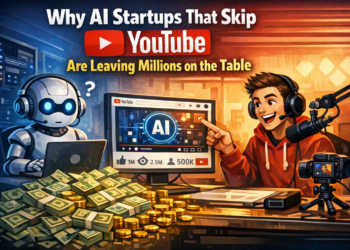
The highest-ROI channel in your stack isn’t the one you’re probably funding.
There’s a pattern repeating itself across AI startups right now. A founding team builds something genuinely compelling — an AI writing assistant, a workflow automation platform, a developer tool, an AI-native CRM — and then they go looking for customers. They stand up a LinkedIn page. They run Google Search ads. They write blog posts optimized for traffic. They chase a podcast appearance. They negotiate a newsletter sponsorship. They hire a PR firm. They do all of this, spend meaningful budget, and then wonder why their CAC is climbing and their pipeline feels thin.
The channel they’re almost certainly skipping? YouTube.
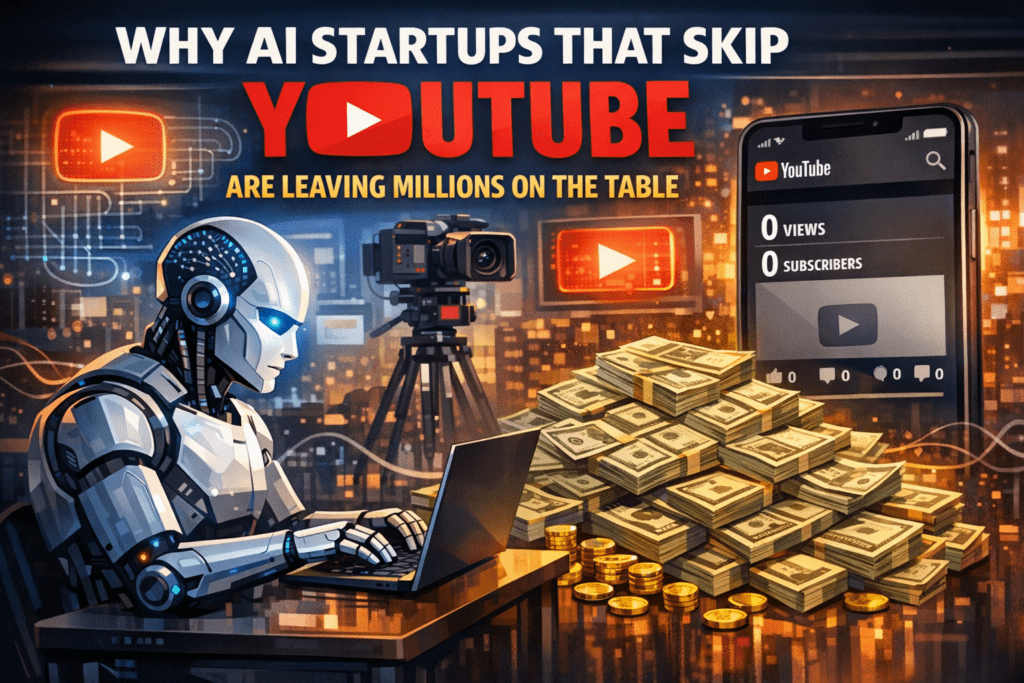
That’s not a content creator’s opinion. It’s what the data says. According to a Google/Ipsos Video & Social Ad Impact Study, users are 98% more likely to trust the recommendations of creators on YouTube than those on other social platforms — a figure drawn from over 13,000 surveyed users across the US, UK, Brazil, France, Germany, Italy, and Japan. Separately, research from Agentio cited in YouTube’s 2026 Creator Marketing Playbook shows that approximately 40% of views and 30% of clicks on sponsored YouTube videos happen more than 30 days after the video goes live. And a Google-commissioned meta-analysis covering 20 CPG brands found that YouTube drives 2.3x higher long-term ROAS than paid social on average.
Those aren’t benchmarks for legacy consumer brands. They’re the baseline reality of a platform that now generates over $36 billion in annual advertising revenue, reaches more 18-to-49-year-olds in the United States than any cable network, and serves as the go-to research destination for every category of buyer — including the technical decision-makers at the companies your AI startup is selling into.
If you’re a founder or CMO at an AI company and you’re not treating YouTube as a core channel, you’re not just leaving brand value on the table. You’re leaving compounding, searchable, trust-building, pipeline-generating revenue on the table.
Here’s why — and what to do about it.
The Trust Gap Is Not Close
Let’s start with the 98% figure, because it’s the one that tends to stop people mid-sentence.
The source matters here. The Google/Ipsos Video & Social Ad Impact Study, fielded from July to August 2023 with over 13,000 respondents across seven countries, found that people who use YouTube are 98% more likely to trust the recommendations they encounter there versus recommendations made by influencers on other social platforms. CreatorIQ’s analysis of this data frames this as a function of the type of relationship YouTube cultivates — one built on expertise, repeat exposure, and subject-matter depth, not virality or aesthetic appeal.
A follow-up study by Google and NRG, fielded across 5,204 US consumers in late 2024, found that 68% of respondents agreed YouTube creators are more trustworthy than traditional celebrities. The same research found that 78% of YouTube viewers agree that creators help them make a quicker decision on whether or not to purchase a product. And a separate Google/Material study from 2023 found that YouTube’s influence actually reduces the average online video shopper’s journey by six days.
Six days. For a product with a 90-day sales cycle, that’s not a footnote — that’s a material acceleration of your pipeline.
This trust dynamic exists because YouTube is structurally different from every other social platform. On TikTok, content is discovery-driven — the algorithm decides what you see, and creators are essentially competing for interruption. On LinkedIn, content is contextually professional but inherently transactional, and the platform’s ad unit is widely understood as promotional. On YouTube, audiences subscribe to specific creators, return to their channels deliberately, and consume long-form content across multiple sessions. The relationship between a YouTube creator and their audience is closer to a podcast listener’s relationship with their host than a social media user’s relationship with a feed.
For AI startups selling complex, often unfamiliar products into skeptical markets, this trust infrastructure is not a nice-to-have. It’s the foundation of every effective conversion.
YouTube Is the World’s Second-Largest Search Engine — and Your Prospects Are Using It
Before you think about YouTube as a social channel or an influencer marketing play, you need to understand what it actually is: the world’s second-largest search engine, processing more queries per day than Bing, Yahoo, and every other search engine combined, second only to Google itself.
This reframes the entire conversation.
When a developer wants to understand how LangChain compares to LlamaIndex, they’re not Googling it — they’re searching YouTube. When a VP of Operations is evaluating AI workflow automation tools, they’re watching demo walkthroughs and explainer videos. When a technical buyer is trying to understand what “vector database” actually means in practice, they’re watching a YouTube tutorial. When a founder is researching which AI writing tools are worth trying, they’re finding creator reviews.
This is not speculation. Traackr’s 2025 Influencer Marketing Impact Report, which surveyed 1,000 US Millennial and Gen Z consumers, found that YouTube ranked #1 for product reviews and product information for the second consecutive year, with 86% of respondents using YouTube at least once a week to consume creator content. About one-third (34%) of all respondents ranked YouTube as their first choice for product research — ahead of Instagram, Facebook, TikTok, and Snapchat combined.
For AI startups, this has a specific implication: your prospective customers are already on YouTube, actively looking for educational content about the problems your product solves. The question is whether they find your content, a competitor’s content, or nothing at all.
YouTube isn’t just where your audience discovers products. It’s where they educate themselves, form opinions, and build the conviction required to book a demo or start a free trial. If your company doesn’t have a presence there, you’re absent from one of the most critical stages of your own customer’s buying journey.
The 40% Long-Tail Advantage: Why YouTube’s ROI Keeps Growing After You Stop Paying
Here’s the structural advantage that separates YouTube from virtually every other marketing channel, and it’s the one most AI startup CMOs haven’t fully internalized.
When you run a Google Search campaign, the moment you turn off spend, the traffic stops. When you run a LinkedIn campaign, the moment the budget runs out, the impressions stop. When you pay for a newsletter placement, the email goes out once. When you sponsor a podcast, the episode lives on but attribution decays within days. Every other channel you’re running is ephemeral by design.
YouTube is different. YouTube videos are indexed by Google. They appear in search results. They accumulate views over time based on keyword relevance, watch-time signals, and algorithmic recommendations. They live in a creator’s archive and continue to surface to new audiences for months and years after publication.
The numbers bear this out. ADOPTER Media, drawing on their own campaign data, reports that 50% of video views on sponsored YouTube content occur after the first 30 days of publication. Agentio’s research, cited in YouTube’s 2026 Creator Marketing Playbook, puts that figure at 40% of views and 30% of clicks arriving after the initial 30-day window. ADOPTER Media also reports that their brand clients saw YouTube views up 300% twelve months after the start of their campaigns — not from ongoing ad spend, but from the compounding effect of evergreen content in the platform’s search and discovery ecosystem.
ThoughtLeaders, which tracks “evergreen scores” for YouTube content across thousands of channels, quantifies this precisely: an evergreen score of 1 or higher means a video received more views in the period after its first 30 days than it did during its first 30 days. Some videos double or triple their initial view counts. When a brand sponsors one of these videos, they pay once and receive compounding exposure — often at a CPM that drops to $0.01-$0.02 over time, compared to the $0.04 CPM at the time of the deal.
What does this mean for AI startups? Every tutorial, every product comparison, every explainer that your product appears in becomes a permanent, searchable brand asset. A developer searching “best AI coding tools” six months from now might find a video that was sponsored by your company today. A CFO evaluating AI finance platforms two years from now might find a creator’s walkthrough that featured your product in their first month of existence.
This is what makes YouTube categorically different from every other channel in your stack. Not just ROI at the campaign level — compounding ROI at the asset level, without additional spend.
The 2.3x ROAS Gap: What the Data Actually Tells You
A Google-commissioned meta-analysis covering 20 CPG brands over a two-year measurement period from 2021 to 2023 found that YouTube drives 2.3x higher long-term ROAS than paid social on average. The methodology matters here: this is an equity-to-sales model, measuring the downstream impact of brand equity built through each channel on subsequent sales, relative to media spend. It’s a broader definition than last-click or view-through attribution — it’s capturing the compounding brand value that YouTube builds, and how that value eventually converts to revenue.
The same 2.3x multiplier appears in a second context. According to Agentio’s research, brands that tested ten or more YouTube channel verticals saw a 2.3x improvement in their KPIs compared to those who stayed in a narrower category footprint. Breadth of creator partnerships compounds returns, not just depth of spend with a single creator.
For AI startup CMOs benchmarking their channel mix, the implication is direct: the channels most of you are over-indexing on — LinkedIn ads, Google Search, paid content distribution — don’t compound. They perform at a relatively stable rate of return as long as you’re feeding them budget. YouTube, by contrast, builds brand equity that persists, creates content assets that keep working, and generates the kind of trust that shortens your sales cycle.
One additional data point from Agentio deserves attention: advertisers doubled their conversion rates between their first and sixth brand integration with the same YouTube creator. The mechanism is relationship depth — both the creator’s increasing fluency with the brand’s message and the audience’s accumulated exposure to the partnership. Frequency, in a trusted context, drives material conversion improvement.
This has a strategic implication for how AI startups should approach YouTube sponsorships. Don’t treat it as a one-time test. Build a multi-integration relationship with a small set of highly relevant creators and compound your returns over time.
The AI Startup YouTube Gap: Why Your Category Is Underserved
Here’s something counterintuitive: despite the AI industry’s explosion over the past three years, most AI startups are dramatically underrepresented on YouTube relative to the audience that’s actively looking for their content.
Search YouTube right now for “best AI tools for [any category]” — marketing, coding, productivity, finance, recruiting, customer service. You’ll find a handful of individual creators who’ve built personal brands around AI tool reviews, and you’ll find very few of the actual AI companies investing in the channel with any consistency. The creators doing the reviews are often working with whatever tools they can access, sponsorships are sporadic, and the category-defining content that positions individual products as category leaders is largely unowned.
This is the window. The AI tooling market is growing faster than YouTube’s AI content coverage. The audience searching for these topics is large, technically sophisticated, and highly motivated to find trusted recommendations. And the barrier to entry is relatively low compared to what it will be once your well-funded competitors figure this out.
The data on this audience is compelling. According to YouTube’s own research conducted with Kantar in late 2025, surveying 7,621 weekly video viewers aged 18 to 64, 90% of YouTube viewers said they use the platform to go deeper on topics they care about, 88% said they use it to explore passions and interests, and 87% said they use it for learning and growing. These are not passive entertainment numbers — these are active learning behaviors. The people using YouTube this way are exactly the profile of a B2B decision-maker or technical buyer evaluating AI tools.
Furthermore, 79% of Gen Z viewers trust recommendations from creators on YouTube, with 74% saying YouTube creators provide helpful context or expertise that enables more confident purchase decisions. The developers, data scientists, and product managers who are making or influencing AI tool decisions at companies right now are disproportionately in the Gen Z and younger Millennial cohort. They have been trained to trust YouTube creators in ways they have never been trained to trust LinkedIn thought leadership, branded blog posts, or Google Search ads.
Your window to establish category authority on this platform is open now. It won’t stay open forever.
How the Platform’s Architecture Works in Your Favor
YouTube’s combination of social discovery and search indexing creates a two-front advantage that no other platform offers.
On the social side, creators with established audiences in adjacent categories — productivity, tech, developer tools, finance — can introduce your product to their subscribers in a context of genuine trust. A well-executed integration in a popular developer-focused YouTube channel reaches an audience that is already predisposed to try new tools, already trusting the creator’s judgment, and already in a research mindset.
On the search side, every YouTube video is indexed both within the platform and by Google. According to ADOPTER Media, YouTube’s integration with Google search means that well-optimized videos can surface in Google search results for relevant queries — not just in YouTube search. Search for “how to use AI for financial modeling” in an incognito browser right now, and you’ll find YouTube videos on the first page of results. For AI startups targeting specific use-case keywords, this means YouTube content can compete directly with blog posts and landing pages for high-intent organic search traffic — without the SEO timeline.
This dual discovery mechanism is what gives YouTube its peculiar economic character. A single sponsored video can generate awareness through the creator’s existing subscriber base, continue to grow through YouTube’s recommendation algorithm, and capture long-tail search traffic from people who didn’t know you existed when the video was published. You pay once. The asset works indefinitely.
ADOPTER Media’s data is blunt about the magnitude of this: “Sponsored YouTube videos achieve click-through rates of 7-10%, far outperforming the 2-5% typical of traditional display ads.” And 70% of YouTube users say they’ve bought a product after seeing it featured in a video. For the software categories AI startups compete in — where the decision to try a tool is often made based on watching someone else use it — this conversion pathway is not just efficient. It’s often the most natural path from awareness to action that exists.
The Television-Scale Distribution You’re Not Accounting For
There’s one more dimension of YouTube’s scale that AI startup marketing teams consistently underestimate: more than half of YouTube’s watch time now happens on televisions.
YouTube’s research documents this shift explicitly. Audiences are watching YouTube creator content on the largest screen in their home, in the same session and context as Netflix, Disney+, and linear TV. YouTube’s advertising revenue hit $9.8 billion in Q2 2025, and the platform is actively positioning itself in agency budget conversations as a television replacement, not just a social media line item.
For AI startup CMOs, this has a specific implication: the audience watching your category’s YouTube content isn’t just scrolling on their phone during a commute. They’re leaning back, giving the content their full attention, and consuming it in longer sessions than any other digital platform supports. Long-form tutorials, product walkthroughs, and deep-dive comparisons — the formats that are most effective for complex software products — are being consumed on television screens by highly engaged audiences.
This is a channel behavior that simply doesn’t exist on LinkedIn, Twitter/X, or email. It’s one of the structural advantages that makes YouTube’s trust and conversion metrics look the way they do.
What an Effective AI Startup YouTube Strategy Actually Looks Like
None of this is useful unless it translates into an actionable approach. Based on the platform data and case evidence, here’s how AI startups should think about structuring their YouTube presence:
1. Identify your category’s creator ecosystem before you spend a dollar.
Every AI category has a handful of creators who have built audiences around adjacent expertise. Developer tools have coding and productivity creators. AI writing tools have content marketing and SEO creators. AI finance tools have CFO and fintech creators. AI customer service tools have CX and SaaS operations creators. The first step is mapping this ecosystem and understanding each creator’s audience composition, engagement rate, and content style. YouTube Creator Partnerships, which unified BrandConnect and the Creator Partnerships Hub in March 2026, now provides a single platform for brand-creator connection with over 3 million vetted creators available for partnership.
2. Prioritize depth over breadth in early partnerships.
The Agentio data showing a doubling of conversion rates between the first and sixth integration with the same creator should drive your strategy. Don’t spray budget across ten creators for a one-time test. Identify two or three creators with genuine audience alignment and build multi-video relationships with them. This compounds trust, compounds familiarity, and compounds your conversion rates in a way that one-off placements cannot.
3. Fund evergreen content formats, not trend-chasing content.
The long-tail data is unambiguous: videos built around durable search queries — “how to use AI for [use case],” “best AI tools for [category],” “[your product] vs [competitor],” “[your product] tutorial” — continue to accumulate views and clicks for months and years. Trend-based content has a shorter shelf life. For AI startups with constrained budgets, every dollar should be going into content that will be just as relevant to a searcher two years from now as it is today.
4. Invest in your own channel, not just sponsorships.
Sponsorships are the fastest path to trust and distribution in the short term, but a company’s own YouTube channel is a long-term asset. Product walkthroughs, use-case demos, founder explainers, and customer success stories published to your own channel feed both YouTube search and Google search, accumulate subscribers who have indicated active interest in your product category, and give you a distribution platform that you own rather than rent.
5. Treat YouTube as a search channel, not a social channel.
Optimize your titles and descriptions for actual search queries. Research the keywords your target buyers are using. Structure your content around specific questions and use cases rather than brand narratives. Think of every piece of YouTube content as a keyword-targeted landing page with a video attached.
The Objections — And Why They Don’t Hold Up
Several objections recur when AI founders and CMOs are confronted with the YouTube opportunity. They deserve direct responses.
“Our customers don’t use YouTube — they’re enterprise buyers.”
The Google/Kantar research was clear: 90% of surveyed YouTube viewers use it to go deeper on topics they care about, and this behavior spans age groups and professional roles. Enterprise decision-makers watch YouTube tutorials, product comparisons, and category explainers exactly the same way consumer buyers do — they’re just searching for different keywords. The VP of Engineering evaluating AI coding tools is watching the same creator content as the individual developer. The platform doesn’t care about their corporate title.
“Video production is expensive and we don’t have the resources.”
Urban Decay partnered with YouTube beauty creators Kelly Strack and Ashley LaMarca for a casual, unpolished campaign that outperformed traditional branded content, achieving a 3% increase in purchase intent and a 278% surge in search lift. The CreatorIQ analysis is explicit: “There’s a misconception that brands need to spend a lot of money and produce ultra-polished, TV-quality branded content to make an impact on YouTube.” Creator-led content doesn’t require production budget — it requires budget allocation to creator fees and a brief that gives creators enough context to authentically incorporate your product.
“YouTube takes too long to see results.”
This is the wrong frame. YouTube’s compounding model means it takes longer to see peak results — but it also means results don’t decay when you stop spending. Compare this to Google Search, LinkedIn, or paid social, where results flatline the moment your budget stops. ADOPTER Media’s own data shows 300% growth in views twelve months after campaign start. If you define “results” as “what happens while I’m actively spending,” then yes — YouTube is slower. If you define results as “total return on the investment over 24 months,” no other channel competes.
“We can’t track attribution from YouTube.”
YouTube attribution has always been imperfect, and that’s true of every trust-building channel, including PR, conferences, and branded content. The right measurement framework for YouTube is incrementality testing and multi-touch attribution, not last-click. ADOPTER Media reports that sponsored YouTube videos drive 7-10% CTRs — multiples above display and social norms — and that 70% of users who see a YouTube ad go on to search Google for the product. That downstream search behavior is trackable. YouTube isn’t a black box; it’s a channel that rewards measurement sophistication.
The Competitive Reality: Your Category Is Still Wide Open
The B2B PPC report from The Digital Bloom found that B2B YouTube ad spend grew 85% year-over-year in 2024-2025 — a signal that the market is waking up to the opportunity. But that growth is coming from a very small base in most B2B categories, and the AI tools category specifically remains dramatically underserved relative to audience demand.
The brands that move first in emerging categories on YouTube tend to own the semantic territory. They appear first in search. Their brand names become associated with the category-defining creators. Their sponsored content becomes the reference point for buyers doing research. The compounding search advantage that a first-mover builds on YouTube is not easily displaced — because every video is indexed, every view adds watch-time authority, and every subscriber represents a direct relationship that competitors can’t buy their way into retroactively.
The AI startup landscape is in the middle of a category-definition period right now. In two or three years, the leading AI tools in most categories will be known to their target buyers through YouTube. The question is whether they built that awareness proactively through a deliberate YouTube strategy, or whether a competitor did it for them.
Why the Math Makes YouTube Unavoidable
Let’s put this in straightforward financial terms for founders and CMOs who need to justify budget allocation.
Your average LinkedIn campaign — if you’re in B2B SaaS — is running at CPLs of $150 or more, with MQL-to-SQL conversion rates of 14-18% and sales cycles measured in months. Your average Google Search campaign is running at CPLs of $48-$250 depending on keyword competitiveness. Both of these are captured-demand channels — they work when your prospect is already aware of the category and actively searching.
YouTube is a demand-creation channel. It builds awareness, establishes trust, shortens consideration cycles, and generates search volume for your brand. And it does all of this with content assets that continue working after you stop paying for them. The Google/NRG research shows YouTube shortens purchase journeys by six days. That acceleration, applied across your entire pipeline, has real dollar value.
The 2.3x long-term ROAS advantage over paid social is the headline number. But the more important figure for AI startups is the counterfactual: every month you’re not on YouTube, a potential customer is watching your category’s content and forming opinions about which products they trust — and your brand is not part of that conversation.
That’s not a marketing problem. That’s a revenue problem.
The Moment to Move Is Now
YouTube’s creator marketing infrastructure is more accessible today than it has ever been. YouTube Creator Partnerships, which consolidated BrandConnect and the Creator Partnerships Hub into a single platform in March 2026, gives brands access to over 3 million vetted creators. YouTube’s Shopping affiliate program has dropped its subscriber threshold from 10,000 to 500 subscribers, meaning there’s a far richer pool of emerging creators in specialized niches that AI startups should be partnering with before their audiences scale and their pricing reflects that scale.
The Traackr data is unambiguous: for the second consecutive year, YouTube ranked #1 for creator content consumption and product research across both Gen Z and Millennial consumers. The Pixability research reported by NetInfluencer shows Sale Guide content — purchase-oriented video — grew 49% year-over-year in views between 2023 and 2024. The audience’s appetite for creator-led product content is accelerating, not slowing.
For AI founders reading this: you are sitting on one of the most significant channel arbitrage opportunities in your market right now. Your competitors are fighting over the same LinkedIn audiences, the same Google Search keywords, and the same paid media placements. YouTube is the channel where trust is highest, competition in your category is lowest, content assets compound over time, and the audience doing product research is most predisposed to make a decision.
The startups that figure this out in the next twelve months will own their categories on the world’s second-largest search engine for years. The ones that wait will spend three times as much to get half as far.
YouTube isn’t optional. It’s the highest-ROI channel in your stack — you just haven’t funded it yet.