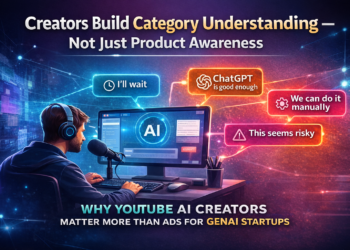
If you’re building an AI product in 2026, you’re not just competing against other startups.
You’re competing against:
- inertia (“we’ll keep doing it manually”)
- skepticism (“sounds like hype”)
- internal risk (“security, compliance, procurement”)
- the default tool (“we’ll just use ChatGPT”)
- DIY bias (“we’ll build it in-house”)
- an explosion of “good enough” alternatives
And here’s the uncomfortable part: most AI marketing funnels were designed for a world where attention was scarce, product categories were stable, and buyers trusted brands. That world is gone.
Today, buyers don’t move in a neat line from ad → landing page → demo request → close. They self-educate, self-shortlist, and increasingly show up to sales conversations already leaning toward a winner.
One large B2B buyer research stream has been documenting this “pre-seller” phase for years, and in its 2025 report it states that buyers fill most of their shortlist on Day One and purchase from that Day One shortlist the vast majority of the time (reported as 95% in 2025).
That reality changes everything about “distribution.”
Because if buyers are deciding early—before they talk to you—then your real job is not lead capture.
Your real job is:
- to shape how the category is understood
- to get included in the short list early
- to earn belief before the first call
- to make trial feel inevitable
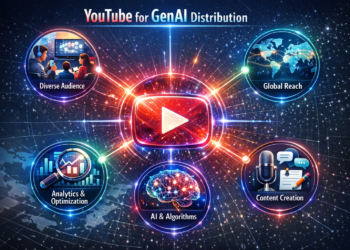
That’s what creators do. And it’s why YouTube is becoming the “new App Store” for AI: the place where people discover what exists, watch it work, compare options, decide who they trust, and learn how to use it.
This article is a playbook for building what I’ll call The Creator Distribution Stack—a creator-led system that replaces the old funnel with something closer to how humans actually buy:
category education → comparison → social proof → trial → adoption
Along the way, we’ll cover:
- the creator-led buyer journey (and how it maps to modern buying behavior)
- how to pick creators like a strategist (not a vibes-based sponsor shopper)
- integration vs. dedicated videos (and when each wins)
- briefing templates you can actually use
- how to measure lift beyond clicks (Brand Lift, Search Lift, “shortlist lift,” pipeline quality)
Why “YouTube Is the New App Store” Is Not a Metaphor (It’s a Behavioral Shift)
The reason AI companies struggle with traditional funnels is simple:
AI is hard to evaluate from a web page.
A landing page can claim “10x productivity,” but it can’t show the workflow. It can’t show the edge cases. It can’t show what breaks. It can’t show the time-to-value. It can’t show what a real user does when the AI output is wrong.
Creators can.
And YouTube doesn’t just host that content. It organizes it the way an app store organizes products:
- discovery (recommendations, search, suggested videos)
- evaluation (reviews, comparisons, tutorials)
- trust signals (creator reputation, comments, long-form proof)
- activation (setup guides, onboarding walkthroughs)
- retention (use-cases, updates, “new features” videos)
Google’s own research framing is telling: in a Think with Google / BCG-backed piece on influence across the purchase journey, the authors explicitly argue that buyers don’t follow funnels—they follow “attention, relevance, and trust,” and they report that YouTube performs strongly across these drivers compared to social platforms.
In another Think with Google piece about shopping behavior, they cite an Ipsos survey and report that YouTube’s influence can shorten the “online video shopper’s journey” (reported as six days in that article), and that people turn to creators both before and after purchase to understand products and performance.
Now translate that into AI.
AI tools are not bought because someone “heard about them.”
They’re bought because someone:
- saw it work
- believed it would work for them
- trusted the source showing it
- felt confident enough to try
- experienced value quickly
That chain is what creators compress.
And once you see distribution this way, you stop asking:
“How many clicks did the video generate?”
…and you start asking:
“Did this creator move us into the buyer’s shortlist?”
“Did they accelerate belief?”
“Did they reduce trial friction?”
That’s the creator distribution stack.
The Creator Distribution Stack (The New Funnel)
Think of your creator program as a stack with four layers—each corresponding to a buyer need:
Layer 1: Category Education (Vocabulary + Mental Models)
Buyers can’t buy what they can’t name.
Creators teach:
- what the category is
- what terms mean
- what “good” looks like
- what to watch out for
- how to avoid getting burned
This is not “awareness.” It’s market formation.
Layer 2: Comparison (Decision-Making + Differentiation)
Once buyers can name the category, they compare.
Creators compress comparison by producing content like:
- “X vs Y” tests
- benchmarks
- use-case shootouts
- “best tools for ___”
- “I replaced my workflow with ___”
- “I tested 10 tools so you don’t have to”
Comparison content is where you win (or lose) shortlist placement.
Layer 3: Social Proof (Trust Transfer + Permission to Believe)
AI buying is high-trust and high-risk.
Creators provide the buyer what internal teams demand:
- “someone credible tested it”
- “it’s not just marketing claims”
- “the tradeoffs are understood”
- “there’s a path to ROI”
- “this isn’t vaporware”
This is trust transfer.
Nielsen has reported, based on its Trust in Advertising study, that a large share of consumers trust influencer opinions/product placements (reported as 71% in Nielsen’s write-up).
Even when you’re selling B2B, the psychology carries: we trust people more than banners.
Layer 4: Trial (Activation + Time-to-Value)
“Trial” isn’t a sign-up button. Trial is the moment a user experiences value.
Creators reduce trial friction by:
- demonstrating setup
- providing templates
- showing the first successful output
- revealing how to avoid common mistakes
- showing what to do when it fails
This is why tutorial creators often outperform “hype creators.” They don’t just generate interest—they generate activation.
The Creator-Led Buyer Journey (Mapped to What Buyers Actually Do)
Let’s map this to what we know about modern buying behavior.
Step 1: Anonymous learning (before they talk to you)
B2B research consistently shows buyers start with independent discovery.
In a 2024 B2B buyer survey report, respondents said they were adding more due diligence behaviors (including detailed ROI analyses) and spending more time researching purchase decisions, while also relying more on peer recommendations and reviews.
That matters because creators are where that “research time” goes.
Step 2: Shortlist formation (the real funnel gate)
Shortlist formation is the real moment of truth.
One B2B buyer experience report describes buyers filling most of their shortlist early and buying from that early shortlist the overwhelming majority of the time.
Creators influence shortlist formation by being the “third-party evaluator” that buyers use as a shortcut.
Step 3: Internal justification (social proof becomes political fuel)
AI purchases often require internal buy-in:
- security
- IT
- finance
- legal
- the “skeptical operator”
- the exec sponsor
Creators provide language and proof that helps champions sell internally.
That same 2024 B2B buyer survey report notes buyers valued content that made it easier to show ROI and build a business case.
Step 4: Validation (trial, demos, proof-of-value)
Creators don’t replace validation, but they reduce the friction to start it.
They turn a “maybe later” into “fine, I’ll try it.”
Step 5: Adoption and ongoing learning (retention content)
Most AI churn isn’t because the product “doesn’t work.”
It’s because:
- onboarding is unclear
- value isn’t reached fast enough
- internal rollout fails
- people don’t know what to do next
Creators keep teaching after the purchase.
That post-purchase behavior is explicitly called out in YouTube’s own shopping-journey framing (people turn to creators after purchase to see product performance and usage).
This is why creator programs can function as retention levers, not just acquisition.
Why Creators Replace Old Funnels (Category → Comparison → Social Proof → Trial)
Old funnels rely on brand-controlled touchpoints:
- ads
- landing pages
- webinars
- email nurture
- SDR outbound
- “book a demo”
But buyers trust these less because they know the incentives.
Creators replace these touchpoints with buyer-controlled learning:
- “I searched and found someone credible”
- “I watched it work”
- “I saw the limitations”
- “I decided to try”
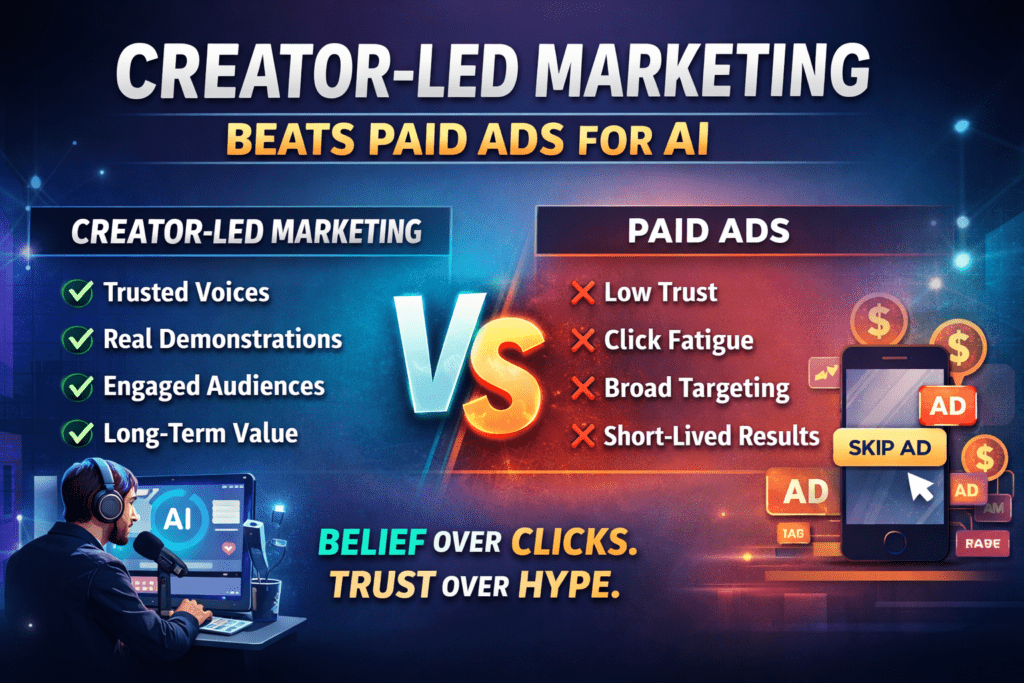
This isn’t theory. In that same 2024 B2B buyer survey report, buyers reported noticing online ads during research, but fewer than one-third said those ads positively impacted their perception of a brand.
Creators operate differently:
- they’re expected to evaluate, not persuade
- they demonstrate, not promise
- they show tradeoffs (which increases trust)
- they speak the buyer’s language
When creator content is done right, it doesn’t feel like an ad. It feels like research.
The Creator Archetypes (Pick the Right “Kind” of Creator)
Most teams pick creators the way people pick restaurants:
- follower count
- vibes
- surface-level fit
- “they’re popular in AI”
That’s how you get expensive videos that do nothing.
Instead, pick creators by role in the buyer journey. Here are the main archetypes:
1) Category Educators (Market Makers)
They define vocabulary and mental models.
Best for:
- emerging categories (agents, copilots, eval tooling, RAG stacks)
- “new to market” products
- reframing a category problem
Signal:
- high watch time on explanatory content
- repeat viewers
- strong comments that show learning (“this finally makes sense”)
2) Benchmarkers / Reviewers (Shortlist Shapers)
They do comparisons, tests, “best tools for…”
Best for:
- competitive categories
- winning shortlist placement
- forcing differentiation
Signal:
- consistent series content (not one-offs)
- clear evaluation criteria
- willingness to critique products (integrity)
3) Builders / Implementers (Trial Accelerators)
They ship workflows, build in public, teach step-by-step.
Best for:
- developer tools
- automation platforms
- anything with onboarding complexity
Signal:
- tutorials outperform their “news” content
- audience asks implementation questions
- they publish templates, repos, docs
4) Operators / Practitioners (ROI Translators)
They speak to buyers who care about cost, workflow fit, security, and time saved.
Best for:
- B2B teams
- “AI inside workflows” products
- compliance-sensitive buyers
Signal:
- content is grounded in work, not trends
- audience includes managers and decision-makers
5) Community Anchors (Trust Compounds Over Time)
They run Discords, newsletters, live streams, long-running series.
Best for:
- sustained distribution
- repeated exposure
- long sales cycles
Signal:
- strong community engagement
- recurring formats
- long-tail view accrual
Your program usually needs more than one archetype.
If you only sponsor one type, you’ll over-index on one stage of the journey.

How to Pick Creators (A Practical, Non-Sloppy Method)
You want to choose creators the way you choose channels in a growth model:
- fit
- credibility
- repeatability
- measurement
- risk controls
Step 1: Start with the buyer, not the creator
Write a one-paragraph “buyer reality”:
- who buys (role, seniority, industry)
- what triggers search
- what fears block purchase
- what proof they require
- what they must show internally
Then pick creators whose audience matches that reality.
Step 2: Confirm they actually influence decisions (not just attention)
Ask for:
- top 10 videos by views and watch time
- average views at 7/30/90 days (not lifetime peaks)
- audience geography and language
- age/role proxies (where available)
- traffic sources (search vs browse vs suggested)
- retention graphs on similar “tool” videos
Step 3: Validate authenticity and quality (before you pay)
Influencer fraud is real, and inflated metrics are a known industry issue. Ipsos has written about the problem of inflated follower counts and the need for verification tools and practices.
Red flags:
- unusually low comments relative to views
- repetitive, bot-like comment patterns
- content that never critiques anything (too “sponsored”)
- audience mismatch (e.g., mostly entertainment viewers)
- “viral spikes” that don’t translate to stable performance
Step 4: Choose creators by format match
Format matters more than niche tags.
Match by content type:
- long-form deep dives (best for complex AI tools)
- step-by-step tutorials (best for onboarding + trial)
- comparisons (best for competitive categories)
- use-case stories (best for ROI translation)
- recurring series (best for compounding lift)
Step 5: Score creators with a simple rubric
Use a 1–5 score:
- Audience fit (role + intent)
- Credibility (history of honest evaluation)
- Content format fit (can they demo your product?)
- Distribution mechanics (search-driven vs spike-driven)
- Production clarity (can viewers actually follow the workflow?)
- Brand safety (tone, past sponsors, disclosure habits)
- Measurement readiness (willing to use links, codes, surveys)
Don’t overcomplicate it. Just don’t wing it.
Integration vs Dedicated Videos (The Real Tradeoff)
Most teams treat this as a budget question.
It’s not.
It’s a strategy question: Do you want depth now, or compounding distribution over time?
Dedicated video (deep evaluation / full review)
What it is: The entire video is about your product or a problem your product solves, with a structured walkthrough.
Best for:
- new product launches
- complex tools that require explanation
- category creation (when the buyer needs education)
- competitive displacement (when you need clear differentiation)
Strengths:
- maximum depth
- higher belief conversion
- better for enterprise-grade scrutiny
Risks:
- higher cost
- higher expectations
- if the creator’s audience isn’t aligned, it can underperform
Integration (embedded segment in an existing video)
What it is: A sponsor segment inside a relevant video (“Today’s video is sponsored by…”), often 60–180 seconds.
Best for:
- repeated exposure across multiple videos
- cost-efficient testing
- driving awareness + light trial
- staying present across a long cycle
Strengths:
- frequency compounds trust over time
- fits naturally into ongoing formats
- easier to scale across multiple creators
Risks:
- less depth
- less persuasive for complex products unless paired with follow-up content
The best-performing pattern for many AI companies
A two-step system:
- Integrations for frequency (stay in the buyer’s world)
- Dedicated deep dive for conversion (when intent is high)
This mirrors how people buy: they don’t “convert” on first exposure. They convert after repeated credible contact.
The Briefing Problem (Why Most Creator Campaigns Underperform)
Most sponsor briefs are either:
- too vague (“talk about our product, mention these features”)
- too controlling (“say exactly this, show exactly that”)
- too shallow (“we want awareness!”)
- too brand-centric (“our mission is…”)
Creators don’t need more marketing language.
They need:
- the buyer problem
- the workflow
- the proof
- the edge cases
- the constraints
And they need enough freedom to be credible.
If your brief forces them to sound like an ad, you destroy the one asset you’re paying for: trust.
Briefing Template #1: Dedicated Video (Copy/Paste)
Use this as a one-page brief.
1) Goal (pick one primary)
- Shortlist placement (comparison-stage win)
- Trial starts (activation)
- Business-case proof (internal justification)
- Category education (market formation)
2) Who is this for?
- Role(s):
- Experience level (beginner / intermediate / advanced):
- Primary pain:
- Current workaround they use today:
3) The “why now” trigger
What makes the viewer search today?
Examples:
- “My team is drowning in repetitive work”
- “We need AI inside our workflow, but it feels risky”
- “We tried tool X and it broke”
- “We’re evaluating vendors and need proof”
4) What you should show on screen (the real conversion)
- Setup in under X minutes
- The first “win” moment (time-to-value)
- A realistic workflow (not a toy demo)
- 1–2 edge cases (show what happens when it fails)
- How to verify output / reduce risk
5) Claims you can make (with proof links)
List 3–5 claims max. Attach proof for each (docs, benchmarks, customer story, product screenshots, pricing pages).
6) Claims you cannot make
Be explicit (compliance + trust).
7) Competitors / alternatives viewers will compare against
Name them. Creators will talk about them anyway.
8) Offer (for trial)
- free plan?
- extended trial?
- credits?
- template pack?
- onboarding call?
9) CTA (one primary action)
Pick one:
- start trial
- join waitlist
- download template
- watch onboarding
- book a demo (only if truly warranted)
10) Tracking + measurement
- UTM link
- coupon code (optional)
- landing page built for creator traffic (recommended)
- self-reported attribution question in signup (“Where did you hear about us?”)
11) Disclosure requirements (non-negotiable)
Creators and brands must comply with platform and legal disclosure obligations. YouTube provides a paid promotion disclosure mechanism (“includes paid promotion”), and requires creators to declare paid promotions in settings.
The FTC provides guidance on disclosing material connections for endorsements and influencer marketing.
12) Creative freedom statement (this matters)
Include a line like:
“We want an honest evaluation. Mention tradeoffs. If something doesn’t work, say so—credibility matters.”
That single sentence often improves performance more than any “messaging.”
Briefing Template #2: Integration Segment (Copy/Paste)
1) Segment goal
Pick one:
- awareness in a high-intent context
- trial starts
- remarketing reinforcement (frequency)
2) The 10-second hook (viewer-first)
What’s the problem this sponsor solves in one sentence?
Example:
- “If you want an AI tool that actually plugs into your workflow instead of being a toy demo…”
3) The 60–120 second proof
- show the UI
- show the workflow
- show the outcome
- show who it’s for
4) The “one thing” takeaway
What should the viewer remember?
5) CTA
One link. One action. No menu of options.
6) Tracking
- UTM link
- unique code if relevant
- pinned comment copy (optional)
7) Disclosure
Same rules apply.
How to Write CTAs That Don’t Kill Trust
Most sponsor CTAs fail because they sound like marketing.
Creators succeed when CTAs sound like a recommendation with a reason.
Bad CTA:
- “Try it now, it’s the best AI tool!”
Good CTA:
- “If you want to test this workflow yourself, the link below gives you X credits so you can replicate exactly what I just did.”
The structure:
- who it’s for
- what they’ll be able to do
- why it’s worth trying
- how to start
That’s it.
Measuring Lift Beyond Clicks (Because Clicks Are Not the Point)
Clicks are easy to measure.
But clicks are not the main outcome creators drive.
Creators drive:
- belief
- recall
- preference
- search behavior
- shortlist placement
- trial confidence
- internal justification
You need measurement that matches those outcomes.
The measurement trap: last-click attribution
Last-click attribution over-credits the final touchpoint.
Creators often operate earlier:
- they introduce a category
- they shape evaluation criteria
- they seed trust
- they create language buyers repeat internally
The buyer might click later from:
- a Google search
- a colleague’s link
- a retargeting ad
- your homepage
…but the creator did the work that made that later click happen.
So: measure creators like you measure brand.
The Practical Measurement Stack (What to Track)
1) Brand Lift (survey-based belief change)
Google describes Brand Lift as a free tool to measure brand outcomes like ad recall, awareness, and consideration (rather than clicks), using control vs exposed survey methodology.
Even if you’re not running YouTube ads, the concept matters: measure belief change, not just traffic.
If you are running YouTube campaigns, Brand Lift is one of the cleanest ways to quantify shifts in perception.
2) Search Lift (intent capture through search behavior)
Google describes Search Lift as a free tool (not available to all accounts) that measures increases in searches for your product/brand after users view your ads, using an experiment design.
Why it matters for creators:
- creators often trigger future search, not immediate clicks
- search is a closer proxy to intent than impressions
Even if you can’t run Search Lift, you can approximate via:
- Google Trends directionality (macro)
- Search Console branded query changes (your property)
- YouTube search query changes (if you have access)
3) “Shortlist Lift” (the B2B metric most teams ignore)
In B2B, the real win is getting onto the shortlist early.
If buyers purchase from their early shortlist most of the time, then your creator program should be measured on:
Did we increase inclusion in the shortlist?
How to measure it practically:
- add a signup question: “Which tools are you evaluating?”
- add a demo request field: “What alternatives are you considering?”
- track competitor mentions in sales calls (structured notes)
- track inbound language (“I saw X compare you to Y”)
This is qualitative—but it’s highly predictive.
4) Activation metrics (trial quality, not trial quantity)
Most AI companies measure:
- signups
Better:
- time-to-first-success
- activation rate (did they reach the “aha”)
- templates used
- integrations connected
- number of successful runs
- week-1 retention
Creators who teach implementation often improve activation because they reduce user error.
5) Pipeline quality (the money metrics)
If your creator program is working, you should see improvements in:
- demo quality (less “junk”)
- conversion rates across stages
- pipeline velocity (time from first touch to meeting)
- CAC payback (over time)
- expansion likelihood (because expectations were set correctly)
This is where creator-led distribution becomes a CFO-friendly lever.
A Measurement Plan You Can Run in 30 Days (Without Fancy Tools)
If you need a practical plan, do this:
Week 0: Setup
- Create a dedicated landing page for creator traffic
- Add a self-reported attribution field at signup (“Where did you hear about us?”)
- Add a “tools you’re considering” field for demo requests
- Set UTMs for each creator
- Align one activation event as your “success” metric (e.g., first workflow completed)
Weeks 1–2: Pilot (2–5 creators)
Run:
- 2 integrations
- 1 dedicated deep dive
- optional: 1 tutorial-style builder creator
Weeks 3–4: Review
Look at:
- direct UTMs (baseline)
- branded search changes (directional)
- self-reported attribution counts
- activation rate differences for creator-attributed users
- sales feedback: are prospects referencing creator content?
Then make one decision:
- scale what produced high-quality activation
not what produced the most clicks.
Compliance and Disclosure (Protect Trust Like It’s an Asset)
If you want creator distribution to compound, you must protect credibility.
That means disclosure is not optional.
- YouTube instructs creators to declare paid promotions (product placements, endorsements, sponsorships) via the paid promotion setting, and it displays a disclosure to viewers when marked.
- The FTC provides guidance on disclosing material connections and how endorsements should be presented, including the importance of clear, conspicuous disclosure.
If you push creators to “hide” sponsorship, you may get short-term performance—but you burn the long-term asset: trust.
Putting It Together: The Creator Distribution Playbook for AI Companies
Here’s the playbook as a system (not a one-off sponsorship):
Phase 1: Category mapping (what buyers need to learn)
- list the misconceptions buyers have
- list the questions they ask before they can buy
- list the “proof moments” they need to see
Phase 2: Creator portfolio (not a single creator)
Build a portfolio across archetypes:
- educator
- reviewer
- builder
- operator
- community anchor
Phase 3: Content sequencing (match the buyer journey)
Sequence content like this:
- category explainer (educator)
- comparison video (reviewer)
- implementation tutorial (builder)
- integration repetition (community anchor / operator)
This mirrors how belief forms.
Phase 4: Measurement aligned to outcomes
Track:
- Brand Lift / belief proxies
- Search intent behavior
- shortlist inclusion (self-report + sales notes)
- activation + retention (product analytics)
- pipeline quality (CRM)
Phase 5: Compounding distribution
The goal is not “one viral video.”
The goal is:
- repeated credible touchpoints
- a library of proof
- content that ranks in search
- creator trust that compounds
That’s how YouTube behaves like an app store:
your “listing” becomes a web of videos buyers encounter while researching.
Why This Matters Even More in AI
AI categories are uniquely vulnerable to:
- hype cycles
- skepticism
- fear of vendor lock-in
- fear of hallucinations and errors
- security and privacy concerns
- “AI washing”
B2B buyers in 2025 report engaging earlier specifically to evaluate how vendors are implementing AI inside solutions (reported as a major driver in one buyer experience report).
Creators reduce that uncertainty by showing:
- what the AI does
- where it fails
- how it’s controlled
- what humans still do
- what guardrails exist
They turn “AI claims” into “AI evidence.”
The Bottom Line
Creators don’t replace your product. They replace the brittle parts of your funnel that buyers no longer trust.
They do the work that old funnels can’t:
- teach the category
- set evaluation criteria
- create trust through demonstration
- provide social proof that survives internal scrutiny
- reduce trial friction and accelerate time-to-value
And YouTube is the platform where this compounds, because discovery and evaluation happen in the same place—and because creator trust is a durable asset.
If you want to win in AI, stop treating creators like a one-off acquisition channel.
Start treating them as a distribution stack—the new infrastructure for belief, shortlist placement, and adoption.