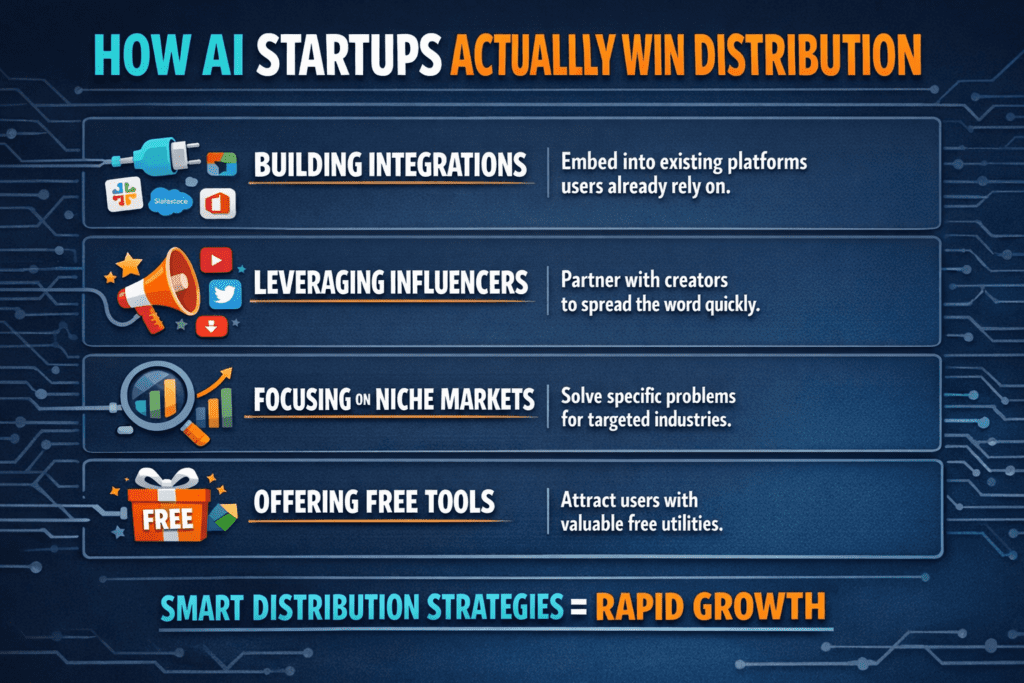
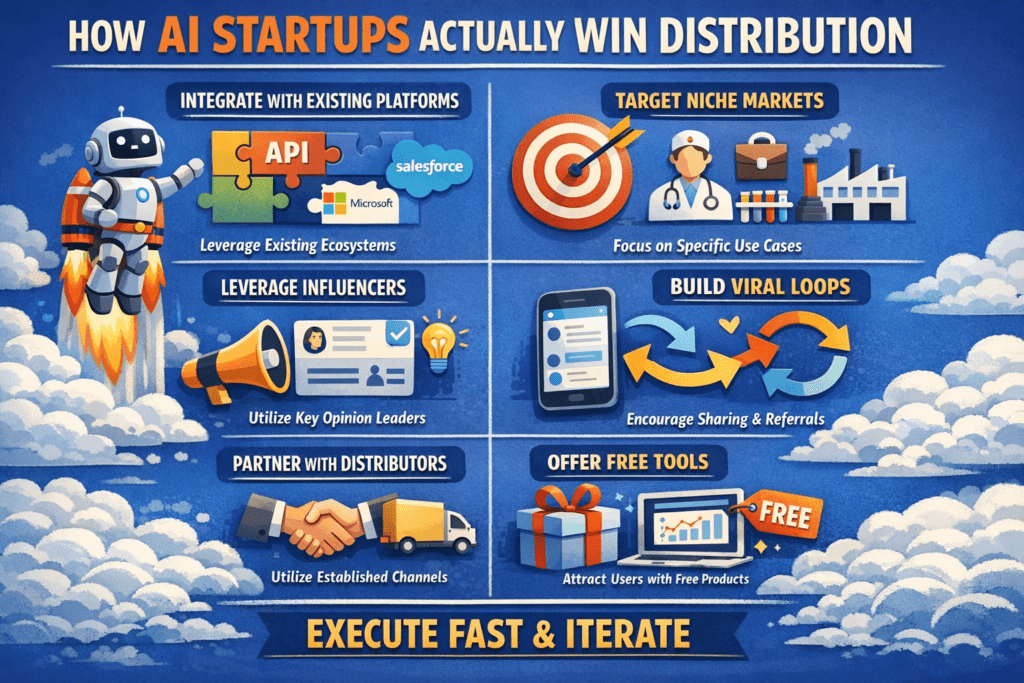
Your AI product is probably good enough. So is everyone else’s.
That sentence stings because it’s true more often than founders want to admit. In the application layer of AI, the core capability (a model that can write, see, speak, summarize, plan, or code) is increasingly accessible. Models improve, prices move, open-source alternatives appear, vendors bundle features, and within months your “killer feature” becomes a checkbox on someone else’s pricing page.
So what wins—reliably—when product parity creeps in?
Distribution. Not “marketing” in the vague sense. Not “growth hacks.” Not “we’ll go viral.” I mean a repeatable system that puts you in front of the right users at the right time—often inside the tools they already use—at a cost and speed your competitors can’t match.
In other words: own the channel, not the model.
This article is a practical field guide to doing exactly that—especially for application-layer AI startups that feel the ground shifting under them. We’ll define what “owning the channel” really means, break down the six most reliable distribution routes, and give you a decision tree and 30-day validation plan so you can stop guessing and start compounding.
1) The New Reality: “Good Enough” Is Everywhere
It’s easy to romanticize building in AI: magical demos, jaw-dropping before/after screenshots, instant productivity gains. And yes—there’s real value here. But the application layer has a structural problem: capability diffusion is fast.
The model layer moves forward, the app layer copies what works, and the market gets crowded. This isn’t a cynical take—it’s just how software behaves when a core capability becomes a commodity input.
Why product alone rarely wins now
Feature cloning is accelerating. When the “intelligence” sits behind an API, new apps can ship lookalike features quickly—especially once patterns are established.
Bundling pressure is constant. Platforms and incumbents can add “AI assist” to existing products and instantly inherit distribution.
Switching costs are weirdly shaped. Early on, switching is easy (users are experimenting). Later, switching is painful (workflows, permissions, integrations, training, governance). The question is: are you the one they stick with when it becomes painful?
Buyers are overwhelmed. There are too many “AI copilots,” “agents,” “assistants,” and “automations.” When everything sounds similar, trust and placement become the tie-breakers.
If you want a concrete signal that the application layer is where real activity is happening (and that it’s crowded), look at how startups actually spend money.
Andreessen Horowitz partnered with Mercury to analyze AI spend across Mercury’s database of over 200,000 customers, focusing on June–August 2025, and then identified a top 50 list of AI-native application-layer companies based on spend data (not just traffic). You can read that report here: The AI Application Spending Report: Where Startup Dollars Really Go (a16z).
One of the most telling details: the report separates horizontal tools (broad productivity) from vertical tools (role-specific), and notes that horizontal apps make up a slight majority of the list. Translation: the “everyone can use this” apps are fighting in a brutally competitive arena, while vertical apps face different—but often more defensible—constraints.
The “parity spiral” (and why it compresses pricing)
Here’s the spiral in plain language:
A startup ships a compelling AI workflow.
Competitors ship similar workflows.
Platforms bundle “good enough” versions.
Users compare options and ask: “Why is yours worth more?”
Pricing compresses unless you have leverage—usually distribution leverage.
And there’s a second force pushing the same direction: model pricing dynamics.
Model providers change pricing and packaging frequently. OpenAI publishes pricing on both the docs and main pricing pages (and notes upcoming billing changes for certain features), which is a reminder that the cost structure of AI apps is not static: OpenAI API pricing (docs) and OpenAI API pricing (site).
Meanwhile, competition can push prices down. For example, Reuters reported that DeepSeek introduced discounted off-peak pricing for developers, cutting costs by up to 75% during a specified window—another example of how quickly the economics beneath application-layer products can shift: Reuters: DeepSeek cuts off-peak pricing for developers by up to 75%.
You can build something wonderful, and still get squeezed if your distribution is rented, fragile, or indistinct.
2) What “Distribution” Actually Is (And Isn’t)
Let’s detox the word “distribution.” In startup land, it often becomes a catch-all for anything after product:
“We’ll do content.”
“We’ll run ads.”
“We’ll partner.”
“We’ll go viral.”
Most of that is not distribution. It’s activity.
Distribution is a system that reliably produces users or customers. It has inputs, outputs, and a feedback loop. It is measurable. It is repeatable. It becomes cheaper or more effective over time because you learn and because your assets compound.
Distribution ≠ marketing
Marketing is how you communicate value. Distribution is how you reach and convert people at scale with leverage.
Think of distribution as control over three things:
Attention: You can get in front of your ICP repeatedly without paying a tax every time.
Trust: The person hearing about you is predisposed to believe you—because of who delivered the message or where they found you.
Access: You appear where work already happens (platform ecosystems, workflows, templates, marketplaces, integrations).
Leading indicators you have real distribution
Predictability: You can forecast next week’s signups or pipeline within a reasonable range.
Source concentration (in a good way): A meaningful share of growth comes from channels you can influence directly (not a single algorithm you can’t).
Conversion stability: Your conversion rates don’t collapse when a platform changes an algorithm or a competitor launches a clone.
Compounding: The same work produces more output over time (SEO pages that keep ranking, partners that keep referring, integrations that keep pulling).
If you can’t point to those signals, you might be “doing marketing” without building distribution.
3) The Distribution Wedge Framework
A distribution wedge is the simplest explanation for why your startup grows even in a crowded market.
If you can’t name your distribution wedge in one sentence, you’re not ready.
Here’s the wedge sentence template:
We grow because [specific channel] delivers [specific ICP] at [specific moment of need] with [specific advantage].
Examples (generic, but structurally correct):
“We grow because Shopify agencies install us during store builds, and merchants keep us because we plug directly into order workflows.”
“We grow because Notion power users discover us in the integration gallery, and activation happens inside their existing docs within 10 minutes.”
“We grow because Salesforce consultants standardize on our tool during Customer 360 rollouts, and we become part of their delivery playbook.”
A lightweight scoring rubric
Pick a wedge by scoring it on five traits. Not with spreadsheets at first—just honest judgement:
Repeatability: Can you run it every week?
Scalability: Does output grow faster than effort?
Defensibility: Can competitors copy it quickly?
Speed to signal: Can you validate in 30–60 days?
Alignment: Does it match your product motion (PLG vs sales-led vs services-led hybrid)?
Channel–product fit matters more in AI than people admit
AI apps come with unique adoption friction: data concerns, accuracy anxiety, workflow disruption, governance questions, and internal change management. That pushes you toward certain wedges:
Bottoms-up (PLG) AI tools: content/SEO + marketplaces + collaboration virality
If you mismatch channel and product, you can spend a year “growing” and still be stuck.
4) Six Reliable Routes to Owning the Channel (With Playbooks)
Let’s get concrete. Below are six routes that repeatedly show up in durable application-layer companies—especially when product parity creeps in.
You don’t need all six. In fact, trying to do all six is a common failure mode. You need:
One primary wedge (the thing you bet on)
One supporting channel (the thing that amplifies and stabilizes)
4.1) Owning a Niche Community
Community distribution is not “having followers.” It’s being the default gathering place for a specific identity with a specific pain.
What it looks like
A tight audience: “RevOps leaders at B2B SaaS companies doing $5–$50M ARR”
A repeatable ritual: weekly teardown, office hours, benchmarks, templates, job board, live builds
A shared language: frameworks, scorecards, playbooks people adopt and repeat
Why it works in AI
AI adoption is confusing; communities reduce uncertainty.
Best practices change fast; people want a “home base” that updates.
Peer proof beats vendor claims—especially when output quality varies.
How to start (without pretending)
Pick an identity, not a topic. “Prompt engineering” is a topic. “Insurance claims adjusters using AI” is an identity.
Run a weekly ritual for 12 weeks. Consistency beats virality. Document everything.
Make the community output useful outside the community. Public templates, public benchmark posts, public teardown notes.
Community moat mechanics
Belonging → retention (people stay because it’s “their place”)
Shared language → positioning advantage (you define the category terms)
Peer proof → conversion (members convince each other)
Pitfalls
Building a community that has no natural bridge to product value
Picking a niche that’s too broad (“AI founders”) or too transient
Over-moderating; the point is peer exchange, not brand theater
A practical community wedge sentence
We grow because our weekly “Ops teardown” community is where mid-market ops teams learn what actually works, and our product is the default implementation tool.
Systems integrators (enterprise deployment, governance, platform rollouts)
MSPs (managed IT + productivity stack maintenance)
Partner-friendly product design
Templates and deploy kits: “Install + configure in 2 hours” playbooks
Multi-client management: partners need to manage many end customers
Governance and permissions: even SMBs increasingly care when AI touches data
Clear ROI artifacts: before/after dashboards, time-saved calculators, audit trails
Incentives: keep it simple
Referral: partner sends lead, you sell, you pay
Reseller: partner sells, partner gets margin
Services-led attach: partner sells services around your product (you stay sticky)
If you want a concrete example of how platforms themselves cultivate partner ecosystems, Shopify’s Partner Program is a useful reference point. Shopify describes its partner community as free to join and outlines recurring revenue share for referrals, themes, and apps: About the Shopify Partner Program (Shopify Help Center).
Pitfalls
Partners who love services revenue but don’t want your product to succeed without them
Long enablement cycles that starve you of early signal
No clear “partner margin story” (why should they bother?)
A practical partner wedge sentence
We grow because RevOps consultants standardize on our AI workflow during CRM cleanups, and we become a required step in their delivery checklist.
4.3) Marketplace Distribution
Marketplaces are unfair advantages when (1) your ICP already shops there, and (2) installation/activation is fast enough that curiosity turns into habit.
The application layer has a massive opportunity here because “AI features” feel safer when they’re distributed through trusted ecosystems.
Intent: users are already in “solution-finding mode”
Trust: platform vetting, reviews, and familiar install flows reduce risk
Distribution inheritance: the platform routes attention; you ride the river
Some marketplaces are enormous. Shopify states its app store has “over 16,000 apps” and describes a review process before apps hit the store: Shopify App Store. Salesforce describes AppExchange as a trusted enterprise marketplace with thousands of apps and consulting organizations: What is AppExchange?.
Marketplace success factors (the non-obvious ones)
Listing positioning: one job-to-be-done, not a feature soup
Fast activation: time-to-value under 10 minutes if possible
Review engine: you build a process to earn reviews continuously
Platform-native “Aha” moment: value appears inside the platform workflow, not in your dashboard
Pitfalls
Choosing a marketplace where your ICP doesn’t actually browse
Shipping a listing without an activation metric and onboarding tuned to the platform
Relying on marketplace traffic without building any owned distribution alongside it
A practical marketplace wedge sentence
We grow because users discover us in the platform marketplace exactly when they hit a workflow bottleneck, and our activation happens within the platform in minutes.
Embedding means you stop asking users to visit you. You go to where they already live.
This matters because AI value is often “moment-based.” The moment someone has a meeting. The moment a lead arrives. The moment a ticket escalates. The moment a doc needs revision. The moment an order is delayed.
The “where work happens” rule
Reduce context switching.
Deliver value at the moment of need.
Make the next action obvious and one-click.
Integration depth ladder (a useful roadmap)
Notifications: “Something happened.”
Actions: “Do something about it.”
Automation: “Handle it by default.”
Governance: “Control it, audit it, scale it.”
Slack is a clean example of a platform pushing deeper integration surfaces. Slack describes building custom apps and automations, and notes both a large number of custom apps used daily and thousands of marketplace apps: Slack integrations.
Why embedding becomes a moat
Workflow lock-in: switching means re-plumbing processes, permissions, and habits
Data adjacency: you sit closer to the system of record
Habit formation: you show up repeatedly in the same place
Pitfalls
Building integrations as “checkbox features” instead of a distribution engine
Shipping too many shallow integrations instead of one deep, high-retention embed
Not designing onboarding around the platform event that triggers value
A practical embed wedge sentence
We grow because we deliver AI outcomes inside Teams/Slack/Notion at the moment work happens, and our integration depth makes switching feel like ripping out plumbing.
4.5) Content + SEO (Especially for Horizontal Tools)
SEO is not dead. In the AI application layer, it can be absurdly powerful—if you stop writing generic “AI is changing everything” content and start building content that behaves like a product.
Why SEO still works for AI apps
People search problems, not products: “meeting summary,” “write a proposal,” “analyze feedback,” “draft a policy,” “convert notes to tasks.”
AI tools map cleanly onto jobs-to-be-done. That’s perfect for landing pages.
Horizontal tools have many entry points; SEO lets you capture long-tail intent at scale.
Content that converts (not just ranks)
Comparisons: “X vs Y for [use case]” (but be honest; credibility compounds)
Templates: downloadable, copyable, opinionated
Benchmarks: small tests done consistently beat giant one-off studies
Workflow guides: “Here’s how teams actually do this” (screenshots + steps)
Role pages: “AI for support leads,” “AI for recruiters,” “AI for founders” (with concrete outputs)
Compounding assets (the secret sauce)
Free tools: calculators, graders, checkers, generators that lead to activation
Libraries: prompt libraries are fine, but workflow libraries are better (“inputs → outputs → next steps”)
Data: even tiny proprietary datasets (aggregated, privacy-safe) can differentiate your content
Pitfalls
Publishing generic AI content with no wedge and no product bridge
Measuring traffic instead of activation
Writing for algorithms instead of writing for the moment someone is about to switch tools
A practical SEO wedge sentence
We grow because users discover us through job-to-be-done SEO pages that lead directly to an in-product “Aha” within minutes.
4.6) Bottoms-Up Virality (Collaboration Invites)
Virality is not a vibe. It’s an engineered loop.
The best B2B virality doesn’t look like social media. It looks like work. It looks like collaboration. It looks like approvals, handoffs, and shared artifacts.
High-performing viral mechanics for B2B
“I created something you need to approve.”
“I shared a report you depend on.”
“This workflow needs your input.”
“Here’s the summary—tag yourself on the action items.”
Activation-first virality
Don’t push invites on the first screen.
Trigger invites after the user experiences value (the “Aha” moment).
Make the shared artifact genuinely useful without forcing the recipient to create an account immediately.
Pitfalls
Forcing invites too early (users feel manipulated)
Building share flows that attract the wrong users (vanity virality)
Measuring invites instead of retained invited users
A practical virality wedge sentence
We grow because every valuable output becomes a collaboration object that naturally invites the next stakeholder into the workflow.
5) Choosing Your Wedge: A Decision Tree
Most founders pick channels based on what they’ve seen on Twitter, what their last startup did, or what feels “modern.”
Pick your wedge based on three realities:
Your product motion (PLG, sales-led, hybrid)
Your buyer environment (risk tolerance, compliance, budgets, procurement friction)
Your unfair advantage (audience, relationships, domain expertise, platform fluency)
Signup form provided by Beehiiv. After submitting, check your inbox for "Confirm your subscription to The Kingy Brief" and open its confirmation link. Check Spam or Promotions if you cannot find it.
Fridays at 09:00 Vancouver time: source-checked AI changes, original tests and one practical thing to try. The weekly restart begins October 9, 2026. We skip a week when there is not enough verified material. Free. Unsubscribe anytime.