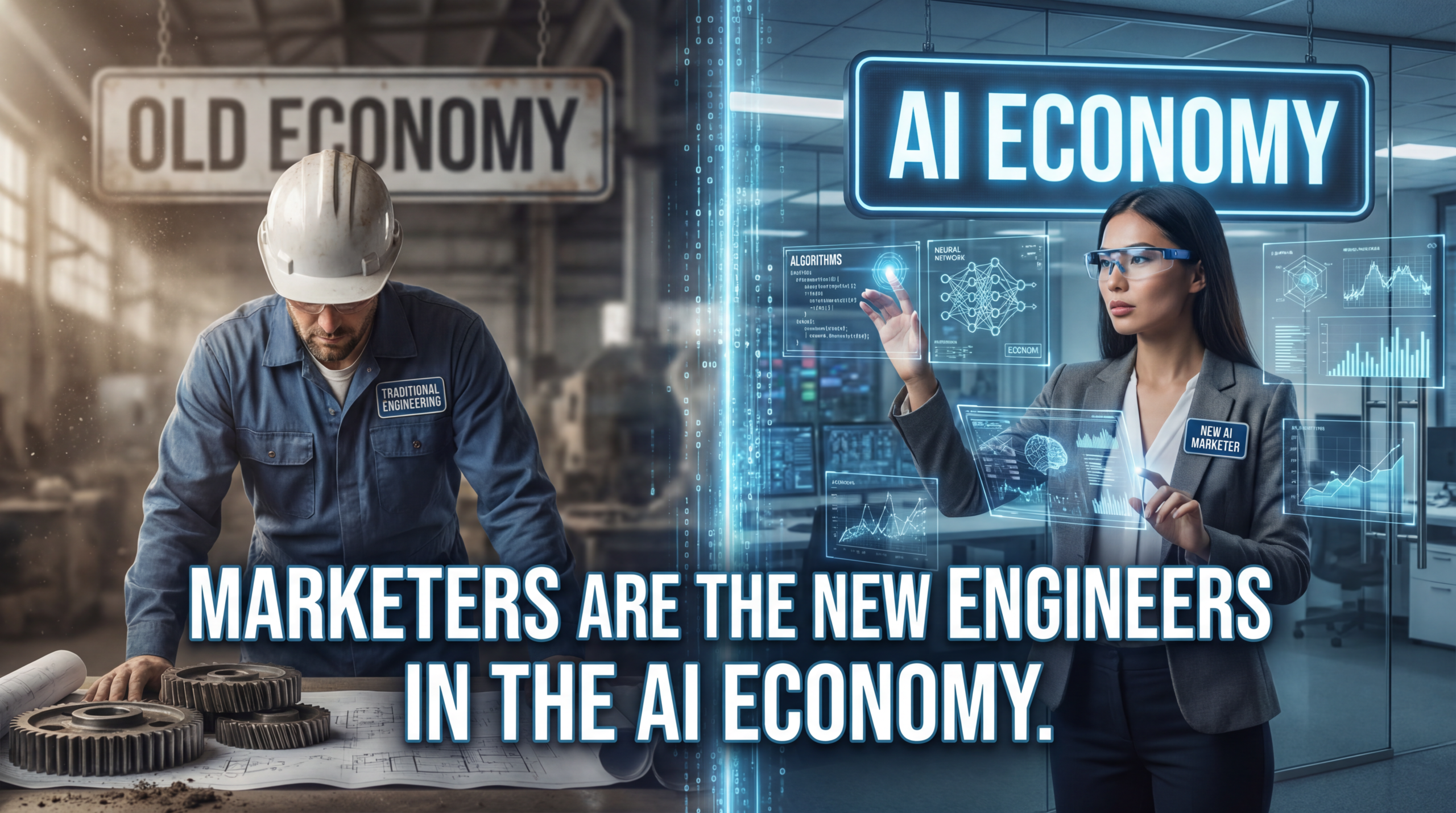
The most valuable skill in the AI era isn’t writing code. It’s knowing who to write it for — and how to make them care.
There’s a quiet power shift happening in the startup world, and most people are looking in the wrong direction to see it.
For the better part of two decades, the engineer was the undisputed king of the tech economy. The person who could build the thing — who could translate an idea into working software — held the leverage. Investors chased them. Founders courted them. Salaries ballooned. The mythology of the lone hacker in a hoodie, shipping code at 2 a.m. and changing the world, became the defining image of Silicon Valley ambition.
That image is not wrong, exactly. It’s just increasingly incomplete.
Because in 2025 and beyond, the ability to build software is no longer the scarce resource it once was. Code is becoming abundant. What remains stubbornly, almost perversely scarce is something far older and far harder to automate: the ability to make people care. The ability to build an audience, craft a narrative, and distribute an idea so effectively that it spreads on its own. In the AI economy, that skill — the marketer’s skill — is becoming the new technical leverage.
This is the argument that Greg Isenberg, CEO of Late Checkout and one of the most-followed voices in the startup-ideas space, has been making publicly and consistently. And the more you look at the data, the harder it is to dismiss.
The Abundance Problem
To understand why distribution is becoming the new moat, you first have to understand what has happened to code.
In February 2025, Andrej Karpathy — former director of AI at Tesla and one of the most respected researchers in the field — popularized the term “vibe coding” to describe a new mode of software development: describing what you want in natural language, letting an AI generate the code, and iterating until it feels right. The barrier to entry, which once required years of study and deep technical fluency, had collapsed to something closer to the ability to clearly describe what you want.
The numbers that followed were staggering. According to a Forbes report, roughly 25% of startups in Y Combinator’s Winter 2025 batch had codebases that were approximately 95% AI-generated. Product Hunt data found that 63% of vibe coding tool users are non-developers — meaning the majority of people building functional software today are marketers, product managers, and founders who never learned to write a line of code in their lives.
J.P. Morgan’s analysis of vibe coding captured the economic implication clearly: a solopreneur who once received a quote of $500,000 from a development agency was able to build and test the same product for a few hundred dollars using AI tools. “What this does is it gives you more shots on goal,” said Asif Bhatti of Replit. “As opposed to just three shots, you have 33.”
More shots on goal sounds like a good thing. And it is — for the individual founder. But zoom out, and you see the systemic consequence: when everyone has 33 shots, the shots themselves become less valuable. The product is no longer the differentiator. The product is table stakes.
This is the abundance problem. When code is cheap and fast and accessible to anyone with a clear idea and a subscription to Cursor or Replit, the competitive advantage can no longer live in the code itself. It has to live somewhere else.
Where the Moat Moved
The venture capital world has been slow to fully internalize this shift, but the signals are unmistakable.
GTMfund, a venture firm that has built its entire thesis around go-to-market strategy, operates under the explicit belief that “distribution is the final moat in the AI era.” Paul Irving, the firm’s COO, put it plainly in a January 2026 interview with TechCrunch: “Building software products has never been easier, so why are so many well-funded startups failing to take off no matter how good their product is? Startups have focused too much on product development and not enough on distribution excellence.”
The insight is not new in principle — Peter Thiel wrote about distribution being underrated in Zero to One more than a decade ago — but the urgency is new. When the cost of building a product was high, a mediocre distribution strategy could still work if the product was good enough. Now that the cost of building has collapsed, the distribution gap is the only gap that matters.
A panel of investors and founders hosted by UAtech in San Francisco made the same case from the trenches. Alyona Mysko, CEO of Fuelfinance, identified go-to-market as the new “moat” for startups, arguing that securing distribution is significantly harder than writing code. Her advice was blunt: “Start selling today, not in 6 months. You can build anything for one day, but it will take months or years for you to figure out how to find scalable go-to-market channels.”
16VC’s analysis framed it even more starkly: “A founder with 50,000 people who trust them online has more distribution power than a corporation spending $500K/month on ads. Audience is the new ad budget.” The piece went on to note that you can clone features, but you cannot clone distribution advantage — you cannot copy an audience, a community, a set of evangelists, or a narrative that has already taken root in people’s minds.
TechCrunch’s year-end review of 2025 observed that even among the largest AI companies, “the fight has moved to distribution.” Perplexity paid Snap $400 million to power search inside Snapchat, effectively buying its way into existing user funnels. OpenAI launched its own browser and expanded ChatGPT into a platform. Google leaned on incumbency, integrating Gemini directly into Calendar, Gmail, and Meet. In a market where it’s getting harder to differentiate by dropping a new model, owning the customer and the business model is the real moat.
The pattern is consistent from the smallest solo founder to the largest AI lab: the battle has moved upstream, from the product to the pipeline that delivers the product to people who want it.

The Rise of the Technical Marketer
So what does this mean for the people building companies?
It means the most valuable archetype in the AI economy is not the pure engineer and not the pure marketer. It’s the hybrid — what Greg Isenberg has called the “technical marketer” or what others are beginning to call the “vibe marketer.” Someone who understands enough about building to move fast, but whose primary leverage is their ability to package ideas, build audiences, and create distribution systems that compound over time.
The Vibe Marketer, a movement co-created by James Dickerson, Greg Isenberg, and Jordan Mix, grew from a Slack conversation in February 2025 to a global community of 2,600+ practitioners across 47 countries, with 686% search growth in under a year. The core definition they landed on: “using AI tools and workflow automation to accomplish what traditionally required large teams — enabling one marketer to execute at the level of five while maintaining strategic oversight and creative control.”
The philosophical bridge they drew was elegant. Vibe coding changed who could build software by shifting the bottleneck from “knowing syntax” to “knowing what to build.” Vibe marketing does the same thing for go-to-market: it shifts the bottleneck from “having a team of specialists” to “having a clear strategy and the ability to describe what you want.” The value, in both cases, is in knowing what to build — not how to build it.
This is a profound reframing. For decades, the marketing function was seen as downstream of the product function. Engineers built the thing; marketers explained it. The hierarchy was implicit but real. What the AI economy is doing is inverting that hierarchy — or at least flattening it dramatically. The person who can identify the right problem, frame it compellingly, build an audience around it, and then deploy AI tools to execute at scale is now more valuable than the person who can write clean code but has no idea who they’re writing it for.
Stormy AI’s analysis of vibe marketing trends noted that “the traditional wall between marketing vision and technical execution is crumbling.” For decades, a marketer’s greatest ideas often died in the “developer backlog” — a purgatory of tickets, sprints, and resource constraints. Vibe coding has eliminated that bottleneck. A marketer who can describe what they want can now build it. The constraint is no longer technical execution. The constraint is strategic clarity and creative judgment.

Greg Isenberg’s Playbook
No one has articulated this shift more practically — or built a more visible personal brand around it — than Greg Isenberg.
Isenberg is the CEO of Late Checkout, a holding company that builds and acquires community-based internet businesses. He’s an ex-advisor to Reddit and TikTok. He runs one of the top 0.1% tech podcasts. He has over 100,000 subscribers to his weekly newsletter. And he has been making the case, loudly and consistently, that content and distribution are becoming the new technical leverage in the AI economy.
His framework for growing a startup in 2025 is instructive precisely because of what it prioritizes. The first step is not “build a great product.” It’s “build a lead generation machine” — launching directories, creating knowledge bases, developing micro-tools that solve specific pain points. The second step is automation. The third is what he calls “vibe marketing” — finding content that’s already winning, amplifying it with paid ads to lookalike audiences, and creating “content triplets” from every successful piece: a thread, a blog post, and a video.
The underlying logic is that distribution is a system, not an event. Most founders treat marketing as something you do after you’ve built the product — a launch, a press release, a Product Hunt post. Isenberg treats it as something you build in parallel with the product, or even before it. “Start selling today, not in 6 months,” is advice he echoes consistently. The audience you build before you launch is the most valuable asset you can have at launch.
His post on building a $10M ARR B2B startup is particularly revealing. The section on distribution is longer and more detailed than the section on product. Phase one of his playbook — “Establish Authority Through Content” — involves flooding LinkedIn, X, and YouTube with 60-second videos solving real industry problems, publishing three platform-native posts daily, two video demonstrations weekly, and one in-depth case study monthly. The goal is not just awareness. It’s authority. It’s becoming the person in a given niche who people trust before they’ve ever seen your product.
“AI and agents let you do what used to take 10 people,” Isenberg has written. “But you still need to know what to build and who it’s for.” That last sentence is doing a lot of work. The AI handles the execution. The human provides the judgment — the taste, the positioning, the understanding of what a specific audience actually needs and how to talk to them about it.
Why Narrative Is the New Technical Leverage
There’s a deeper reason why narrative and packaging matter more in the AI economy, and it has to do with the nature of attention.
We are living through a period of extraordinary product proliferation. The same tools that allow a solo founder to build a functional SaaS product in a weekend allow thousands of other solo founders to build competing products in the same weekend. The result is a market that is simultaneously more innovative and more crowded than at any point in history. In that environment, the product that wins is rarely the best product. It’s the product that people hear about, understand, and trust first.
This is not a new insight — it’s the basic logic of branding and marketing. But the AI economy has accelerated the dynamic to a degree that makes it qualitatively different. When product cycles compress from years to weeks, the window in which a technical advantage can be sustained shrinks to near zero. The only advantages that compound over time are the ones that are hard to copy: audience, community, narrative, trust.
Andreessen Horowitz’s State of Consumer AI 2025 report made a related observation about the competitive landscape among AI labs: “Model companies don’t have the intuition or, quite frankly, the attention and resources to be innovating outside their areas of core competency.” The implication is that the white space in the AI economy is not in building better models — it’s in building better distribution, better packaging, better consumer experiences around models that already exist. The founders who win will be the ones who understand their audience deeply enough to build something those people actually want to use, and who have the distribution to reach them.
This is exactly the kind of work that marketers have always done. The difference is that in the past, marketers needed engineers to execute their ideas. Now, increasingly, they can execute those ideas themselves.
The Founder as Media Operator
The logical endpoint of this argument is one that makes many traditional founders uncomfortable: the best AI founders may need to think like media operators.
This is not a metaphor. It’s a description of what the most successful builders in the current environment are actually doing. Pieter Levels, the Dutch indie hacker who built a real-time multiplayer flight simulator in JavaScript and then monetized it by selling in-game advertisements to his large Twitter following, is the canonical example. The product was interesting. The distribution — a pre-existing audience of tens of thousands of people who trusted him — was the actual business.
The pattern repeats across the most successful solo founders and small teams of the current era. They are not just building products. They are building audiences first, then building products for those audiences. They are treating content not as a marketing afterthought but as a core business function — a distribution engine that compounds over time and creates a moat that no amount of engineering talent can replicate.
Greg Isenberg has built his entire business model around this insight. Late Checkout is not primarily a software company. It is a media and community company that happens to build software. The newsletter, the podcast, the Twitter presence, the YouTube channel — these are not marketing for the products. They are the products, or at least the distribution infrastructure that makes all the other products viable.
His framework for building an audience from zero in 2025 is essentially a media playbook: pick one painful problem and one platform, create daily micro-insights, make people laugh or learn, test different formats and styles, create swipe files of winning formulas, and build a distribution machine that amplifies what works. This is not how engineers think about building companies. It is how media operators think about building audiences.
The distinction matters because the skills required are different. Building a great product requires deep technical knowledge, systems thinking, and the ability to manage complexity. Building a great audience requires empathy, taste, consistency, and the ability to communicate clearly about things that matter to specific people. These are not the same skills, and for most of the history of the tech industry, they have lived in different people.
What the AI economy is doing is making it possible — and increasingly necessary — for them to live in the same person.
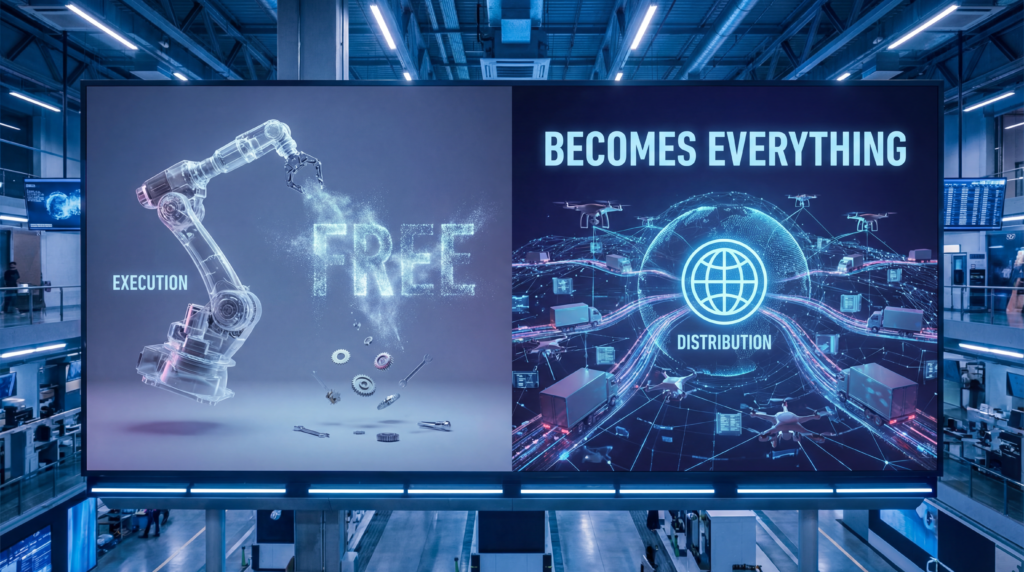
The Limits of Vibe Coding (and Why They Reinforce the Argument)
It’s worth pausing here to acknowledge the counterargument, because it’s real and it’s important.
TechStartups’ deep investigation into the vibe coding backlash documented what happened when founders confused speed with engineering: AI coding usage fell 76% in 12 weeks across several major platforms, and an estimated 10,000 startups that tried to build production apps with AI assistants now need rebuilds or rescue engineering, with costs ranging from $50,000 to $500,000 each. The total cost of AI-generated technical debt, by some estimates, runs into the billions.
Alex Turnbull, founder of Groove, was blunt: “VibeCoding isn’t just bullshit. It’s expensive bullshit that is actively a disaster for thousands of startups.” His team spent 12 months building two enterprise-grade AI products and found that real engineering — the kind that handles security, scalability, multi-tenant architecture, and the thousand other things that matter when real users touch your product — could not be replaced by AI-generated code.
This is a genuine and important caveat. The argument that marketers are the new engineers is not an argument that engineering doesn’t matter. It’s an argument about where the leverage has shifted. Engineering still matters enormously for building products that work at scale, that handle real data, that don’t fall apart under load. What has changed is that the entry point — the ability to build something that demonstrates value, attracts early users, and validates a market — no longer requires deep engineering expertise. And the moat — the thing that makes a business defensible over time — is no longer primarily technical.
The founders who will win are not the ones who abandon engineering for marketing, or marketing for engineering. They are the ones who understand that in the current environment, distribution is the constraint, and who build their companies accordingly — treating audience-building and content as first-class business functions, not afterthoughts.
What “Technical Marketer” Actually Means
The term “technical marketer” risks being dismissed as a buzzword, so it’s worth being specific about what it actually describes.
A technical marketer in the AI economy is someone who:
Understands the product deeply enough to talk about it credibly. This doesn’t mean they can write the code. It means they understand what the product does, why it matters, and what makes it different — well enough to explain it to someone who has never heard of it, in terms that make that person want to try it.
Can build distribution systems, not just campaigns. The difference between a campaign and a system is compounding. A campaign runs, generates some results, and ends. A system — a newsletter, a podcast, a YouTube channel, a community — generates results that compound over time. Technical marketers build systems.
Uses AI to execute at the speed of thought. The vibe marketing framework is essentially about collapsing the gap between idea and execution. A technical marketer can take an insight, turn it into a thread, a blog post, a video, and a lead magnet in the time it used to take to write a brief for a content team. They use tools like Claude, Gumloop, n8n, and Zapier not as novelties but as core infrastructure.
Treats distribution as a data problem. Greg Isenberg’s advice to “ship 10+ hooks a day and let the algorithm tell you which one wins” is not a content strategy. It’s an engineering mindset applied to distribution — rapid iteration, data-driven decision-making, systematic testing of hypotheses. Technical marketers think about audience-building the way engineers think about product development: as a system to be optimized, not an art to be practiced.
Builds in public. The most effective distribution strategy in the current environment is building in public — sharing the process, the failures, the insights, the behind-the-scenes reality of building a company. This creates trust, generates content, and builds an audience simultaneously. It requires a willingness to be visible and vulnerable that many engineers find uncomfortable. Technical marketers have learned to embrace it.
The Compounding Advantage
Here is the thing about distribution that makes it more valuable than code in the long run: it compounds.
A codebase can be copied. A feature can be replicated. A technical architecture can be reverse-engineered. But an audience that trusts you — a community of people who open your emails, watch your videos, share your content, and buy your products — cannot be copied. It took years to build, and it will take years for a competitor to build something comparable.
This is why the most valuable AI companies of the next decade will not necessarily be the ones with the best models or the most sophisticated engineering. They will be the ones with the best distribution — the ones that have built the deepest relationships with the most valuable audiences, and that have created the most compelling narratives around what they’re building.
GTMfund’s thesis is that “distribution is the last sustainable competitive advantage” in the AI era. The reasoning is straightforward: technical moats erode quickly because the tools to build them are available to everyone. Distribution moats erode slowly because they are built from trust, and trust takes time.
The founders who understand this are already acting on it. They are investing in newsletters before they have products. They are building YouTube channels before they have customers. They are treating every piece of content as an asset that will compound over time, not a task to be completed and forgotten. They are, in the most literal sense, thinking like media operators.
The Uncomfortable Implication
There is an uncomfortable implication buried in all of this, and it’s worth naming directly.
If distribution is the new moat, and if the ability to build audiences and craft narratives is the new technical leverage, then the people who have been doing this work for decades — the marketers, the writers, the community builders, the storytellers — have been systematically undervalued by an industry that fetishized engineering.
The AI economy is not just changing what skills matter. It is changing who has power. The person who spent the last ten years building an audience of 100,000 people who trust their judgment about a specific domain is, in the current environment, more valuable than the person who spent the last ten years mastering a programming language that AI can now write fluently.
This is not a comfortable thing to say in a culture that has spent decades celebrating the engineer as the hero of the innovation economy. But the data is pointing in one direction, and the most successful founders of the current era are already living in the world it describes.
Greg Isenberg has been saying this for years. The vibe marketing movement has been saying it for months. The venture capital firms that are rewriting their investment theses around distribution are saying it with their money.
The most valuable AI skill isn’t coding. It’s distribution. And the founders who internalize that truth — who build their companies as media operations first and software companies second — are the ones who will define the next decade of the tech economy.
What to Do With This
If you’re a founder, the practical implications are clear.
Start building your audience before you build your product. The audience you have at launch is the most valuable asset you can bring to a launch. If you don’t have one, start building one now — pick one painful problem, pick one platform, and show up every day with something useful.
Treat content as infrastructure, not marketing. A newsletter, a podcast, a YouTube channel — these are not nice-to-haves. They are distribution systems that compound over time and create moats that no amount of engineering talent can replicate.
Learn to use AI to execute at the speed of thought. The gap between idea and execution is collapsing. The founders who can take an insight and turn it into a thread, a blog post, a video, and a lead magnet in an afternoon are operating at a different speed than the ones who are still writing briefs for content teams.
Think like a media operator. Ask yourself: if my company were a media company, what would it publish? Who would read it? Why would they trust it? The answers to those questions are the foundation of your distribution strategy.
And finally: remember that the goal is not to become a marketer instead of a builder. The goal is to become a builder who thinks like a marketer — who understands that in the AI economy, the product is only as valuable as the audience you can put it in front of, and that building that audience is the hardest and most important work you can do.
The engineers built the last decade of the tech economy. The technical marketers will build the next one.