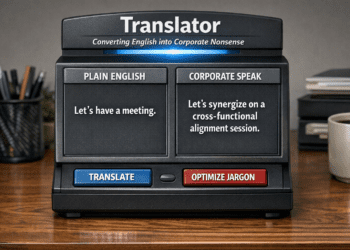
A deep dive into Kagi’s viral “LinkedIn Speak” feature, the AI-powered engine turning “I’m hungry” into a strategic nutritional alignment roadmap
There is a special breed of internet creation that feels less like a product launch and more like someone finally saying out loud what the rest of us have been thinking for years. The wheel was one. Sliced bread was another. And now, nestled between those two pillars of human ingenuity, sits Kagi’s LinkedIn Speak Translator.
Let me set the scene. It’s a Tuesday. You’ve just eaten a banana. In the pre-Kagi era, you might have mentioned this to nobody, because eating a banana is not news. It is a banana. You peeled it. You ate it. Life continued. But in the post-Kagi era — in this bold, optimized, synergy-forward era we now inhabit — you can transform that banana-eating experience into the following LinkedIn post:
“I’m thrilled to announce that I’ve successfully completed the consumption of a high-potassium superfruit today. This experience reinforced the importance of consistent fueling and maintaining a growth-oriented nutritional strategy to optimize peak performance. How are you fueling your journey today? Let’s connect and discuss sustainable energy for high-impact results! #GrowthMindset #PeakPerformance”
You’re welcome. Your Tuesday just became a thought leadership moment.
The Origin Story (Every LinkedIn Post Has One)
Kagi is a privacy-focused search engine that has been quietly building a suite of tools for people who are tired of the ad-saturated internet. Among its offerings is Kagi Translate, a web-based translation tool that does the sensible things you’d expect — Spanish to English, French to Japanese, that kind of thing.
And then, presumably, someone on the Kagi team had a thought. A chaotic, beautiful, deeply unhinged thought: What if we added LinkedIn Speak as a target language?
Reader, they did it.
The feature went viral almost immediately, spreading across X/Twitter, Reddit, and — deliciously — LinkedIn itself, where people were posting the satirical outputs ironically and, if we’re honest, probably also somewhat sincerely. NDTV Profit covered the viral moment, noting that “most posts poked fun at how LinkedIn users often exaggerate even the simplest achievements for social media effects.”
The Hacker News thread that followed became a goldmine of user-submitted examples, each one more absurd than the last, each one also somehow indistinguishable from an actual post you’ve seen this week.
The internet’s collective reaction, as summarized by one commenter, was simply: “Babe wake up, someone created Google Translate for LinkedIn.”
How It Works (The Technical Bit, Made Palatable)
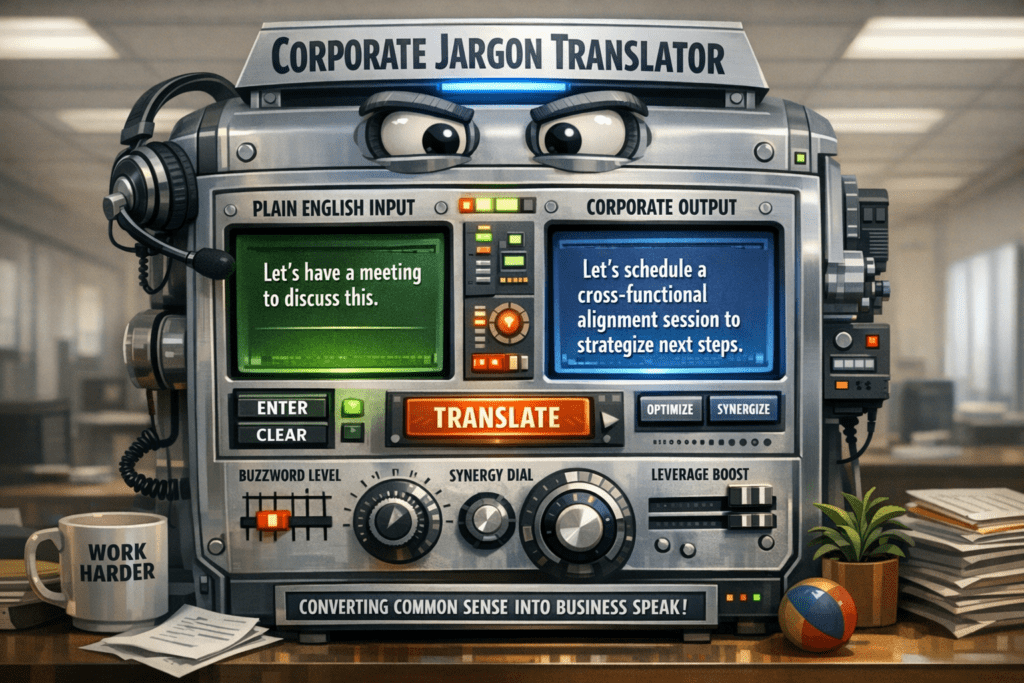
At its core, Kagi Translate operates like most modern translation tools — with one notable twist. The interface is clean and familiar: you select your source language (English, presumably, though we’ll get to that), you select your target language (LinkedIn Speak), you type your text into the input box, and you press Translate.
Behind the scenes, Kagi routes your input to a large language model (LLM) — the same class of AI that powers ChatGPT, Claude, and the rest of the conversational AI ecosystem you’ve definitely been reading about in every newsletter since 2022. The model has been prompted, configured, or fine-tuned to respond in the distinctive register of LinkedIn posts: maximally optimistic, lavishly buzzworded, relentlessly self-promotional, and inexplicably grateful for everything, including the Tuesday banana.
The flowchart is genuinely simple:
- You type something normal into the box at translate.kagi.com.
- Kagi sends it to an AI model with instructions to perform the LinkedIn-ification.
- The AI produces a reworded version, injecting buzzwords, formal tone, and motivational clichés at a rate that would make a McKinsey consultant weep with recognition.
- The output appears on screen, and you feel simultaneously amused, horrified, and seen.
There’s a Standard/Best toggle for output quality, which likely affects the underlying model or its decoding settings. Presumably “Best” means more LinkedIn, which is a sentence I did not expect to write today but here we are.
One particularly delightful discovery from the Hacker News community: you can also put LinkedIn Speak as the source language and translate back to plain English. Which means if you’ve ever read a LinkedIn post and thought but what does this actually mean, there is now a tool for that. We live in an age of miracles.
A Taxonomy of Transformation: Or, How Your Perfectly Reasonable Sentence Gets Ruined
The translator doesn’t randomly sprinkle corporate words onto your input like parmesan on a pasta. It applies systematic transformations across multiple linguistic dimensions. Let’s break them down, because nothing says “LinkedIn” like turning a fun thing into a structured framework.
1. Buzzword Injection
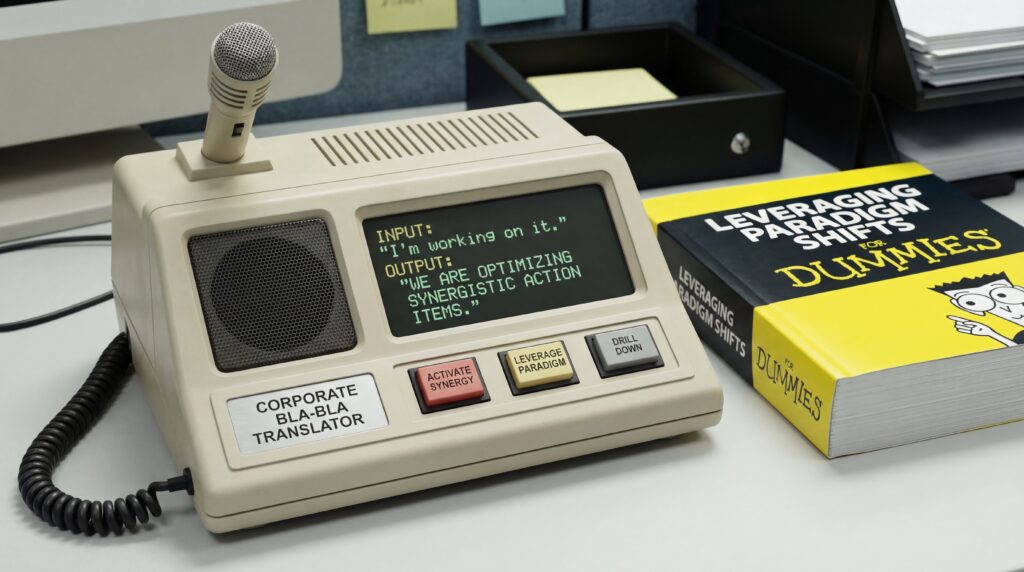
This is the signature move. The translator replaces normal words with their corporate-approved synonyms, a process that reads less like translation and more like passing your sentence through a business school mixer.
“Help” becomes “leverage your expertise.” A “break” becomes “logistical challenges.” The word “complain” — apparently too honest and direct for LinkedIn — becomes “out-of-the-box thinking.” (Which, to be clear, is the exact phrase you’d use on LinkedIn to describe an idea that everyone in the room thinks is terrible but nobody wants to say so.)
The full vocabulary list of preferred terms reads like the index of a 2019 startup pitch deck: optimize, synergy, ecosystem, pivot, roadmap, stakeholders, leverage, metrics, strategic, alignment, mission, core values, high-impact. These words appear constantly, interchangeably, and with a confidence that suggests the model has absorbed approximately twelve thousand LinkedIn posts and emerged from the experience believing they were literature.
The most illuminating example might be this one, sourced from the NDTV coverage: the Hindi movie line “Thakur ye hath mujhe de de” — a dramatic, culturally specific request for someone’s hands — was rendered by the translator as:
“Thakur, I’m looking to leverage your expertise and hands-on leadership for this strategic initiative.”
It works. It absolutely, terrifyingly works.
2. Elevated Formal Tone (Or: The Art of the Run-On)
Simple sentences become complex ones. Short statements grow subordinate clauses like barnacles. The translator appears constitutionally incapable of saying anything in fewer words than absolutely necessary, which is, of course, the defining feature of LinkedIn posts everywhere.
Consider the test input “I took a dump,” which — and I cannot stress this enough — is perhaps the most perfect sentence ever submitted to a translation engine. The output was:
“I just completed a high-impact, end-to-end internal optimization process. It’s all about streamlining the system, letting go of what no longer serves the mission, and making room for the next big deliverable. Grateful for the opportunity to decompress and refocus on the core objectives. #Efficiency #GrowthMindset”
This is, structurally, a perfect LinkedIn post. It has the reflective opening. It has the three-part insight structure. It has the gratitude moment. It has the hashtags. If you replaced “internal optimization process” with “my last role” and posted it tomorrow, someone would give it three thousand likes and ask if you’re available for a webinar.
3. Positive/Excited Emotional Language
The translator maintains an unflinching commitment to positivity that borders on delusional, and is therefore entirely authentic to its source material. Every output is saturated with words like “thrilled,” “excited,” “grateful,” and “honored.” The model appears to have decided that the world is, universally and without exception, wonderful, and that every moment — from eating a banana to what we’ll diplomatically call completing an internal optimization process — deserves a standing ovation.
The template is remarkably consistent: “I’m thrilled/excited to announce/share that…” followed by whatever you typed, reframed as a triumph of the human spirit.
“Fuck it, I quit!” — a sentence vibrating with the raw energy of someone who has had enough — was translated into:
“I’m excited to announce that I’m starting a new chapter! After much reflection, I’ve decided to step away from my current role to focus on personal growth and new challenges. Grateful for the journey and the lessons learned. Onward and upward! #NewBeginnings #CareerGrowth”
The translator has performed a miracle here. It took what was essentially a two-word resignation and a single expletive, and produced something that sounds like it was drafted by a PR firm, approved by legal, and reviewed by a life coach. The original emotion — frustration, liberation, probably some relief — has been successfully laundered into pure aspiration.
4. The Humblebrag Framework
LinkedIn posts occupy a peculiar space in the history of human communication. They are, structurally, acts of self-promotion. But they cannot appear to be acts of self-promotion, because that would be crass. Instead, they must present themselves as moments of humble reflection, grateful acknowledgment, and reluctant self-disclosure.
“I got a promotion” is brag. “I’m humbled and grateful to share that I’ve been entrusted with new responsibilities in my continued journey of growth” is LinkedIn.
The translator understands this distinction at a deep level. Even an input like “I updated a README” — genuinely one of the least glamorous things a developer can do, a task so routine it barely registers — emerged as:
“I’m thrilled to share that I’ve just optimized our project’s core documentation to enhance clarity and streamline onboarding for the entire team. Documentation is the backbone of scalable engineering, and I’m committed to ensuring our technical assets reflect the highest standards of excellence.”
A README. The backbone of scalable engineering. Committed to the highest standards of excellence. For a README.
This is peak humblebrag. This is the form perfected.
5. Hashtag Finales
Every output ends with hashtags, because of course it does. The hashtags serve as punctuation, benediction, and SEO strategy all at once. #GrowthMindset, #Leadership, #Innovation, #CareerGrowth, #NewBeginnings, #PeakPerformance — they appear with the certainty of a sunrise, tagging the post into LinkedIn’s algorithmic ecosystem where other growth-mindset warriors will engage with a like, a fire emoji, or the devastating “Insightful” reaction.
What’s particularly funny about the hashtags is their complete detachment from specificity. The banana gets #GrowthMindset. The bathroom break gets #GrowthMindset. The resignation gets #NewBeginnings and #CareerGrowth. If the tool had been used to translate “The stock market crashed today,” it would almost certainly have ended with #GrowthMindset. The hashtag is universal. The hashtag is inevitable. The hashtag is the amen at the end of the corporate prayer.
The Full Table of Examples (With Commentary)
Here are the translations in their full glory, pulled from actual user-submitted examples via NDTV and the Hacker News thread, with brief annotations:
| Original | LinkedIn Speak | What It’s Really Saying |
|---|---|---|
| “I want to go home.” | “Reflecting on the importance of work-life integration and the value of returning to one’s personal sanctuary to recharge for the next day’s challenges.” | I am tired. I would like to leave. |
| “I’m hungry.” | “Excited to announce that I am currently prioritising my personal fuel intake and focusing on whole-person wellness to ensure maximum professional performance.” | Please, for the love of God, feed me. |
| “Cab is running late, ETA 8AM.” | “My cab is currently facing logistical challenges. This delay is a powerful reminder that agility and adaptability are key.” | I am going to be late to the meeting. This is not a lesson. This is traffic. |
| “Do not go gentle into that good night.” | “Don’t just settle for the status quo as you approach the end of your career journey. Keep grinding. Stay hungry.” | Dylan Thomas is rotating in his grave at approximately 4,000 RPM. |
| “That is the dumbest idea I’ve heard in a long time.” | “I appreciate the out-of-the-box thinking here, but I’m not sure this aligns with our current strategic roadmap.” | This is a bad idea. I am declining to say that directly. |
| “I am in crisis.” | “I’m thrilled to share that I am a passionate, results-driven professional dedicated to continuous growth and delivering high-impact value in everything I do.” | Please help me. |
That last one is perhaps the most revealing. The gap between “I am in crisis” and the LinkedIn output isn’t just comedic — it’s a precise demonstration of what LinkedIn culture actually asks of people: perform relentless positivity, suppress authentic expression, and frame everything — everything — as a demonstration of your commitment to delivering high-impact value.
Why This Is Funny: A Completely Unnecessary Academic Breakdown
The humor operates on several levels simultaneously, and since we’re here anyway, let’s over-analyze it. That’s the LinkedIn way.
Incongruity. The foundational mechanism of humor is incongruity — the collision of two things that don’t belong together. A banana and a strategic nutritional framework. A bathroom visit and an end-to-end optimization process. The gap between the ordinary and the grandiose is where the laugh lives, and the translator has an almost supernatural instinct for maximizing that gap.
Satire by amplification. The tool doesn’t invent anything new. Every phrase it generates — “growth mindset,” “leverage expertise,” “core values,” “high-impact results” — exists in the wild, right now, on LinkedIn, in posts being written and liked and shared by real human beings who mean them sincerely. The translator’s trick is to apply this language to contexts that expose its absurdity. When “I took a shit” becomes “an internal optimization process,” the joke isn’t just about bathroom humor. It’s about the fact that the phrase “end-to-end optimization process” was already meaningless before it was applied to this scenario.
Register shift. There’s a specific kind of comedy that comes from extreme mismatches in register — the formal responding to the casual, the corporate absorbing the human. The translator’s consistent refusal to acknowledge any difference between “I’m hungry” and “I’m grateful to announce a new chapter in my career journey” is itself the joke. It treats all inputs as equally worthy of the LinkedIn treatment, which is funny because LinkedIn treats all inputs as equally worthy of the LinkedIn treatment.
The humblebrag as a genre. LinkedIn invented a specific literary form — the humblebrag disguised as gratitude — and the translator has mastered it completely. Every output performs the same ritual: acknowledge the achievement, frame it as humble, gesture toward growth, express gratitude, add hashtags. It’s a formula. And when you can see the formula this clearly, the formula becomes ridiculous, which is uncomfortable, because you’ve definitely used the formula yourself.
How to Use It (A Step-by-Step Guide for the Truly Chaotic)
In the spirit of providing actual value (a phrase the translator would render as “delivering high-impact actionable frameworks”), here’s how to use Kagi Translate:
- Navigate to translate.kagi.com. Ensure you’re on the “Text” tab.
- Set your source language to English and your target language to “LinkedIn Speak.” It may appear abbreviated as “LI Speak” in some versions of the interface.
- Type or paste your text. The tool accepts up to 20,000 characters, so you could theoretically paste an entire novel and receive it back as a series of professional milestones. You probably shouldn’t, but you could.
- Toggle quality if desired. The Standard/Best toggle affects output quality — “Best” likely uses a more capable model and produces more elaborate, subtly worded outputs.
- Click Translate. The LinkedIn-speak version appears immediately.
- Copy and share. The output is yours to do with as you please. Post it ironically. Post it sincerely. Post it somewhere it will cause the maximum amount of delighted confusion.
Pro tips from the community:
- Simple, concrete inputs produce the funniest outputs. The more absurd or mundane your original text, the more spectacular the transformation. Single sentences, casual observations, or lines from movies work especially well.
- Profanity translates magnificently. The contrast between raw language and corporate polish is maximum here. “Fuck it, I quit” → new chapter announcement is a near-perfect demonstration.
- Try the reverse. Paste a real LinkedIn post as the source in LinkedIn Speak and translate it to plain English. The deflation is equally comedic.
- Movie quotes and idioms are excellent inputs. As demonstrated by the Dylan Thomas example, classic literature becomes motivational content instantly. Imagine what the tool would do with Crime and Punishment. On second thought, don’t — someone might actually post it.
Prompt Variations: For When You Want More Control Over Your Corporate Nonsense
While Kagi’s implementation is fixed to one style, you can experiment with variations using AI chat tools like ChatGPT or Claude by adjusting your prompt. Here are some flavors worth trying:
Humblebrag mode:
“Translate this into humblebrag LinkedIn speak: I got promoted, and I’m genuinely proud of myself.”
Inspirational mode:
“Rewrite as a motivational LinkedIn post: I failed at something important, but I learned from it.”
Corporate-speak maximum:
“Convert this into full corporate buzzword LinkedIn style: We launched a product.”
The apology that isn’t really an apology:
“Write in LinkedIn style: We made a mistake that cost clients money.”
That last one, if you’re curious, would likely emerge as something like: “We’re grateful for the opportunity this unexpected situation has provided to double down on our commitment to client-centric excellence and implement robust frameworks for future resilience. #Growth #Leadership”
Not an apology. Not even close to an apology. But exactly what LinkedIn sounds like.
The Limits of the Joke (Or: When the Satire Gets Complicated)
No good satire is without complications, and the LinkedIn Speak translator has a few worth noting.
The sanitization problem. The tool is extraordinarily good at making bad things sound fine. One user example noted that “I’ll murder my colleague” was rendered as something to the effect of “I’ll be permanently offboarding a team member” — which is, grammatically and tonally, the kind of sentence a VP of People Operations might actually write in an internal memo. The translator’s commitment to positive framing means it will take almost any input, however dark or problematic, and dress it in business casual.
This is funny in the context of a satirical tool. It becomes less funny if you consider that the same mechanism — reframing harmful or difficult realities in smooth corporate language — operates constantly in actual corporate communications. The translator is satirizing something that isn’t entirely fictional.
Privacy and data. As with any online translation tool, your inputs are processed by Kagi’s servers. You shouldn’t paste sensitive personal information, confidential business data, or anything you’d be uncomfortable sharing with a third-party service. The LinkedIn Speak translator is a novelty feature, not a secure document processing tool.
The misuse potential. Someone, somewhere, is absolutely using this to generate genuine LinkedIn posts. The outputs are good enough — earnest enough, well-structured enough, buzzword-dense enough — that they could pass as authentic thought leadership content. Which raises the mildly existential question: if an AI generates a LinkedIn post that is indistinguishable from a human LinkedIn post, does it matter which is which? Is authentic LinkedIn speak even authentic LinkedIn speak?
We’ll leave that one to the philosophers. Or the LinkedIn algorithms. Whoever gets there first.
The bias question. As with all large language models, the translator’s outputs reflect the training data it was built on. LinkedIn’s culture — like most professional social media — skews heavily toward specific demographics, industries, and communication styles. The “LinkedIn voice” the tool imitates is not universal; it’s particular. And when it’s applied to inputs from outside that cultural context (like the Hindi movie line that became a “strategic initiative”), the result is funny partly because of that mismatch. Worth being aware of.
Who Is This For, Really?
Meme-makers and social media users. This is the primary constituency. The screenshots are shareable, the outputs are quotable, and the tool provides near-instant comedic content. The Hacker News thread and the NDTV coverage both document how rapidly the outputs spread across platforms.
Writers and satirists. If you’re writing about corporate culture, the future of work, hustle culture, or professional social media, this tool is a research instrument disguised as a joke. The outputs are genuine artifacts of what AI trained on LinkedIn content produces when asked to perform LinkedIn. That’s sociologically interesting.
Educators. There is a genuinely useful exercise buried in here. Ask students to translate a clear, direct sentence into LinkedIn Speak, then back-translate it to plain English. The information lost in transit — the specificity, the honesty, the actual meaning — is a concrete demonstration of how jargon obscures communication. It’s a lesson in clarity dressed up as a joke.
People who work in offices. Use this at your next team offsite. Enter the mission statement. Enter the Q3 goals. Enter your CEO’s email about returning to the office. The results will either be indistinguishable from the originals or slightly more coherent. Either way, you’ll learn something.
The Bigger Picture: What We’re Actually Laughing At
The viral spread of the Kagi LinkedIn Speak translator isn’t really about the tool. The tool is a mirror. What it reflects — and what people are actually laughing at — is a mode of professional communication that has become so detached from meaning that it can be perfectly replicated by an AI model trained to optimize for tone over substance.
LinkedIn posts, at their most formulaic, are not communications. They are performances. They are demonstrations of professional identity, vectors for engagement metrics, and rituals of belonging in a community that values hustle, growth, and the appearance of continuous self-improvement. The translator succeeds as satire because the register it imitates is already performative. It is, in a sense, translating performance into performance — just with the source material made visible.
When “I took a shit” becomes an internal optimization process, the joke works because somewhere on LinkedIn, right now, someone is describing something equally mundane in equally grandiose terms. And getting fourteen thousand likes for it.
The translator doesn’t invent the language. It just makes sure we can see it clearly.
Final Thoughts (A Conclusion That Will Be Rewritten Into LinkedIn Speak in the Comments, Inevitably)
Kagi has built something that is simultaneously a joke, a tool, a sociological mirror, and an accidental commentary on AI capabilities. It works as satire because it works as translation — the model is genuinely good at capturing the voice it’s imitating, which is itself a testament to how formulaic that voice has become.
The fact that a banana can be translated into a thought leadership moment, that a bathroom break can be an optimization process, that “fuck it, I quit” can become a new chapter announcement — all of this is funny. But it’s funny the way good satire is always funny: uncomfortably, with a small knot of recognition somewhere underneath the laughter.
Go try it at translate.kagi.com. Enter something mundane. Watch it become profound.
And when you share the screenshot, remember: you’re not just sharing a meme. You’re leveraging a high-impact content delivery mechanism to drive authentic engagement with your network and reinforce your personal brand as a curator of innovative digital experiences.
#GrowthMindset #ThoughtLeadership #Onward