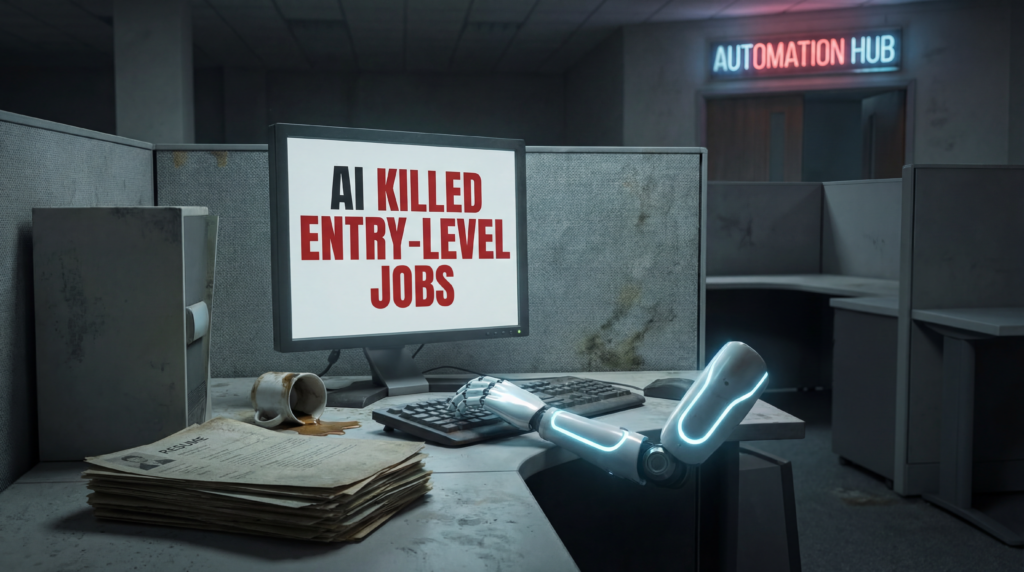
The “AI ate junior roles” narrative is satisfying. It’s also only about half the story.
There is a story doing the rounds in tech circles, LinkedIn posts, and cable news panels that goes something like this: generative AI arrived, companies realized they could automate the grunt work that used to fall to junior analysts and entry-level coders, and now a generation of recent graduates is locked out of the workforce. The story has a villain, a victim, and a clear causal arc. It is, in other words, a perfect media narrative.
And like most perfect media narratives, it is somewhat true, significantly incomplete, and dangerously misleading if you act on it without reading the footnotes.
The actual picture — if you pull the data, go back to first principles about how labor markets function, and resist the gravitational pull of a clean storyline — is far messier. Yes, there is real and measurable pain hitting early-career workers in AI-exposed occupations. A landmark study from Stanford’s Digital Economy Lab documented it in remarkable detail. But the broader hiring slowdown for young workers isn’t confined to AI-exposed roles. It spans industries. It touches both college graduates and people without degrees. And it has roots in macro forces — post-pandemic over-hiring, rising interest rates, a generational demographic blockage, and structural shifts in how companies think about headcount — that existed long before ChatGPT became a household name.
This matters for a very specific reason: if you’re a founder, an operator, or a young professional trying to navigate this market, the “AI killed entry-level jobs” frame will send you in the wrong direction. It will make you either fatalistic or laser-focused on the wrong variable. The real question isn’t whether AI changed the entry-level labor market. It did. The real question is how, and in which direction the new openings are actually pointing.
That’s what this piece is about.
The Numbers That Launched a Thousand Think Pieces
Let’s start with the data that everyone is citing, because it is genuinely alarming and deserves to be taken seriously on its own terms.
In August 2025, Erik Brynjolfsson, one of the world’s leading economists of technology, published a paper with colleagues Bharat Chandar and Ruyu Chen at the Stanford Digital Economy Lab that shook the labor economics community. The study, titled “Canaries in the Coal Mine? Six Facts about the Recent Employment Effects of Artificial Intelligence,” drew on high-frequency payroll records from millions of American workers via ADP — the largest payroll software provider in the United States — across tens of thousands of firms.
This wasn’t a survey. It wasn’t self-reported LinkedIn data. It was the closest thing we have to a real-time, ground-level X-ray of the American labor market.
The findings were striking. Since the widespread adoption of generative AI, early-career workers between the ages of 22 and 25 in the most AI-exposed occupations experienced a 16 percent relative decline in employment — even after controlling for firm-level shocks. In absolute terms, entry-level workers in those occupations saw a 6% decline in employment from late 2022 to July 2025. During the same period, workers aged 30 and over in the same occupations saw employment grow between 6 and 12 percent.
Read that again. The same occupations. Very different outcomes by age cohort. The gap between young and experienced workers in AI-exposed fields wasn’t just a story of the labor market cooling — it was a story of the labor market cooling very specifically for people who were new to it.
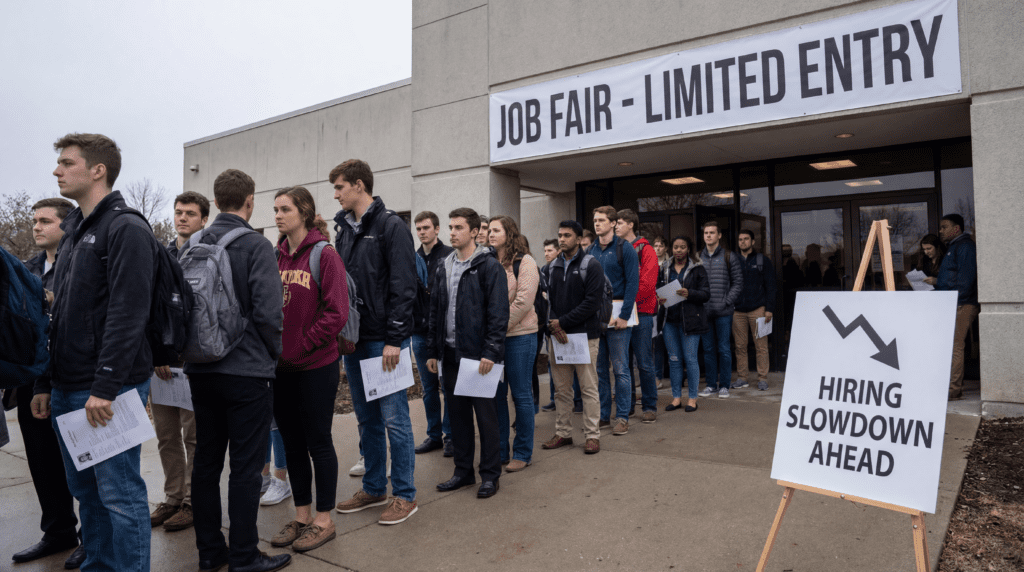
Other data points tell a similar story at the industry level. Entry-level hiring at the 15 biggest tech firms fell 25 percent from 2023 to 2024, according to a SignalFire report. In the UK, tech graduate roles fell by 46 percent in 2024, with projections for a further 53 percent drop by 2026, according to the Institute of Student Employers. Revelio Labs, a labor research firm, found that postings for entry-level jobs in the US plunged 35 percent from January 2023 to June 2025. The Stepstone Group, analyzing 4 million job ads across Europe, found that in Q1 2025, the share of jobs listed as “entry-level” was 45 percent below the five-year average.
The US unemployment rate for recent college graduates aged 20 to 24 sat at 9.5 percent by September 2025, according to IntuitionLabs’ analysis of Bureau of Labor Statistics data — nearly double the general adult unemployment rate, and a level not seen outside of the pandemic shock of 2020.
So something is clearly wrong. The question is whether the diagnosis is correct.
Why “AI Stole Junior Jobs” Is Only Part of the Story
Here’s where the narrative gets complicated, and where intellectually honest analysis has to slow down.
The Stanford paper — which is the most rigorous large-scale study we have on this topic — contains a careful and often overlooked set of caveats. The authors repeatedly stress that the “overall impact of AI on aggregate employment is likely small right now.” As Chandar wrote in a blog post for the Stanford Digital Economy Lab, the evidence suggests “overall hiring has not declined meaningfully due to AI.” The large, statistically significant effects are concentrated among workers aged 22 to 25 in the most AI-exposed occupations — not across the board.
This is a crucial distinction. When the headline says “AI is killing entry-level jobs,” it implies a widespread, cross-industry phenomenon driven by a single technological cause. The data says something more specific: early-career workers in a handful of AI-exposed, often software- and services-adjacent occupations are getting hit hardest. Workers in nursing, skilled trades, construction, food service, and physical healthcare are not in the same boat.
But there’s a deeper problem with the pure AI narrative: employment has also declined for young workers in occupations that are not heavily AI-exposed. The broader hiring slowdown for workers aged 22 to 25 is real across the economy, not just in software engineering and customer service. As Hessie Jones argued in Forbes, the decline in entry-level hiring began with post-pandemic economic shifts and monetary tightening long before AI became a dominant force. Tech job postings fell 36 percent below pre-pandemic levels as of mid-2025 — a decline that started in 2022, when the Federal Reserve began its aggressive rate-hiking cycle, not in late 2022 when ChatGPT launched.
This matters enormously. If the hiring slowdown was purely AI-driven, we’d expect it to be tightly correlated with AI exposure. But if it’s also driven by macroeconomic factors — interest rates, corporate spending pullbacks, a post-pandemic correction from over-hiring — then the AI explanation is at best partial and at worst a convenient scapegoat for decisions that had other origins.
The truth is almost certainly a mixture of both. AI has contributed to the slowdown, particularly in software development and clerical roles. But it has been accelerating a trend that macro forces had already set in motion.
The Post-Pandemic Over-Hiring Hangover
To understand why so many companies are not hiring junior talent right now, you need to understand what they were doing in 2020, 2021, and 2022.
During the pandemic, a combination of zero-interest-rate monetary policy, surging demand for digital services, and general optimism about remote-work-enabled growth caused companies — particularly in tech, finance, and consulting — to hire aggressively. They didn’t just hire for immediate needs; they hired speculatively, banking on growth trajectories that assumed the 2020-2021 environment would persist. Junior roles were created by the thousands. Internships were extended into full-time offers. Graduate hiring cohorts were huge.
Then the Federal Reserve raised interest rates at the fastest pace in decades. The cost of capital went up. Growth projections were revised downward. And companies that had over-hired by 20, 30, or 40 percent found themselves sitting on bloated headcount they couldn’t justify.
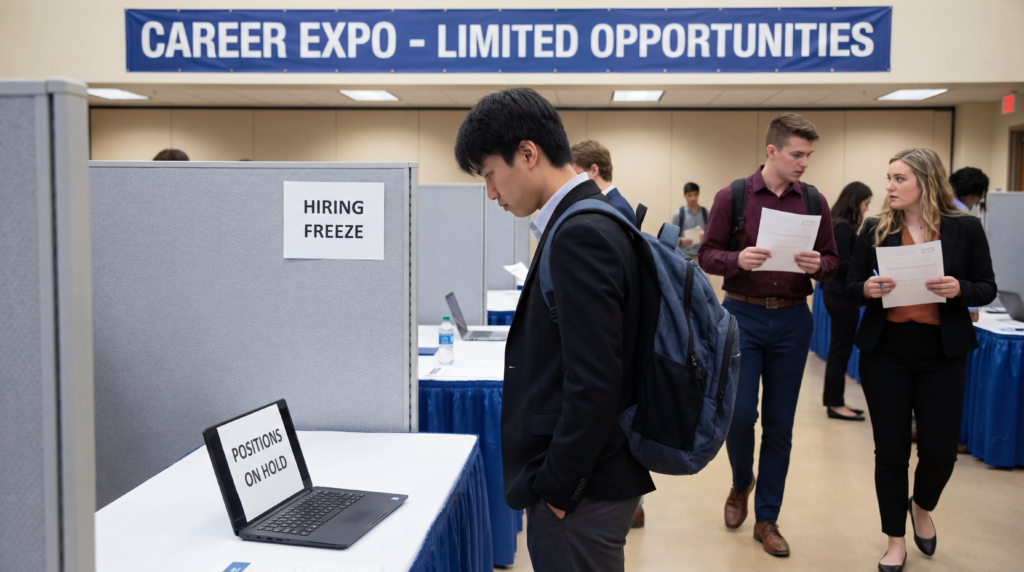
The subsequent tech layoffs of 2022 and 2023 weren’t primarily AI-driven. They were a correction. And crucially, the correction didn’t just involve cutting existing jobs — it involved simply not replacing people who left. In a “low-hiring, low-firing” labor market, companies achieve headcount reduction through attrition, not mass layoffs. Which means that entry-level positions — the ones that need to be actively created, not just backfilled — are the first to disappear from the budget.
National hiring slowed by nearly 9 percent year-to-date through late 2025, remaining over 20 percent below pre-pandemic levels as measured against 2019 baselines, according to LinkedIn workforce data. That 20 percent gap is not a recent development. It predates the AI deployment cycle that everyone is now pointing to.
None of this means AI is irrelevant. It means AI arrived into an already contracting hiring environment and has since accelerated the contraction in specific categories — creating a headline number that looks more dramatic than it would have in a healthier macro context.
The Gray Ceiling Nobody’s Talking About
There is a third variable in this equation that receives almost no coverage in the “AI ate junior jobs” discourse: demography.
The American workforce is aging, and older workers are staying in it longer. The “Great Resignation” of 2021-2022 — during which millions of workers, particularly those near retirement age, left the labor force — was followed almost immediately by the “Great Stay,” as economic uncertainty and rising costs of living drove workers to prioritize job security over career mobility.
Quit rates collapsed to historic lows by 2024 and 2025. The salary premium from job-hopping — which had been nearly 20 percent in 2022 — shrank to roughly 7 percent by mid-2025, essentially matching the raises received by people who stayed put. When switching jobs stops paying, people stop switching. When people stop switching, the vacancy chain that normally allows entry-level workers to move up — as seniors leave, creating mid-level openings, creating junior openings — freezes.
This “gray ceiling” operates independently of AI. It is a function of retirement being too expensive and too uncertain in a world of elevated inflation and volatile markets. It is a function of older workers having fewer places to “go down” to, so they stay where they are. And it is a function of corporate loyalty cuts during the layoff era creating a generation of experienced workers who have no intention of leaving a stable role.
For a 23-year-old software engineer trying to get their first job, this blockage is nearly invisible. They see the job market as hostile and assume the algorithm is the culprit. Sometimes it is. But sometimes the culprit is a 58-year-old senior developer who decided not to retire yet, whose departure would have created the mid-level opening that would have triggered the junior opening that would have been this graduate’s first job.
Matt Beane, an associate professor at UC Santa Barbara and author of The Skill Code: How to Save Human Ability in an Age of Intelligent Machines, puts the underlying tension well: the “expert-novice” relationship, where juniors learn by doing alongside seniors, has existed for 160,000 years, and companies are now disrupting it in ways they don’t fully understand. The problem isn’t just that AI is replacing junior tasks. It’s that when those tasks disappear — whether from AI, from demographic stasis, or from a combination of both — the transmission mechanism for building the next generation of senior workers breaks down.
“The way you make a senior employee is not through school,” Beane told CNBC. “It’s by doing the job alongside someone who knows more, and you learn by doing. And that’s where the bulk of our skill comes from.”
What the Stanford Paper Actually Found — and What It Didn’t
Given how widely the Stanford study has been cited, it’s worth spending a moment on what its authors actually claim and where they deliberately pull back.
The study analyzed employment changes using an AI-exposure measure that distinguishes between “automative” and “augmentative” AI use. This is one of the paper’s most important contributions. Not all AI use is the same. In occupations where AI is primarily automating tasks — replacing human output directly — employment for young workers declined. In occupations where AI is primarily augmenting workers — making them faster or more capable, but not replacing them — employment trends were far more muted.
This is a more nuanced picture than “AI kills jobs.” It’s more like: AI kills certain kinds of jobs, specifically the repetitive, codified-task variety, while potentially growing demand for people who can use AI as leverage. As the TIME summary of the Stanford research noted, “employment is growing in professions where AI is used to augment workers rather than automate their tasks.”
The study also found something important about wages: the adjustment in the labor market is happening through employment rather than compensation. Junior workers in AI-exposed fields are not being paid less — they’re simply being hired less. This is what economists call “wage stickiness,” and it suggests that if you do land an entry-level role in an AI-exposed sector, you’re probably still being paid market rate. The gate is just harder to get through.
Brynjolfsson himself is careful about causal claims. As he told TIME: “Our findings are consistent with the hypothesis that AI is having this effect, especially for entry-level workers.” Consistent with. Not proof of. The authors ran extensive robustness checks — excluding tech firms, excluding remote-work-amenable occupations, controlling for firm-level hiring shocks — and the pattern held. But they are honest that they do not have a controlled experiment.
What the study cannot rule out is that some of the firms experiencing the largest drops in junior hiring are the same firms that over-hired during the pandemic boom and are now correcting — and that those firms also happen to be tech companies that are more likely to be AI-exposed. Disentangling the AI contribution from the correction contribution is genuinely difficult.
Chandar is open about this in his detailed post-study analysis on the Stanford Digital Economy Lab site: “If you believe our various alternative analyses offer compelling evidence of a causal impact of AI, then you should update your beliefs more. If you need more evidence to convince you of a causal impact, then you should update less accordingly.”
That’s the kind of intellectual honesty that rarely makes it into the media summaries.
Automation vs. Augmentation: The Fork in the Road
The distinction the Stanford paper draws between automative and augmentative AI use is not just an academic taxonomy. It has direct implications for where the new openings are forming.
In roles where AI automats — customer service representatives executing scripted interactions, junior accountants running standard reconciliation workflows, entry-level software developers writing boilerplate code — the headcount math has changed. A 2025 study co-authored by researchers at MIT, Northwestern, and Yale found that when AI can perform most tasks for a specific job, the share of people in that role within a company falls by about 14 percent. That’s not destruction. It’s compression.
But in roles where AI augments — a healthcare worker who now has real-time diagnostic support, a junior analyst who can now produce in an hour what used to take a week, a marketer who can iterate on campaign copy at five times the speed — the math goes the other way. The human becomes more valuable because they can leverage the tool. And more output capacity per person often means more revenue per firm, which eventually means more hiring — just at a different level and in a different shape.
As a16z General Partner Alex Rampell argued in a widely-read 2024 essay, the real story of AI in the enterprise isn’t headcount reduction — it’s the transmutation of capital into labor. Software, which was previously limited to digitizing filing cabinets, can now execute multi-step workflows that used to require human beings. “The enterprise software market — which looks big at $300B/year in spend — is infinitesimal compared to the white-collar labor market, at many, many trillions of dollars a year,” Rampell wrote. The implication: AI doesn’t shrink the addressable surface of work — it massively expands what software can address, creating whole new categories of economic activity that didn’t previously have dedicated software tooling.
This is the venture-capital optimist’s view, and it deserves scrutiny. But the underlying observation is correct: there are sectors and use cases where AI is creating net-new demand for human labor, not reducing it. The question is whether those jobs are accessible to the people who are being displaced from the jobs that are disappearing.
Where the Openings Are Actually Moving
If the jobs aren’t where they used to be, where are they?
The data paints a picture of significant geographic and sectoral redistribution, not absolute destruction.
Healthcare and physical services. Healthcare, government, and leisure/hospitality accounted for almost 75 percent of all jobs added in late 2024 and 2025. Healthcare entry-level postings specifically rose by 13 percentage points, bucking the overall decline trend. These are roles that require physical presence, regulatory certification, or interpersonal skills that AI cannot replicate — at least not yet. Nursing assistants, physical therapy aides, health technicians, home care workers. The pay trajectories are different from a software engineering career, but the jobs exist, and they are growing.
AI-adjacent roles in non-tech sectors. In 2024, the majority of job postings requiring AI skills — 51 percent — were outside the tech sector, according to a Lightcast analysis. Overall, job postings requiring generative AI skills in non-tech roles increased ninefold from 2022 to 2024, to more than 29,000. A marketing operations coordinator who can build and manage AI-driven content pipelines. A financial analyst who can prompt-engineer their way through complex modeling tasks. A paralegal who can use AI tools to accelerate document review. These roles are emerging across industries that are not “AI companies” in any traditional sense.
Security and infrastructure. As Hugo Malan, president of the science, engineering, technology, and telecom unit at Kelly Services, noted in an interview with IEEE Spectrum, while programmer employment in the US fell 27.5 percent between 2023 and 2025, information security analyst roles grew in double digits during the same period. Generative AI creates new attack surfaces, new compliance requirements, and new audit needs — all of which require human judgment. Every AI deployment is an enterprise security event. Every agentic workflow introduces new risk vectors.
Secondary and tertiary markets. Cities like Nashville, Detroit, and Atlanta showed resilience in hiring through 2025, with growth rates of 4 to 7 percent, even as traditional tech hubs declined. The geographic redistribution of opportunity is real, even if it’s invisible from San Francisco or New York. Companies are finding that they can build strong junior pipelines in lower-cost markets where competition for talent is less extreme. For young workers willing to relocate — or for companies willing to hire remotely into these markets — the landscape looks different.
The coordination layer. As AI agents proliferate, someone has to orchestrate them. Someone has to evaluate their outputs, debug their failures, design the prompts that guide them, and make the judgment calls at the edges of their capability. These are emerging roles — sometimes called “AI orchestrators” or “prompt engineers” or simply “AI-augmented analysts” — that require a combination of technical literacy and domain expertise. They don’t look like the junior roles of 2019, but they are entry points into careers that didn’t exist five years ago.
The Talent Pipeline Problem: Why Companies Are Making a Long-Term Mistake
Here is the thing that isn’t in most of the data, but is in plain sight if you think through the math: companies that are eliminating entry-level roles in the name of efficiency are potentially sawing off the branch they’re sitting on.
The pipeline from junior to senior is not automatic. It requires exposure, mentorship, and time-on-task. When a firm stops hiring junior analysts, it doesn’t just save money today — it depletes the bench of mid-level talent it will need in three to five years. As Molly Kinder, a senior fellow at the Brookings Institution, put it in an interview with CNBC: “What happens in a few years if a company doesn’t have any seasoned coders? If a law firm doesn’t have lawyers who know how to argue in court and make legal judgments? If a consulting firm doesn’t have consultants who are ready to talk to clients?”
This isn’t a speculative risk. The “expert-novice” model of skill transfer is, as Beane noted, one of the oldest and most robust mechanisms humans have for building expertise. It is extraordinarily hard to shortcut. You can use AI to speed up code reviews, but you cannot use AI to give a junior developer the intuition that comes from having shipped six products and watched three of them fail in production.
Kinder articulated the collective action problem clearly: “Companies may be reluctant to hire and train their workers out of fear that competitors will poach them later, since competitors themselves may have a scarcity of early-career talent to promote. That fear might drive companies to lean on AI even more. If everyone does that, the entire pipeline of talent starts to collapse and, in a few years, employers in lots of sectors are going to find themselves in trouble.”
This is a classic tragedy of the commons, playing out in real time in the labor market. Each individual firm has a rational incentive to free-ride on the training investments of competitors. But if all firms behave this way simultaneously, the aggregate outcome is catastrophic for everyone.
Mike Roberts, founder and CEO of Creating Coding Careers, a nonprofit focused on early-career entry into software development, made the same point in his interview with IEEE Spectrum: “If you don’t train new early entrants into the market, you will eventually have no more people becoming mid-levels. It’s very myopic.” The companies that are treating AI as a replacement for junior hiring are, in Roberts’ framing, optimizing for the next quarter at the expense of the next decade.
There is a reasonable counter-argument here: maybe AI itself will eventually substitute for the experiential learning that entry-level work currently provides. Maybe it will be possible to train a junior into a senior using AI-driven simulations, coaching tools, and accelerated feedback loops. This is not impossible. But we are nowhere near that world yet, and betting the talent pipeline on it is a significant gamble.
What Founders Should Rethink: Junior Hiring in the AI Era
If you run a startup or a growing company, the cultural moment is pushing you toward two dysfunctional extremes. The first is reflexive AI replacement: cut all the junior roles, buy an AI subscription, and declare victory. The second is willful denial: ignore the capabilities of AI tools and keep hiring junior staff to do work that the tools could do faster and cheaper.
Both of these are wrong. The right move is to redesign the junior role around the actual current capabilities of AI — and build a deliberate apprenticeship structure around the residual gap.
Here’s what that looks like in practice.
Hire junior for judgment, not execution. The execution layer of most junior jobs is already being augmented or replaced by AI. The remaining value in a junior hire is not their ability to run a SQL query or draft a first-pass email — it’s their ability to evaluate the output, to catch the errors, to ask the right questions of the tool, and to develop the taste that makes them useful when the stakes are high. Hire for curiosity, coachability, and domain interest. The technical execution will be AI-assisted from day one.
Build explicit apprenticeship structures. The informal apprenticeship that used to happen organically — the junior analyst sitting next to the senior director, absorbing how they think — doesn’t happen on its own in a remote-first, AI-augmented workplace. It has to be designed. That means structured one-on-one time, deliberate exposure to high-stakes decisions, and a clear articulation of what the junior is supposed to be learning at each stage. As Roberts noted in IEEE Spectrum, apprenticeship models “much more effectively close the experience gap” than traditional university programs, especially in a world where the production environment has changed so radically.
Use AI to accelerate the ramp, not eliminate it. There’s a meaningful difference between using AI to make a junior’s first six months more productive and using AI to conclude you don’t need the six months at all. AI can give junior staff access to context they would previously have had to spend years accumulating. It can surface relevant precedents, flag potential errors, and help them produce outputs that punch above their experience level. As Roberts puts it: “I find it an exciting time, because it’s never been faster to build high-quality software. But it’s weird that folks are not seeing the virtue of continuing to invest in humans.”
Don’t hire AI-phobic; don’t hire AI-dependent. The ideal junior hire in 2025 and beyond is someone who is genuinely fluent with AI tools but hasn’t outsourced their thinking to them. The risk on one end is someone who refuses to use the tools and is therefore uncompetitive. The risk on the other end is someone who uses AI to generate everything and has no ability to evaluate it, making them a liability when the tools are wrong. As Jamie Grant, senior associate director for the engineering team at the University of Pennsylvania’s career services, told IEEE Spectrum: “Think about an exoskeleton that you could wear that allows you to lift 1,000 pounds. AI should be, just as the people at Stanford say, an augmentation to your work, to your higher-order critical-thinking skills.” That framing is correct. The exoskeleton metaphor is apt. You still need the person inside it.
The New Shape of Entry-Level Work
What does entry-level work actually look like if you redesign it from the ground up in 2025?
It looks less like a collection of task-based deliverables and more like a continuous series of judgment calls, collaborations with AI systems, and human relationships that the AI cannot replicate.
The tasks that used to define junior roles — data entry, first-draft research reports, basic code generation, formatting documents, scheduling meetings — have been compressed by AI. That compression doesn’t mean the role disappears; it means the role has a different shape. More time on synthesis, less on production. More time on stakeholder communication, less on research assembly. More time on evaluating AI outputs critically, less on generating outputs from scratch.
This is a higher cognitive starting point than junior work used to require. The positive framing is that junior workers can now operate at a level of apparent seniority they wouldn’t have reached for years in a pre-AI environment. As Malan of Kelly Services noted in IEEE Spectrum, the expectation is that new graduates will “slot in at a higher level almost from day one.” The negative framing is that young workers who don’t have the foundational domain knowledge to evaluate AI outputs will struggle — because the tools will produce confident-sounding errors, and only someone with genuine subject-matter grounding will catch them.
This is why the “AI killed entry-level” narrative, while emotionally resonant, misses the more important point. The question isn’t whether AI eliminated the entry-level position. It’s whether it eliminated the easy path into the entry-level position — the one that assumed you could be useful at the bottom of the ladder without much pre-existing domain knowledge. That path is definitely narrowing. But it’s narrowing because the floor of required competence is rising, not because the ladder is disappearing.
The World Economic Forum’s Future of Jobs 2025 report projects that AI and information processing technologies will create 11 million new jobs and displace 9 million others — a net gain of roughly 2 million globally. What the WEF number doesn’t capture is the distributional question: will the 11 million new jobs be accessible to the people displaced from the 9 million old ones? Will they require skills that take ten years to acquire, or skills that can be developed in a year of deliberate practice? That’s the policy question that actually matters, and it’s almost entirely absent from the public debate.
What Young Workers Can Actually Do About It
The advice that gets handed to young workers in this environment tends toward the useless (“learn AI!”) or the vague (“develop transferable skills!”). Let’s be more specific.
Become a native in at least one AI workflow, not a tourist in all of them. There’s a meaningful difference between someone who has used ChatGPT to write a few emails and someone who has spent months building genuine fluency with AI tools in a specific domain — law, medicine, finance, software engineering, marketing operations. Depth in one area is more valuable than shallow familiarity with everything. Pick the domain you care about and get genuinely good at what AI can and can’t do within it.
Go where AI is augmenting, not automating. The Stanford research is clear that employment outcomes diverge sharply based on whether AI is being used to automate or augment in a given role. Healthcare support roles, physical operations, security, and any role requiring ongoing interpersonal judgment are on the augmentation side of the ledger. Standard customer service, routine data processing, and boilerplate legal or financial document work are on the automation side. The choice of sector matters as much as the choice of skill.
Consider non-traditional entry points. Apprenticeships, rotational programs, and direct-to-operator paths into growing companies are becoming more attractive alternatives to the traditional “big firm junior cohort” model, which is shrinking. Some companies that are unable to justify large junior cohorts under traditional hiring models are open to apprenticeship structures that offer more flexibility. The deal is different — often less pay, but more mentorship access and faster ramp-up time — but for the right person in the right context, it’s a better career investment than waiting for a traditional role to appear.
Geographic arbitrage is real. If you’re a recent graduate in a traditional tech hub, you’re competing with everyone else who was told that San Francisco, New York, or London was where the jobs were. Nashville, Detroit, and Atlanta are showing hiring resilience that the headline markets are not. Secondary markets are not consolation prizes. They are, in many cases, genuinely better early-career environments — lower competition, more mentorship access, faster advancement, and lower cost of living.
Pair AI fluency with human skills AI can’t replicate. As Alison Lands, vice president of employer mobilization at Jobs for the Future, put it to CNBC: “It will help you leapfrog that broken rung on the career ladder” if you can pair AI capability with the interpersonal skills, strategic thinking, and client-relationship development that AI genuinely cannot perform. The junior workers who will thrive in this environment are not the ones who know the most AI tools — they’re the ones who know which problems require AI and which require a human, and can fluidly deploy both.
The Honest Conclusion
The “AI killed entry-level jobs” story is not false. It is incomplete.
There is real, large-scale, rigorous evidence — primarily from the Stanford Digital Economy Lab’s landmark 2025 study — that early-career workers in AI-exposed occupations are experiencing employment declines that older workers in the same occupations are not. That is a significant and specific finding. It warrants serious attention, serious policy response, and serious rethinking of how companies build their junior talent pipelines.
But the broader picture is considerably more complicated. The hiring slowdown affecting young workers spans both AI-exposed and non-AI-exposed roles. It was set in motion by the post-pandemic macro correction before generative AI was widely deployed. It is being deepened by demographic factors — older workers staying in the labor force longer, blocking the upward mobility that would create junior openings — that have nothing to do with language models.
And it is happening in an environment of sectoral divergence that the headline numbers completely obscure: healthcare is growing, secondary markets are growing, AI-augmented roles are growing, even as pure AI-automation roles in tech are contracting.
The framing that matters for anyone trying to navigate this moment — whether you’re a founder, an operator, a recent graduate, or a policy maker — is not “AI is destroying entry-level work.” It’s “AI is changing which entry-level openings exist, where they are, and what they require.” That framing is harder to fit in a headline. It produces less social media traction. But it’s the one that maps onto the data, and it’s the one that produces useful action.
A16z’s Alex Rampell got at something real when he argued that the enterprise software market is dwarfed by the white-collar labor market, and that AI is beginning to address economic categories that never had dedicated software tooling. That is where new categories of work — and new categories of entry-level opportunity — will emerge. Not from defending the old ladder, but from building the new one.
The ladder isn’t gone. It’s being rebuilt, rung by rung, in different shapes, in different sectors, in different cities. The people who will climb it first are the ones who stopped arguing about whether it exists and started figuring out where it is.