Brand Lift and Search Lift are two of the most useful “beyond-clicks” measurement tools in the Google / YouTube ecosystem because they’re built to answer a simple question that dashboards often dodge:
Did this advertising change people’s minds… and did it change what they do next?
- Brand Lift measures changes in perception (ad recall, awareness, consideration, favorability, purchase intent, association) using randomized control vs exposed groups and 1-question surveys.
- Search Lift measures changes in intent-driven action by comparing organic search behavior (on YouTube and Google Search) between exposed vs holdback groups for selected search terms.
This document covers what they are, how Google runs them, how to set them up, how to read every metric, what can go wrong, and how to use the results to make better decisions—across Google Ads (YouTube campaigns) and Display & Video 360 (DV360).
1) The core idea: lift is an experiment, not a report
A lift study is a controlled experiment: Google splits eligible users into two groups automatically:
- Treatment / Exposed: users who can be shown your ads
- Control / Holdback: users who are blocked from seeing your ads
Then Google compares outcomes between groups. The difference is your lift.
This matters because it’s a different category of truth than:
- Attribution (which assigns credit among touched channels)
- Marketing mix modeling (which estimates impact from aggregated time-series data)
- Brand tracking panels (which measure brand health but usually not randomized to ad exposure)
Lift studies are designed to estimate incrementality: what happened because of ads, not just alongside them.
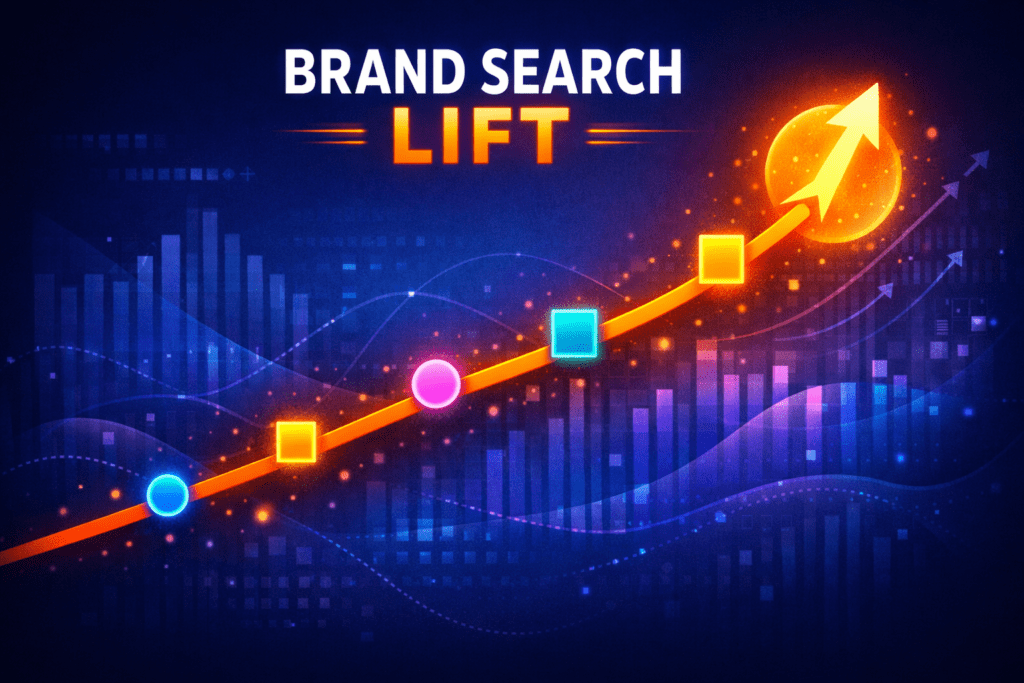
2) Brand Lift vs Search Lift (and where each fits in the funnel)
Brand Lift: perception outcomes (survey-based)
Brand Lift focuses on “how people feel/think” after exposure:
- Ad recall
- Awareness
- Association
- Consideration
- Favorability
- Purchase intent
Brand Lift is especially good when:
- you’re launching something new
- you’re changing positioning
- you’re testing creative strategy
- you need proof that “upper funnel” work is actually working
Search Lift: intent behavior (organic search-based)
Search Lift focuses on “what people do next”:
- do they search for your brand/product more after watching?
Search Lift is especially good when:
- you care about demand creation (brand demand and product curiosity)
- your buying journey includes search
- you want a strong bridge metric between “video attention” and “pipeline intent”
Quick mental model
- Brand Lift = mind change
- Search Lift = intent action (organic search behavior)
3) Availability + access: who can run these?
A key practical reality:
- Brand Lift isn’t available for all Google Ads accounts; Google explicitly says you need to contact your Google account representative (and if you don’t have one, you may not be able to use it).
- Search Lift also isn’t available for all accounts and likewise requires a Google account representative.
So: this guide explains “everything,” but your access may depend on account eligibility.
4) Where these run: Google Ads vs DV360 (and YouTube TV/CTV)
In Google Ads
- Brand Lift is available for Video campaigns and Demand Gen campaigns running on YouTube.
- Important nuance: for Demand Gen, Google warns that Brand Lift measurement won’t capture results from Gmail or Discover, and you should prioritize video ads on YouTube for accurate measurement.
- Search Lift is available for Video campaigns on YouTube, and Google lists Demand Gen surfaces including YouTube placements plus Discover and Gmail (channel availability is described in Google’s “Comparing lift types” page).
In DV360 (Google Marketing Platform)
DV360 supports Brand Lift and Search Lift measurement, with DV360-specific reporting conventions and thresholds.
YouTube TV / Connected TV (CTV)
Google Ads supports Brand Lift and Search Lift for YouTube TV. Brand Lift surveys are optimized for TV screens and remote interactivity, and YouTube TV impressions can be included in Search Lift measurement depending on campaign type.

5) Methodology: what exactly is being compared?
Brand Lift: survey responses (exposed vs control)
Google’s Brand Lift description is consistent across sources:
- randomized control group not shown your ad
- exposed group shown your ad
- a one-question survey is delivered to both groups
- lift is the difference in positive response rates
Search Lift: organic searches (exposed vs holdback)
Search Lift is described as:
- choose a “Product or Brand” grouping and select search terms
- Google splits eligible users into exposed vs blocked
- Google monitors search behavior on YouTube and Google Search
- lift is the difference in search behavior between groups
6) Setup in Google Ads: Brand Lift (step-by-step, with the details that trip people up)
6.1 Requirements + campaign types
Before you can set up Brand Lift in Google Ads, Google indicates you’ll need a Video or Demand Gen campaign.
And again: if you’re measuring Demand Gen, Google warns measurement won’t capture Gmail/Discover—prioritize YouTube video.
6.2 Create a “Product or Brand” and define the survey
In Google Ads (Goals → Lift studies / Lift measurement), you:
- Create a Product/Brand name
- Choose survey language (should match ad language)
- Choose survey question configuration using:
- Product or brand type
- Final intended action
- Select up to 3 metrics (from recall/awareness/association/consideration/favorability/purchase intent)
- Enter your product/brand plus up to 3 competitors as answer options
- Associate campaigns (a campaign can only be associated to one product/brand)
6.3 Approval + editorial realities
- Brand Lift surveys can take up to 48 hours to be approved.
- Misspellings or policy violations can cause rejection.
Google also has an explicit Brand Lift Editorial Policy style guidance (spelling, language match, avoid duplicate “none of the above,” avoid irrelevant answers, etc.).
6.4 Policy constraints (don’t learn these by getting suspended)
Google/YouTube explicitly says:
- you cannot use Brand Lift surveys to collect personally identifiable information
- sensitive topics (demographic info, sexual orientation, race, politics, religion, health/medical info, etc.) are restricted
- violations can lead to survey disabling and potentially account suspension
7) Setup in Google Ads: Search Lift (step-by-step, plus term strategy)
7.1 What Search Lift measures
Search Lift measurement determines how your ads impact someone’s likelihood to search for your brand/product on YouTube and Google Search.
7.2 You can run Search Lift alone or with Brand Lift (and/or Conversion Lift)
Google explicitly states a Search Lift study can run on its own or together with Brand Lift and/or Conversion Lift.
7.3 Budgeting: Search Lift budgets are not additive
A crucial (and commonly misunderstood) rule:
- Search Lift budget requirements are the same as the minimum budget to measure 1 Brand Lift question.
- If you’re eligible for 1 Brand Lift question, you’re also eligible to measure Search Lift without additional budget.
- Budgets aren’t additive (Brand + Search doesn’t mean double).
7.4 Search terms: how to pick terms that can actually show lift
Google’s own best-practice guidance is blunt:
Do:
- pick a small number of terms (1–5 per group)
- keep terms brand/product related
- choose specific terms you expect to uplift
Don’t:
- don’t pick too many terms/groups
- don’t pick generic terms
- don’t pick competitor terms
- don’t use long sentence-like queries
- don’t add spelling/punctuation variations (Google says they’re already captured)
Google’s example explains why:
- “Pixel 7 Pro” is specific and likely to change after ads
- “Google” or “Pixel” are too broad (high baseline, hard to detect lift)
7.5 Mechanics: create term groups
- You can have up to 5 groups, but Google says typically 1–2 groups are enough.
8) Budgeting + eligibility: the part that quietly determines whether you get results
8.1 Brand Lift eligibility is based on spend over the first 10 days
Google Ads Brand Lift eligibility is calculated on a minimum total campaign budget over a 10-day period, and the UI includes a “Measurement eligibility” box that tells you if you’re eligible.
8.2 More questions = higher minimum required budget
Google says the required budget changes based on:
- the number of questions you run (up to 3)
- the country targeting bucket
8.3 Enhanced Lift: when “not enough data” keeps happening
Google Ads Brand Lift includes Standard Lift and Enhanced Lift:
- Enhanced Lift is designed to collect ~3x survey responses
- requires 3x the minimum budget
- tends to run 9–14 days (longer to collect responses)
Google explicitly positions Enhanced Lift for cases where you’ve seen “No lift” or “Not enough data” despite investment (but notes it doesn’t guarantee positive results).
9) “Did we get results?” — statuses, thresholds, and why “No lift” often doesn’t mean “no impact”
9.1 Brand Lift: how many responses you need (and what Google surfaces while you wait)
Google provides clear guidance on detectability:
- you may start seeing lift results around 2,000 responses per lift metric
- at recommended minimum budget, expect results at ~4,100 responses per metric
- if there’s no lift after ~16,800 responses per metric, you may not be able to detect lift
They also publish a response-count table showing that detecting smaller absolute lifts requires dramatically more responses (e.g., ~20k–45k for ~1% lift, and far more below that).
9.2 Brand Lift statuses: “Not enough data” vs “No lift detected”
Google describes progress/status behavior:
- below a threshold: Not enough data
- once measurement is “complete,” if positive statistically significant lift: you see lift; otherwise: No lift detected
And Google explicitly warns: results can fluctuate while studies are running; they recommend waiting until completion for the final report.
9.3 Certainty of lift: Google’s “how sure are we?”
Google Ads provides Certainty of lift, defined as:
- certainty = 1 − p-value
- it represents how likely the lift was driven by your campaigns vs chance
Google says it aims to detect lift at the highest certainty (90%), but can show lower certainty results down to 50% (below 50% not reported).
Important nuance:
- In Google Ads, results below 50% certainty show as “No lift” (this is explicitly described as not necessarily meaning the ads were ineffective—often it means you need more power).
9.4 Confidence intervals: how wide is the uncertainty band?
Google Ads explains lift metrics include a confidence interval:
- 80% two-sided confidence intervals in Google Ads
- interpreted as “80% chance true lift lies between lower/upper bound,” and “90% chance lift is greater than the lower bound.”
DV360 documentation describes confidence intervals too, and DV360 may present intervals differently (DV360 help pages reference 90% confidence intervals for lift metrics in that UI).
Practical takeaway: use confidence intervals to avoid over-reading small differences between segments/creatives—if intervals overlap heavily, you may not have a real winner. Google explicitly warns about this when comparing segments.
10) Brand Lift metrics: definitions, formulas, and when each matters
Google Ads and DV360 expose closely related metric concepts. Here are the key ones, with how to think about them.
10.1 Absolute Brand Lift (the “percentage point change”)
Google defines Absolute Brand Lift as the difference in positive response rate between exposed and baseline/control groups.
Formula (conceptual):Absolute lift = Positive% (exposed) − Positive% (control)
This is the cleanest “effect size” number, but it’s not always the best efficiency measure because it ignores cost and reach.
10.2 Lifted Users (the scaled impact estimate)
Google Ads defines “Lifted users” as an estimate of how many users’ perception changed due to your ads, extrapolated from survey samples to overall reach.
Use it for: magnitude/scale narratives (“how many people did we move?”)
Don’t use it for: targeting individuals or re-engagement (Google notes you can’t use it to find or re-engage “lifted users”).
10.3 Cost per Lifted User (CPLU) (the efficiency KPI Google keeps hinting you should use)
Google Ads defines CPLU as total cost divided by lifted users.
And Google explicitly says absolute lift doesn’t necessarily reflect overall performance; it may be better to focus on CPLU because it factors in reach and cost.
Formula (conceptual):CPLU = Spend / Lifted users
10.4 Headroom Lift (why it exists)
Headroom lift adjusts for how “close to saturated” your baseline is. Google defines it as absolute lift divided by (1 − baseline positive rate).
Why this matters:
If your brand already has high baseline awareness/favorability, you have less room to improve. Headroom lift helps normalize across brands/categories where baseline is high.
10.5 Relative Lift (often used more in Search Lift, but exists as a concept)
Relative lift is essentially “percent improvement vs baseline.” DV360 describes relative lift as a way to compare by dividing absolute lift by baseline response rate.
11) Search Lift metrics: what you actually get, and how to read it
Google Ads describes Search Lift as reporting (when detectable):
- Relative Lift
- Normalized Incremental Searches Per Impression
- Normalized Incremental Searches Per Cost
DV360 Search Lift reporting includes related metrics such as incremental searches, incremental searches per impression/cost, and breakouts by property (YouTube vs Google Search).
11.1 Relative Lift (the headline intent shift)
Relative lift answers: how much more likely did exposed users search vs control (relative to baseline). Google recommends relative lift as a strong comparison metric for Search Lift segments.
11.2 Normalized incremental searches per impression (demand per exposure)
This is your “how many incremental searches do we generate per impression (normalized)” metric—useful for comparing creatives/campaigns controlling for delivery volume.
11.3 Normalized incremental searches per cost (demand per dollar)
This is the “how many incremental searches do we generate per dollar (normalized)” metric—useful when budgets differ.
11.4 Confidence intervals + certainty apply here too
Google Ads’ Search Lift metrics include:
- confidence intervals
- certainty of lift (1 − p-value)
12) The single biggest factor in getting Search Lift to “work”: baseline management
Google’s own Search Lift term guidance is basically a masterclass in experimental power:
- Lift is easier to detect when a term is unlikely to be searched without the ad but likely after exposure (low baseline, high uplift).
That’s why:
- generic terms are deadly (huge baseline → tiny relative change)
- competitor terms are prohibited (and also conceptually noisy)
- long exact-sentence queries won’t have enough volume
If you want Search Lift to sing: pick terms that are specific, branded, and aligned to the creative promise.
13) Why studies fail (and what Google explicitly says to check)
Google Ads’ own Brand Lift troubleshooting includes a few landmines people hit constantly:
13.1 “Not enough data” even though you spent money
Google suggests checking:
- did you actually spend the budget (eligibility needs spend, not just budget settings)
- is volume too low (bids too low, losing auctions)
- is your control group compromised by configuration
13.2 Control group contamination (the silent killer)
Google warns you may fail to build a control group if you target audiences that already viewed the ad video (or similar sequencing setups).
It also warns about creative contamination: if control users have seen the creative elsewhere, exposed and control responses converge and lift shrinks. Google suggests minimizing this by avoiding overlapping video campaigns and being careful with running similar creatives across channels/platforms.
14) Optimization playbook: what you do with results (not just what you report)
Brand Lift and Search Lift are only “definitive” when they change decisions. Here’s a practical playbook aligned to how Google frames these tools (near real-time optimization and segmentation).
14.1 Choose the right “primary KPI” per goal
Google itself recommends:
- For Brand Lift: often CPLU or absolute lift (not just lifted users)
- For Search Lift: often relative lift
14.2 Use segmentation, but don’t fall for the “highest certainty = best” trap
Google explicitly says:
- segments will have different certainties
- don’t conclude the segment with the highest certainty is necessarily best
- use confidence intervals; overlap often means “no real difference”
14.3 Creative optimization: what lift is uniquely good at
Lift is especially strong for answering:
- Which creative actually changes perception?
- Which message increases branded search?
- Which audience segment responds to this framing?
A practical workflow:
- Run multiple creatives with clearly distinct hypotheses (not tiny edits)
- Wait for study completion (results can fluctuate mid-study)
- Compare creatives using CPLU / absolute lift (Brand) and relative lift (Search) with confidence intervals
- Scale winners, cut losers, and re-run with a new hypothesis set
14.4 When to use Enhanced Lift
Use Enhanced Lift when:
- you repeatedly get “not enough data”
- you suspect lift exists but is too small to detect at current response volume
- you can afford 3x minimum budget
14.5 Remeasurement: turn “low power” into “more answers”
Google explicitly recommends remeasurement to increase survey responses/search volume/conversions when certainty is low.
15) YouTube TV / CTV specifics: what changes on the biggest screen
If you’re buying YouTube on TV screens, Brand Lift and Search Lift still apply, but the mechanics of response collection and context shift.
Google states:
- Brand Lift surveys are optimized for TV screens and remote interactivity on the YouTube main app on CTV devices and the YouTube TV app.
- YouTube TV campaigns can be measured with Brand Lift, and surveyed users may be reached on YouTube TV or the YouTube main app on a signed-in device.
- Search Lift can be run on YouTube TV reservation campaigns (and eligible auction campaigns with YouTube TV impressions included).
Interpretation tip: CTV often changes attention quality and co-viewing context. DV360 includes co-viewing-related lift fields in some Brand Lift reporting views, which is a hint that “who was in the room” can matter even when the survey goes to a signed-in user.
16) DV360 (Display & Video 360) notes: what’s different vs Google Ads
If you’re operating in DV360, you’ll see familiar concepts but some DV360-specific framing:
- DV360 Brand Lift measurement has documented privacy minimums and may show “Not enough data” when minimums aren’t met.
- DV360 documentation includes metric definitions like absolute lift, relative lift, headroom lift, lifted users, cost per lifted user, and confidence intervals in its UI descriptions.
- DV360 Search Lift reporting similarly provides incremental search metrics and breakouts (including by property).
Practical takeaway: the experiment logic is the same; the UI and reporting conventions can differ, so align your team on the definitions and confidence interpretation you’re using.
17) Common questions (answered using what Google explicitly publishes)
“Is Brand Lift / Search Lift free?”
Google calls Search Lift a free tool.
(Brand Lift is treated as a built-in measurement product with minimum spend requirements; you don’t “pay for the report,” but you must fund enough delivery to power the experiment.)
“Do I need Brand Lift to run Search Lift?”
No—Google explicitly says Brand Lift isn’t required to run Search Lift.
“Why can’t I see results even though I’m spending?”
Because lift needs power: survey response volume (Brand Lift) or query volume (Search Lift), plus a clean control group. Google’s troubleshooting guidance points to volume, bidding, and control group contamination as common causes.
“Does ‘No lift’ mean the ads failed?”
Not necessarily. Google explicitly explains that low certainty can produce “no lift” labeling even when lift may exist; it may require more data or remeasurement.
18) A practical “do it right” checklist
Before launch
- Confirm account access (rep required for many accounts).
- Pick the lift type that matches your objective (Brand vs Search vs both).
- Ensure you can hit minimum spend in the first 10 days (Brand Lift eligibility logic).
- Lock in creative strategy early to avoid contamination and “moving goalposts.”
Brand Lift setup
- Use correct survey language + spelling (editorial policy).
- Choose up to 3 metrics (don’t overload if budget is tight).
- Respect survey policy restrictions (no PII; no sensitive topics).
Search Lift setup
- Build 1–2 tight term groups; 1–5 terms per group.
- Avoid generic + competitor terms; keep terms specific and ad-relevant.
- Remember budgets aren’t additive with 1 Brand Lift question eligibility.
During flight
- Expect fluctuations; don’t call winners too early.
- Watch certainty + confidence intervals, not just point estimates.
After completion
- Use CPLU/absolute lift (Brand) and relative lift (Search) for comparisons, with interval overlap checks.
- If certainty is low or “not enough data,” consider remeasurement or Enhanced Lift (budget permitting).
19) One last, important implementation reality: APIs + automation
If you’re hoping to automate lift reporting via the Google Ads API, note that Google’s own Ads API forum responses have historically indicated Brand Lift metrics weren’t available via the API (at least in the referenced thread), pushing users to the UI instead.
(If API access is critical to your workflow, treat it as something to confirm with your rep and current docs, because availability and surfaces can change over time.)
Sources used (official docs and primary references)
All key claims above are grounded in Google/YouTube Help Center and Google’s own explainer materials, including:
- Lift study methodology + control/exposed split
- Brand Lift setup, budgets, eligibility window, Enhanced Lift
- Search Lift setup, budgeting rules, search term best practices
- Statuses, response thresholds, troubleshooting (Brand Lift)
- Certainty of lift + confidence intervals interpretation
- YouTube TV lift notes
- Brand Lift survey policies (PII + sensitive topics)
- DV360 measurement definitions and reporting framing