If you’ve been building on the modern web in 2026, you’ve probably felt the shift:
- Frontend work is faster than ever (frameworks, templates, design systems, copilot-style tools).
- But “AI-powered features” are now the differentiator: assistants, smart search, workflows, agentic UX, automated back-office.
- And the gap isn’t “can you call an LLM?” — it’s: can you build something reliable, safe, debuggable, and shippable?
Anthropic just made it dramatically easier to close that gap.
Anthropic Academy is now hosting a growing set of free, structured courses on Skilljar (Anthropic’s course platform at https://anthropic.skilljar.com/). These cover everything from “Claude basics” to hands-on developer topics like the Claude API, Model Context Protocol (MCP), and Claude Code workflows — plus tracks for educators, students, nonprofits, and enterprise adoption. Anthropic also highlights these learning paths on its official “Learn” hub at https://www.anthropic.com/learn, including earning certificates for completion.
Executive summary (what’s worth taking, and why)
If you’re a web dev, the big value of these courses is that they line up with how real products get built:
- Claude 101
If you need an official baseline on Claude usage and everyday workflows, start with https://anthropic.skilljar.com/claude-101. - AI Fluency: Framework & Foundations
This is the “operating system” course: a practical framework for collaborating with AI effectively and safely. It explicitly teaches a fluency framework (including the “4D” approach) on the official page at https://anthropic.skilljar.com/ai-fluency-framework-foundations. - Building with the Claude API
This is where product-grade development begins: building real app patterns with the Claude API at https://anthropic.skilljar.com/claude-with-the-anthropic-api. - Claude Code in Action
This is the “developer workflow” course — integrating Claude Code into how you actually build. Course page: https://anthropic.skilljar.com/claude-code-in-action. - Introduction to Model Context Protocol (MCP) + Advanced Topics
If you want Claude connected to tools and data in a standardized way, MCP is a practical developer skill. Intro course: https://anthropic.skilljar.com/introduction-to-model-context-protocol. Advanced topics: https://anthropic.skilljar.com/model-context-protocol-advanced-topics. - Cloud platform deployment courses (Bedrock + Vertex)
For teams shipping in enterprise environments, these platform-specific courses matter:
- Amazon Bedrock: https://anthropic.skilljar.com/claude-in-amazon-bedrock
- Google Vertex AI: https://anthropic.skilljar.com/claude-with-google-vertex
- Agent Skills + Enterprise adoption/training tracks
If you’re scaling adoption across a team/org, these are worth a look:
- Agent skills: https://anthropic.skilljar.com/introduction-to-agent-skills
- Enterprise adoption: https://anthropic.skilljar.com/driving-enterprise-adoption-of-claude
- Train-the-trainer: https://anthropic.skilljar.com/enterprise-train-the-trainer
If you only do two courses as a web dev:
- Claude Code in Action (https://anthropic.skilljar.com/claude-code-in-action)
- Building with the Claude API (https://anthropic.skilljar.com/claude-with-the-anthropic-api)
If you do four:
- Claude 101 (https://anthropic.skilljar.com/claude-101)
- AI Fluency: Framework & Foundations (https://anthropic.skilljar.com/ai-fluency-framework-foundations)
- Claude Code in Action (https://anthropic.skilljar.com/claude-code-in-action)
- Building with the Claude API (https://anthropic.skilljar.com/claude-with-the-anthropic-api)
If you want the “builder’s stack”:
- Building with the Claude API (https://anthropic.skilljar.com/claude-with-the-anthropic-api)
- Introduction to MCP (https://anthropic.skilljar.com/introduction-to-model-context-protocol)
- MCP Advanced Topics (https://anthropic.skilljar.com/model-context-protocol-advanced-topics)
- Claude Code in Action (https://anthropic.skilljar.com/claude-code-in-action)
- Introduction to agent skills (https://anthropic.skilljar.com/introduction-to-agent-skills)
How the platform works (in plain English)
Anthropic is hosting these courses on Skilljar, a learning platform used for interactive course delivery and progress tracking. The course site itself explains that learning analytics like progress, lesson completion, quiz scores, and time spent can be tracked, and this supports completion outcomes like certificates (see the platform context on the catalog site at https://anthropic.skilljar.com/ and Anthropic’s “Learn” hub.
This matters for two reasons:
- The structure is real — you’re not just skimming docs.
- You can complete courses and walk away with a concrete outcome (completion/certificate mechanics are explicitly referenced in the official learning materials at https://www.anthropic.com/learn).
Recommended learning path for web developers (fast + practical)
Here’s a sequence that matches how you actually build products.
Phase 1 — Baseline (1 afternoon)
- Claude 101 (https://anthropic.skilljar.com/claude-101)
- AI Fluency: Framework & Foundations (https://anthropic.skilljar.com/ai-fluency-framework-foundations)
Outcome:
- You know Claude’s baseline capabilities.
- You have a reliable mental model for collaborating with AI safely and productively (see the AI Fluency framework details on https://anthropic.skilljar.com/ai-fluency-framework-foundations).
Phase 2 — Build (2–5 sessions)
- Building with the Claude API (https://anthropic.skilljar.com/claude-with-the-anthropic-api)
- Claude Code in Action (https://anthropic.skilljar.com/claude-code-in-action)
Outcome:
- You can build and ship Claude features in web apps.
- You can accelerate your dev workflow using Claude Code, rather than treating AI as a separate “tool tab.”
Phase 3 — Connect Claude to your world (optional but powerful)
- Introduction to MCP (https://anthropic.skilljar.com/introduction-to-model-context-protocol)
- MCP Advanced Topics (https://anthropic.skilljar.com/model-context-protocol-advanced-topics)
Outcome:
- You can standardize tool/data integration (MCP overview and primitives are described on https://anthropic.skilljar.com/introduction-to-model-context-protocol).
- You can build MCP servers/clients (especially if you work in Python-heavy stacks).
Phase 4 — Team + org adoption (if relevant)
- Introduction to agent skills (https://anthropic.skilljar.com/introduction-to-agent-skills)
- Driving enterprise adoption of Claude (https://anthropic.skilljar.com/driving-enterprise-adoption-of-claude)
- Enterprise train-the-trainer (https://anthropic.skilljar.com/enterprise-train-the-trainer)
Outcome:
- You can teach others, scale internal workflows, and deploy “Claude literacy” across a company.
Course-by-course summaries (each one separately)
Below: what the course is, who it’s for, what you’ll get out of it, and how it maps to web dev work.
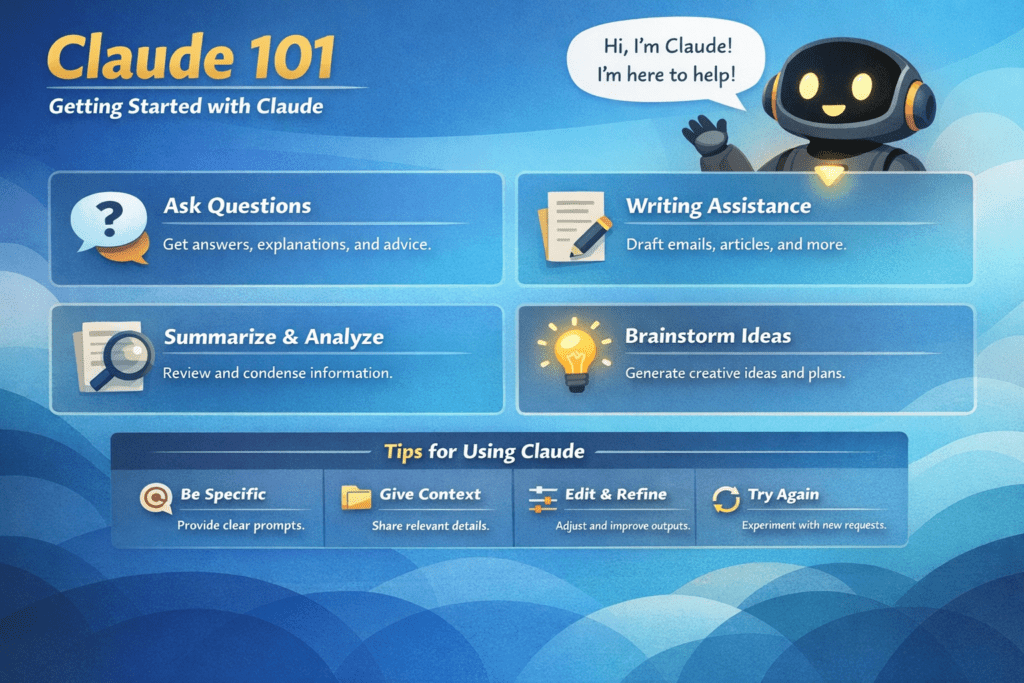
1) Claude 101 (https://anthropic.skilljar.com/claude-101)
What it is:
A baseline course on using Claude for everyday work tasks, learning core features, and finding next-step learning resources (see the official course page at https://anthropic.skilljar.com/claude-101).
Who it’s for:
- New Claude users
- Teams onboarding Claude for general productivity
- Builders who want an official “start here” foundation before API and developer workflow courses
Why it matters for web dev:
Even if you’re a developer, your product success depends on understanding “how people actually use Claude.” Claude 101 is about practical usage patterns (the same patterns your users will have), and it’s positioned as an on-ramp on https://anthropic.skilljar.com/claude-101.
Practical way to apply it immediately:
- Draft a “Claude usage guide” for your team (how to request code reviews, summarize PRs, generate docs, write tests, etc.).
- Use it as a baseline for onboarding non-technical teammates who will collaborate with you on AI features.
2) AI Fluency: Framework & Foundations (https://anthropic.skilljar.com/ai-fluency-framework-foundations)
What it is:
A foundational course on collaborating with AI systems effectively, efficiently, ethically, and safely — built with academic experts. It explicitly teaches an AI Fluency framework and a “4D framework” approach (Delegation, Description, Discernment, Diligence), plus deep dives into what generative AI is, capabilities/limitations, and effective prompting techniques (all described on the course page at https://anthropic.skilljar.com/ai-fluency-framework-foundations).
Who it’s for:
- Anyone who uses AI systems seriously (developers included)
- People who need repeatable, responsible methods (not just prompt tricks)
- Teams who want consistent practices rather than random, personal AI habits
Why it matters for web dev:
Because shipping AI features is mostly about failure modes:
- Delegation: What tasks should Claude do vs your code doing it deterministically?
- Description: How do you specify constraints so the output is usable?
- Discernment: How do you evaluate outputs (accuracy, security, correctness)?
- Diligence: How do you apply safety, privacy, and guardrails?
That “4D” framing is explicitly part of the course’s structure on https://anthropic.skilljar.com/ai-fluency-framework-foundations.
Practical way to apply it immediately:
- Turn the 4D framework into your internal “AI feature checklist” for new product work.
- Use it to define team norms: what’s allowed, what needs human review, what requires red-teaming.
3) AI Fluency for students (https://anthropic.skilljar.com/ai-fluency-for-students)
What it is:
A student-focused version of the AI Fluency training, aimed at learning, career planning, and academic success through responsible AI collaboration (see https://anthropic.skilljar.com/ai-fluency-for-students).
Who it’s for:
- Students and early-career builders
- Anyone mentoring students
- Bootcamp cohorts and learning communities
Why it matters for web dev:
If you mentor juniors, run a dev community, or hire entry-level talent, this is a clean “baseline literacy” course to standardize responsible AI use (as positioned on https://anthropic.skilljar.com/ai-fluency-for-students).
Practical way to apply it immediately:
- Recommend it to interns/juniors.
- Use it as an onboarding requirement for apprentices.
4) AI Fluency for educators (https://anthropic.skilljar.com/ai-fluency-for-educators)
What it is:
An educator-focused course that helps faculty, instructional designers, and educational leaders apply AI Fluency to teaching practice and institutional strategy (see https://anthropic.skilljar.com/ai-fluency-for-educators).
Who it’s for:
- Teachers, faculty, instructors
- People building AI policy and pedagogy inside schools/universities
- Teams designing curriculum around AI
Why it matters for web dev:
If you create developer education content (docs, tutorials, onboarding, internal enablement), this is relevant: it’s about structured teaching with AI support — which maps directly to “developer experience” work (course framing at https://anthropic.skilljar.com/ai-fluency-for-educators).
Practical way to apply it immediately:
- Use it to improve onboarding docs and internal training.
- Use it to create better learning resources for your product users.
5) Teaching AI Fluency (https://anthropic.skilljar.com/teaching-ai-fluency)
What it is:
A course for teaching and assessing AI Fluency in instructor-led settings (see https://anthropic.skilljar.com/teaching-ai-fluency).
Who it’s for:
- People who teach AI fluency workshops
- Trainers, facilitators, organizational learning teams
- Bootcamps and internal enablement leaders
Why it matters for web dev:
If you’re the “AI champion” at your company, your job isn’t only building — it’s getting adoption. Teaching AI Fluency is one way to scale consistent practice (as described at https://anthropic.skilljar.com/teaching-ai-fluency).
6) AI Fluency for nonprofits (https://anthropic.skilljar.com/ai-fluency-for-nonprofits)
What it is:
A nonprofit-focused course: applying AI fluency to increase impact/efficiency while staying aligned with mission and values (see https://anthropic.skilljar.com/ai-fluency-for-nonprofits).
Who it’s for:
- Nonprofit staff and leaders
- Consultants supporting nonprofit operations
- Builders shipping AI tools for nonprofit contexts
Why it matters for web dev:
Nonprofits are often resource-constrained. If you build AI tools that serve nonprofits, or you volunteer with orgs, this course helps frame realistic adoption and guardrails (course positioning at https://anthropic.skilljar.com/ai-fluency-for-nonprofits).
7) Building with the Claude API (https://anthropic.skilljar.com/claude-with-the-anthropic-api)
What it is:
A developer course covering building with Anthropic models through the Claude API (official page: https://anthropic.skilljar.com/claude-with-the-anthropic-api).
Who it’s for:
- Developers building Claude into products
- Web devs who want production-grade patterns
- Anyone shipping LLM-powered features that need reliability
Why it matters for web dev:
This is the “ship it” course. If you’re building assistants, document workflows, retrieval-backed search, content tools, or internal productivity tooling, this maps directly to your day job (course entry point at https://anthropic.skilljar.com/claude-with-the-anthropic-api).
Practical way to apply it immediately (web dev project ideas):
- Build a Next.js app with streaming responses and tool invocation.
- Add a “summarize this page” feature using server-side API routes.
- Create a retrieval-backed help center assistant.
- Build a “draft PR description + test suggestions” pipeline for your repo.
8) Claude Code in Action (https://anthropic.skilljar.com/claude-code-in-action)
What it is:
A course designed to integrate Claude Code into your development workflow (course page: https://anthropic.skilljar.com/claude-code-in-action). The public listing describes Claude Code working through reading files, executing commands, modifying code via a tool system, plus context management and workflow extension patterns.
Who it’s for:
- Developers who live in terminals and IDEs
- Teams who want consistent “AI-assisted dev” workflows
- Anyone who wants Claude Code to feel like a real teammate
Why it matters for web dev:
Most devs don’t fail at “writing code.” They fail at navigating legacy codebases, keeping context straight, making safe changes, verifying outputs, and avoiding time sinks. Claude Code is positioned as workflow acceleration on its course page at https://anthropic.skilljar.com/claude-code-in-action.
Practical way to apply it immediately:
- Create a repeatable “PR assistant” workflow: analyze diff → propose tests → update docs → generate PR summary.
- Standardize team patterns (lint, test, types) via repeatable workflows.
- Treat Claude Code as a “local agent” that can reason across your repo with guardrails.
9) Introduction to Model Context Protocol (MCP) (https://anthropic.skilljar.com/introduction-to-model-context-protocol)
What it is:
A developer course that teaches MCP as a protocol for connecting Claude to external services and data sources (official course page: https://anthropic.skilljar.com/introduction-to-model-context-protocol). The page describes building MCP servers and clients using the Python SDK and frames MCP around three primitives: tools, resources, and prompts.
What you’ll learn (high-level, but specific):
- MCP architecture and transport-agnostic communication
- Request-response flow across clients/servers/services and back into Claude
- Building MCP servers using Python SDK patterns
- Using the MCP Server Inspector
- Defining tools/resources/prompts and when to use each
These topics and prerequisites are spelled out on https://anthropic.skilljar.com/introduction-to-model-context-protocol.
Prerequisites (explicit):
- Working knowledge of Python
- Basic understanding of JSON and HTTP request-response patterns
(From https://anthropic.skilljar.com/introduction-to-model-context-protocol)
Why it matters for web dev:
If your web app needs Claude to take actions safely (or read real data), MCP gives you a structured pattern. This is the difference between “Claude said something about my product” and “Claude can actually interact with my product ecosystem in a controlled way,” which is exactly what MCP is designed to support (as framed at https://anthropic.skilljar.com/introduction-to-model-context-protocol).
Practical way to apply it immediately:
- Build an MCP server that exposes a subset of your product’s internal APIs as tools.
- Create reusable “prompt primitives” for consistent tasks.
- Add read-only resources for config/reference docs.
10) Model Context Protocol: Advanced Topics (https://anthropic.skilljar.com/model-context-protocol-advanced-topics)
What it is:
An advanced MCP course focused on production-ready MCP server/client patterns (course page: https://anthropic.skilljar.com/model-context-protocol-advanced-topics). Public summaries describe deeper implementation topics including things like sampling, notifications, file system access, and transport mechanisms.
Who it’s for:
- Developers who already understand MCP basics
- Teams moving from experiments to production
Why it matters for web dev:
Your biggest challenges aren’t “can I connect Claude to tools?” — they’re reliability, operational safety, deployment/transport choices, and boundary management. This course exists for that “production gap” (see https://anthropic.skilljar.com/model-context-protocol-advanced-topics).
11) Claude with Amazon Bedrock (https://anthropic.skilljar.com/claude-in-amazon-bedrock)
What it is:
A course covering how to use Claude models through AWS Bedrock APIs (course page: https://anthropic.skilljar.com/claude-in-amazon-bedrock). Public listings describe making API calls and implementing more advanced patterns like tool use, retrieval pipelines, and broader integrations.
Who it’s for:
- Developers deploying on AWS
- Teams building compliant enterprise workloads
- Anyone who needs the AWS-native integration story
Why it matters for web dev:
Many web products eventually sell into companies standardized on AWS. Learning the Bedrock deployment path early reduces friction later (course entry point: https://anthropic.skilljar.com/claude-in-amazon-bedrock).
12) Claude with Google Cloud’s Vertex AI (https://anthropic.skilljar.com/claude-with-google-vertex)
What it is:
A course covering how to use Claude through Google Cloud’s Vertex AI (course page: https://anthropic.skilljar.com/claude-with-google-vertex). Public summaries mention implementing core API features like streaming and tool use via Vertex AI.
Who it’s for:
- Developers deploying on GCP
- Teams invested in Vertex AI governance
- Builders shipping features aligned with GCP platform standards
Why it matters for web dev:
If your customers are on GCP, you’ll want these patterns (see https://anthropic.skilljar.com/claude-with-google-vertex).
13) Introduction to agent skills (Skills in Claude Code) (https://anthropic.skilljar.com/introduction-to-agent-skills)
What it is:
A course about building, configuring, and sharing “Skills” in Claude Code — described publicly as reusable markdown instructions that Claude can automatically apply to tasks (course page: https://anthropic.skilljar.com/introduction-to-agent-skills). The framing is essentially: stop repeating yourself and teach Claude once.
Who it’s for:
- Developers using Claude Code regularly
- Teams standardizing AI workflows
- Anyone who wants repeatable, shareable automation patterns
Why it matters for web dev:
You’ll inevitably develop patterns (tests, API clients, refactors, docs, PR review). Skills are how you turn personal prompt habits into team-level leverage (see https://anthropic.skilljar.com/introduction-to-agent-skills).
Practical way to apply it immediately:
- Create a skill for writing consistent Next.js route handlers (errors, validation).
- Create a skill for tests matching your stack (Jest/Vitest/Playwright).
- Create a skill for “PR review: security + correctness + DX”.
14) Driving enterprise adoption of Claude (https://anthropic.skilljar.com/driving-enterprise-adoption-of-claude)
What it is:
A course aimed at enterprise rollout (course page: https://anthropic.skilljar.com/driving-enterprise-adoption-of-claude). Public summaries describe resources like technical configuration checklists and adoption strategy templates.
Who it’s for:
- Technical leaders implementing Claude across organizations
- Champions responsible for adoption outcomes
- Teams bridging IT/security and product usage
Why it matters for web dev:
Adoption is part of the job: either you’re shipping an AI product that must be adopted, or you’re implementing Claude internally. This course targets the “we bought it, but nobody uses it” failure mode (see https://anthropic.skilljar.com/driving-enterprise-adoption-of-claude).
15) Enterprise Train the Trainer (https://anthropic.skilljar.com/enterprise-train-the-trainer)
What it is:
A training course designed to help internal trainers master Claude’s capabilities and facilitation techniques so they can deliver demos, support colleagues, and build internal momentum (course page: https://anthropic.skilljar.com/enterprise-train-the-trainer).
Who it’s for:
- Enablement leads
- Internal trainers and champions
- Teams scaling AI use beyond early adopters
Why it matters for web dev:
In practice, the most valuable builders often become the ones who can teach. If you can train others, you amplify adoption and reduce support load — which keeps you building (see https://anthropic.skilljar.com/enterprise-train-the-trainer).
What to take first (depending on your goals)
If you’re a solo web dev shipping a product:
- Building with the Claude API (https://anthropic.skilljar.com/claude-with-the-anthropic-api)
- Claude Code in Action (https://anthropic.skilljar.com/claude-code-in-action)
- Intro to MCP (https://anthropic.skilljar.com/introduction-to-model-context-protocol)
If you’re joining a team and want to ramp quickly:
- Claude 101 (https://anthropic.skilljar.com/claude-101)
- AI Fluency: Framework & Foundations (https://anthropic.skilljar.com/ai-fluency-framework-foundations)
- Claude Code in Action (https://anthropic.skilljar.com/claude-code-in-action)
If you’re building integrations and “AI actions” into your app:
- Intro to MCP (https://anthropic.skilljar.com/introduction-to-model-context-protocol)
- MCP Advanced Topics (https://anthropic.skilljar.com/model-context-protocol-advanced-topics)
- Building with the Claude API (https://anthropic.skilljar.com/claude-with-the-anthropic-api)
If you’re targeting enterprise buyers:
- Bedrock (AWS customers): https://anthropic.skilljar.com/claude-in-amazon-bedrock
or Vertex (GCP customers): https://anthropic.skilljar.com/claude-with-google-vertex - Driving enterprise adoption: https://anthropic.skilljar.com/driving-enterprise-adoption-of-claude
- Train-the-trainer: https://anthropic.skilljar.com/enterprise-train-the-trainer
How to turn these courses into a portfolio (without overthinking it)
Here’s a simple portfolio strategy that proves real skill:
Project A: “Claude-powered support assistant” (RAG + guardrails)
- Build with the Claude API course patterns (https://anthropic.skilljar.com/claude-with-the-anthropic-api)
- Add retrieval over product docs
- Add a verification step (borrow the “discernment/diligence” discipline from AI Fluency: https://anthropic.skilljar.com/ai-fluency-framework-foundations)
- Ship it as a small web app
Project B: “Developer workflow automation” (Claude Code + Skills)
- Use Claude Code in Action patterns (https://anthropic.skilljar.com/claude-code-in-action)
- Build a reusable Skill (agent skills course: https://anthropic.skilljar.com/introduction-to-agent-skills)
- Write a README showing the workflow before/after
Project C: “MCP tool integration”
- Build a minimal MCP server exposing 2–3 tools (Intro MCP: https://anthropic.skilljar.com/introduction-to-model-context-protocol)
- Document transport/deployment choices (Advanced MCP: https://anthropic.skilljar.com/model-context-protocol-advanced-topics)
Those three projects map directly to how companies evaluate AI builders today:
- Can you ship with APIs?
- Can you improve workflows?
- Can you connect models to real systems safely?
Quick links (all courses referenced)
Main catalog: https://anthropic.skilljar.com/
Anthropic Learn hub: https://www.anthropic.com/learn
Claude 101: https://anthropic.skilljar.com/claude-101
AI Fluency: Framework & Foundations: https://anthropic.skilljar.com/ai-fluency-framework-foundations
AI Fluency for students: https://anthropic.skilljar.com/ai-fluency-for-students
AI Fluency for educators: https://anthropic.skilljar.com/ai-fluency-for-educators
Teaching AI Fluency: https://anthropic.skilljar.com/teaching-ai-fluency
AI Fluency for nonprofits: https://anthropic.skilljar.com/ai-fluency-for-nonprofits
Building with the Claude API: https://anthropic.skilljar.com/claude-with-the-anthropic-api
Claude Code in Action: https://anthropic.skilljar.com/claude-code-in-action
Introduction to Model Context Protocol: https://anthropic.skilljar.com/introduction-to-model-context-protocol
Model Context Protocol: Advanced Topics: https://anthropic.skilljar.com/model-context-protocol-advanced-topics
Claude with Amazon Bedrock: https://anthropic.skilljar.com/claude-in-amazon-bedrock
Claude with Google Vertex AI: https://anthropic.skilljar.com/claude-with-google-vertex
Introduction to agent skills: https://anthropic.skilljar.com/introduction-to-agent-skills
Driving enterprise adoption of Claude: https://anthropic.skilljar.com/driving-enterprise-adoption-of-claude
Enterprise train-the-trainer: https://anthropic.skilljar.com/enterprise-train-the-trainer