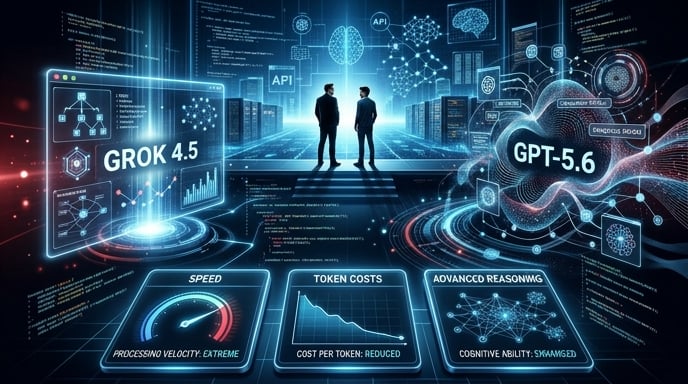
Another Week, Another AI Heavyweight Arrives
The artificial intelligence industry has apparently decided that peaceful petly releasing a model, publishing technical documentation, and letting developers test it, the leading AI companies now prefer something closer to a heavyweight boxing promotion. There are rival announcements. Bold performance claims. Strategic timing. Occasionally, a billionaire throws a verbal folding chair into the ring.
That brings us to Grok 4.5.
SpaceXAI officially introduced Grok 4.5 on July 8, describing it as the company’s smartest model for coding, agentic tasks, and knowledge work. Elon Musk had already created anticipation by saying strong feedback from private beta customers convinced the company to move quickly toward a public release. ng attracted nearly as much attention as the model itself.
Reports said OpenAI was preparing to expand access to its GPT-5.6 model family during the same period. That transformed what could have been an ordinary software update into the latest chapter of the long-running competition between Musk and OpenAI.
Suddenly, Grok 4.5 was not merely a new chatbot model. It was a challenger arriving just as its biggest rival stepped into the spotlight.
Subtle? Not remotely.
Effective? Absolutely.
Musk Promises an “Opus-Class” Competitor
Musk pitched Grok 4.5 as an “Opus-class” model that runs faster, consumes fewer tokens, and costs less.
The reference matters.
Opus is the name Anthropic uses for its most capable Claude models. By invoking that label, Musk positioned Grok 4.5 alongside the premium end of the AI market rather than presenting it as a modest upgrade for casual chatbot users.
That is an ambitious comparison.
It also reflects how the AI industry increasingly markets models. Companies no longer talk only about benchmark scores or parameter counts. They talk about model “classes,” practical abilities, speed, reliability, and operating costs.
Developers care about intelligence, of course. However, intelligence alone does not pay the cloud bill.
A model may produce brilliant answers, but businesses will hesitate if every request burns through tokens like a sports car burns through fuel. Musk’s promise therefore combines three highly attractive ideas: strong performance, quicker responses, and lower costs.
SpaceXAI has since listed Grok 4.5 at $2 per million input tokens and $6 per million output tokens through its API. The company also offers configurable reasoning levels, allowing developers to select low, medium, or high reasoning effort. , that makes Grok 4.5 more than a flashy chatbot. It becomes a serious candidate for software teams building AI-powered products at scale.
Built for More Than Clever Conversation
Grok began life with a reputation for personality.
It was positioned as the less restrained, more irreverent alternative to conventional AI assistants. That helped the product stand out. It also encouraged people to view Grok primarily as a chatbot attached to X.
Grok 4.5 is trying to push beyond that image.
SpaceXAI says the model was built for coding, agentic tasks, and knowledge work. Those three categories reveal where the commercial AI market is heading. odels help developers write, review, explain, and repair software. Knowledge-work models summarize documents, analyze information, prepare reports, and support business decisions. Agentic models go further by completing multi-step tasks, selecting tools, and working through problems with less human supervision.
In other words, the industry is moving away from AI that merely answers questions.
The new goal is AI that does things.
SpaceXAI also says Grok 4.5 was trained with fresh datasets covering science, engineering, and mathematics. The model supports a context window of 500,000 tokens, giving it room to process large collections of code, reports, instructions, or other material during a single session. es it potentially useful for serious workloads.
It can still chat, naturally. But SpaceXAI would clearly prefer developers to see Grok 4.5 as a worker rather than a wisecracking digital roommate.
Cursor Helps Shape the New Grok
One of the most interesting parts of the launch involves Cursor, the popular AI coding environment.
SpaceXAI says Grok 4.5 was trained alongside Cursor. Reports also described the model as using supplemental coding data connected to Cursor’s development ecosystem. ationship could give Grok 4.5 a practical advantage.
Coding benchmarks are useful, but laboratory tests cannot perfectly reproduce the messy reality of software development. Real programmers jump between incomplete files, outdated documentation, mysterious dependencies, and functions written by someone who apparently considered readable variable names a personal insult.
Training informed by a working coding platform may help a model understand those less glamorous conditions.
It also shows how AI companies are tightening their relationships with developer tools. Models no longer live in isolation. They sit inside editors, terminals, repositories, cloud systems, and automated workflows.
SpaceXAI now provides instructions for using Grok 4.5 through Grok Build and the company’s API. Developers can place it inside agent loops, coding environments, or their own applications. The documentation even supports OpenAI-compatible client libraries, reducing the amount of technical surgery required to switch models. t point matters enormously.
A model may impress during a demonstration, but developers adopt tools that fit into existing systems. Easy integration turns curiosity into actual usage.
GPT-5.6 Complicates the Celebration

Grok 4.5 did not arrive in an empty market.
OpenAI was simultaneously preparing a broader rollout of GPT-5.6, its newest model family. According to the reports, GPT-5.6 comes in three versions: Sol, Terra, and Luna. esents the flagship offering. OpenAI reportedly designed it for advanced agentic work, including demanding tasks in coding, biology, and cybersecurity.
Terra targets everyday professional work. It appears intended for users who need strong performance without deploying the largest model for every email, spreadsheet, or research task.
Luna focuses on speed and affordability.
That structure reflects an important change in AI development. Companies increasingly recognize that one model cannot efficiently serve every purpose. A cybersecurity researcher, a marketing assistant, and a customer-service bot do not need identical levels of reasoning.
Model families let customers choose the right balance.
OpenAI’s rollout therefore challenges Grok 4.5 on several fronts. Sol competes for high-end performance. Terra targets broad workplace adoption. Luna fights for cost-sensitive applications.
Grok 4.5 must prove it can compete with that flexibility, not merely win a cherry-picked benchmark or produce a faster coding demo.
The AI contest has become a portfolio war.
Every major laboratory wants a premium brain, a dependable daily worker, and an economical speedster parked in the same digital garage.
The Musk–OpenAI Rivalry Adds Extra Voltage
The overlap between the releases would have generated attention regardless of the personalities involved.
But these are not ordinary competitors.
Musk helped co-found OpenAI in 2015 and left its board in 2018. Years later, he sued OpenAI and its leadership, arguing that the organization had abandoned commitments connected to its original nonprofit mission. A jury rejected his case in 2026 after concluding that he had waited too long to bring the claims. tory gives every product announcement an additional layer of drama.
When OpenAI launches a major model and Musk announces a rival within hours, observers naturally see more than coincidental scheduling. The releases become proxies for a broader dispute over who should lead AI, how the technology should develop, and which organization can build the most capable systems.
Still, the personal rivalry should not obscure the product questions.
Users will not choose a model merely because one chief executive posted the spicier message.
Developers will test accuracy. Businesses will compare costs. Researchers will examine reliability. Security teams will investigate vulnerabilities. Ordinary users will decide whether the tools genuinely improve their work or simply create more tabs to keep open.
The drama gets people watching.
Performance keeps them paying.
Grok 4.5 must therefore survive the least glamorous but most important part of any launch: sustained use by people who do not care about billionaire feuds.
Efficiency Becomes the New Battleground
For years, AI companies competed primarily on intelligence.
Who had the smartest model? Who topped the benchmark? Who could solve the hardest mathematics problem while everyone else stared nervously at the leaderboard?
That competition continues, but efficiency has become nearly as important.
Both Musk and OpenAI are emphasizing speed and affordability in their newest model offerings. Business Insider noted that companies have become increasingly conscious of token spending, pushing AI laboratories to develop models that cost less to operate. ft makes sense.
Businesses do not buy benchmark scores. They buy outcomes.
A slightly smarter model may not win if it costs five times more to handle the same workload. An inexpensive model may also lose if employees must constantly correct its mistakes.
The winning system must find the sweet spot: capable enough to be useful, fast enough to feel responsive, and cheap enough to deploy widely.
Grok 4.5’s configurable reasoning effort directly addresses that problem. Developers can reserve high reasoning for difficult tasks while using lower settings for simpler requests. That may prevent users from paying for a philosophical expedition when they only wanted a function renamed. Sol, Terra, and Luna lineup follows a similar logic through separate models.
Different packaging. Same economic reality.
The AI industry has entered its fuel-efficiency era—and the engines remain enormous.
Public Access Turns Marketing Into Measurement
Before a public launch, companies control most of the story.
They select demonstrations. They choose benchmarks. They publish favorable examples. They decide which capabilities deserve the largest font on the announcement page.
Public access changes everything.
Once developers start testing Grok 4.5, independent comparisons will examine its coding performance, instruction following, factual reliability, tool use, latency, and cost.
Users will also discover the strange failures that polished launch materials never mention.
Can the model maintain consistency across a large codebase? Can it follow a complicated instruction without wandering off? Does it cite reliable information? Can it recover after making an incorrect assumption? Will it complete a multi-step task, or confidently declare victory halfway through?
Those questions determine whether an agentic model works outside a controlled demonstration.
SpaceXAI’s API release gives developers immediate access to that testing ground. Grok 4.5 is available for coding tools, custom applications, enterprise workflows, and automated agents, although the company’s documentation says API-console availability in the European Union is expected later in July. ic launch therefore marks the beginning of Grok 4.5’s real examination.
Musk has made the claim.
Now thousands of developers get to grade the homework.
They are not known for giving participation trophies.
More Competition Is Good—Mostly
The increasingly crowded AI market creates obvious benefits.
Competition pushes companies to improve models more quickly. It pressures providers to reduce prices. It gives developers alternatives when one platform becomes too expensive, too restrictive, or too unreliable.
Grok 4.5 adds another credible option to a field that already includes OpenAI, Anthropic, Google, and several fast-growing challengers.
However, rapid competition creates risks too.
Companies may rush releases to seize attention. Benchmark marketing may become more aggressive than transparent. Important questions about safety, bias, security, and reliability can get buried beneath claims about speed and intelligence.
Agentic capabilities raise the stakes further.
A chatbot that produces a bad paragraph creates an inconvenience. An autonomous system that modifies software, accesses tools, or executes a chain of actions can create a much larger mess.
That does not mean companies should stop building agents. It means users should treat capability claims as starting points rather than guarantees.
Grok 4.5’s public availability will provide more evidence. Independent researchers can test it. Developers can compare it with Claude and GPT-5.6. Enterprises can measure whether lower token costs translate into genuine savings.
The market needs that scrutiny.
AI announcements arrive wrapped in superlatives. Reality usually arrives wearing work boots and carrying a bug report.
Google Waits Just Outside the Ring
The Musk–OpenAI storyline dominates the headlines, but the competition extends well beyond those two camps.
Google is also expected to advance its Gemini model family, while Anthropic continues developing Claude as a major option for coding, business work, and advanced reasoning. Business Insider reported that Google was preparing another frontier-model release, adding yet another contender to an already congested launch calendar. ader context matters because AI leadership can change quickly.
A model may dominate developer conversations for several weeks, only to face a stronger or cheaper competitor shortly afterward. Features also spread rapidly. Large context windows, reasoning modes, tool use, coding agents, and multimodal capabilities rarely remain exclusive for long.
The result resembles a technological relay race in which nobody hands over the baton. Everyone keeps sprinting.
For customers, this creates both opportunity and confusion.
More options mean greater leverage. They also make long-term planning difficult. A company can spend months integrating one model, then discover that a rival offers better performance at half the price.
This uncertainty encourages developers to build flexible systems that can switch providers rather than depending completely on one laboratory.
Grok 4.5 benefits from entering this competitive market with API access and compatibility options.
But it will not receive much breathing room.
In frontier AI, the newest model starts aging the moment the announcement goes live.
The Real Contest Starts Now
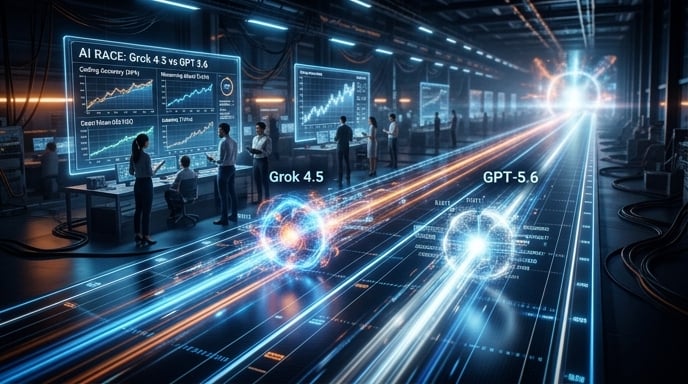
Grok 4.5 arrives with an impressive sales pitch.
SpaceXAI describes it as the company’s strongest model for coding, agents, and knowledge work. Musk says it offers Opus-level performance with greater speed, improved token efficiency, and lower costs. The API pricing makes it attractive enough for developers to investigate seriously. meanwhile, is countering with a three-model GPT-5.6 family designed to cover advanced reasoning, everyday work, and inexpensive high-speed tasks.
The rivalry makes excellent theatre.
Yet the outcome will not depend on launch-day applause.
Grok 4.5 must prove that it can write dependable code, complete agentic workflows, handle large contexts, avoid costly errors, and remain useful under the unpredictable conditions of real work.
OpenAI must demonstrate the same qualities with GPT-5.6.
The winners may differ by task. One model could excel at coding while another handles research better. A cheaper model may dominate high-volume automation even if a premium rival produces stronger individual answers.
That is ultimately healthy.
The AI market does not need one universal champion. It needs capable systems competing on measurable value.
Grok 4.5 has stepped into that contest with considerable noise, confidence, and ambition.
Now comes the quiet part: opening the model, submitting the prompt, and seeing whether the answer deserves the hype.
Sources
- Mashable — Musk’s Grok 4.5 launch
- BeInCrypto — Elon Musk rushes Grok 4.5 to the public as OpenAI prepares GPT-5.6
- Business Insider — OpenAI’s GPT-5.6 rollout collides with Musk’s latest Grok release
- Bitcoin Ethereum News — Grok 4.5 pitched as a cheaper Opus rival
- SpaceXAI — Introducing Grok 4.5
- SpaceXAI Documentation — Grok 4.5 model overview
- SpaceXAI Documentation — API release notes and pricing
The Kingy Brief
Get The Kingy Brief.
AI changes, original tests and one practical thing to try. Fridays at 09:00 Vancouver time.
Free · Double opt-in · Unsubscribe anytime
Sign up for The Kingy Brief on Beehiiv.
Signup help and newsletter schedule
Signup form provided by Beehiiv. After submitting, check your inbox for "Confirm your subscription to The Kingy Brief" and open its confirmation link. Check Spam or Promotions if you cannot find it.
Fridays at 09:00 Vancouver time: source-checked AI changes, original tests and one practical thing to try. The weekly restart begins October 9, 2026. We skip a week when there is not enough verified material. Free. Unsubscribe anytime.