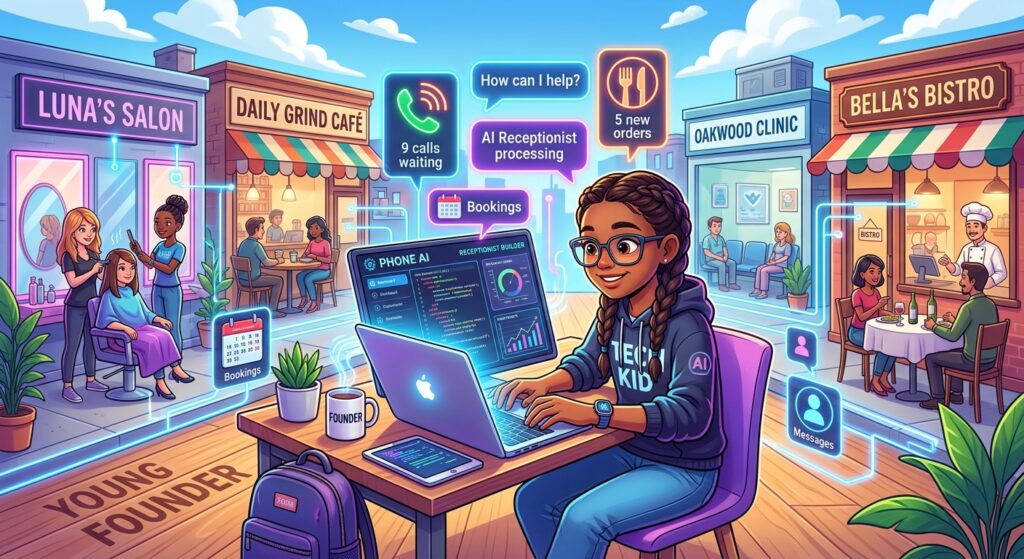
The Founder Is 12. The Problem Is Very Adult.
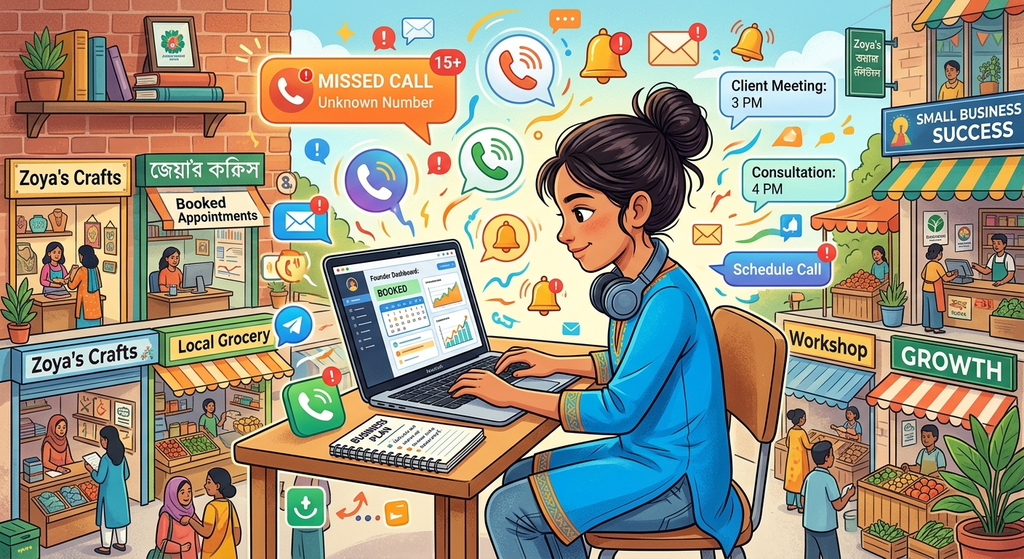
Small businesses have a painfully simple problem: the phone rings, nobody answers, and money quietly walks out the door.
That is the problem Mana Jampala, a 12-year-old founder from British Columbia, Canada, is trying to solve with Voxa, an AI-powered receptionist built for small businesses. According to Business Insider, Jampala launched Voxa in November 2025 after noticing that her father’s workplace often missed calls because the team was too busy to catch every inquiry.
That detail matters. This is not a kid building a chatbot because “AI is cool.” It starts with a boring business bottleneck. Boring is good. Boring pays invoices.
Voxa is designed to answer calls around the clock, book appointments, record restaurant orders, manage missed calls, and create summaries after conversations. Business Insider reported that the product is already handling hundreds of calls, though Jampala is still working on landing her first paying customer.
So, no, this is not yet a billion-dollar empire run between math class and basketball practice. It is an early-stage product. But it is also a sharp signal. AI tools are lowering the startup floor so dramatically that a 12-year-old can now build something that looks, sounds, and behaves like real business software.
That should make founders excited. It should also make them mildly nervous.
Voxa Wants to Catch the Calls Businesses Miss
Small businesses often live and die by responsiveness. A missed call can mean a missed appointment, a missed dinner reservation, a missed lead, or a missed sale. One missed call is annoying. Hundreds become a leak in the boat.
Voxa steps into that gap as a voice assistant that can answer calls when human staff cannot. Business Insider describes it as a 24/7 AI receptionist that helps companies field calls and avoid losing potential customers.
The target market makes sense. Big companies already have call centers, software stacks, and customer-support workflows. Small businesses often have a person at the front desk doing six jobs at once, plus a manager who is somehow also the IT department, finance department, and emergency plumber.
That is where AI receptionists become interesting. They do not need lunch breaks. They do not panic when three people call at once. They do not forget to write down the customer’s name because someone spilled coffee near the register.
Of course, the real test is not whether an AI can answer a clean demo call. The real test is mess. Accents. Background noise. Half-finished questions. Angry customers. Weird requests. People who begin every conversation with “Yeah, so basically…”
Let’s Data Science noted that the next meaningful signal for Voxa will be paying-customer traction and evidence that the product can handle messy calls reliably. That is exactly right. A voice agent is only useful if it survives reality.
The Origin Story: A Workplace, Missed Calls, and a Lightbulb
Jampala told Business Insider she got the idea while visiting her father’s workplace when she was 11. She noticed the team missed many calls because they were small, busy, and stretched thin. Some calls went ignored. Others simply slipped through unnoticed.
That is the kind of observation founders love to romanticize later. But the core insight is practical: small teams do not miss calls because they hate customers. They miss calls because humans have limits.
AI products often sound abstract when companies describe them. “Autonomous workflow orchestration.” “Agentic customer engagement.” “Conversational enterprise intelligence.” Translation: software that does some work so people can stop drowning.
Voxa’s pitch is cleaner. It answers the phone.
That clarity helps. A restaurant owner, clinic manager, salon operator, or home-service business does not need a lecture on transformer models. They need to know whether the thing can pick up, understand the caller, book the appointment, take the order, or summarize the interaction without causing chaos.
The product still appears early. Business Insider reported that Voxa is less than a year old and is seeking its first paying customer. That means the story should not be oversold. This is not proof that AI receptionists have conquered small business.
But it is proof of something else: young builders can now move from idea to working prototype at ridiculous speed.
ChatGPT, Claude, and the New Builder Stack
The most important part of the story may not be Voxa itself. It may be how Jampala built it.
Business Insider reported that Jampala initially used OpenAI’s ChatGPT to iterate on small pieces of basic code, then later switched to Anthropic’s Claude coding system because she found it more helpful. She said she preferred asking AI to write small snippets rather than generating the whole codebase at once, then reviewing, testing, and fixing each piece.
That is a smarter workflow than many adults use.
The lazy version of AI coding is: “Build my app.” Then the model produces a pile of code, something breaks, and the user stares at the screen like it insulted their ancestors.
Jampala’s method is more disciplined. Small request. Inspect. Test. Fix. Repeat. That turns AI from a magic vending machine into a coding partner.
She also reportedly moved from third-party systems to her own custom-built backend. The basic system took two weeks, but she continues adding code, fixing bugs, and building features.
That detail is crucial. AI helped accelerate the build, but the product did not appear by fairy dust. Someone still had to test it. Someone still had to understand enough to debug it. Someone still had to decide what mattered.
AI lowers the barrier. It does not eliminate the work.
Generation Alpha Enters the Startup Chat
Jampala belongs to Generation Alpha, the cohort growing up with AI, smartphones, online communities, and low-friction software tools as normal background noise. Business Insider frames her as part of a new generation of founders using advanced technology from a very young age.
She reportedly became interested in AI at age 9, attended Scratch coding camps, learned Python, won a special prize in a collegiate-level science competition while visiting India, and earned a 1517 Medici Project grant. The 1517 fund gives grants to high school students, college students, and dropouts who are building startups.
The easy headline is “12-year-old builds AI company.” The deeper story is that the startup learning curve is compressing.
A decade ago, building a voice receptionist required specialized engineering knowledge, infrastructure, APIs, speech systems, and probably a team. Today, the pieces are more accessible. Cloud tools exist. Coding assistants exist. Voice-agent frameworks exist. Tutorials exist. Discord communities exist. The internet has become a messy, chaotic, occasionally brilliant apprenticeship machine.
That does not mean every kid with a laptop becomes a founder. Most will not. Ideas are cheap. Execution still punches people in the face.
But the ceiling has moved. A motivated young builder can now prototype products that once required adult teams, venture money, and a suspicious number of standing meetings.
Building Young Can Be Lonely
There is a less glossy side to the story.
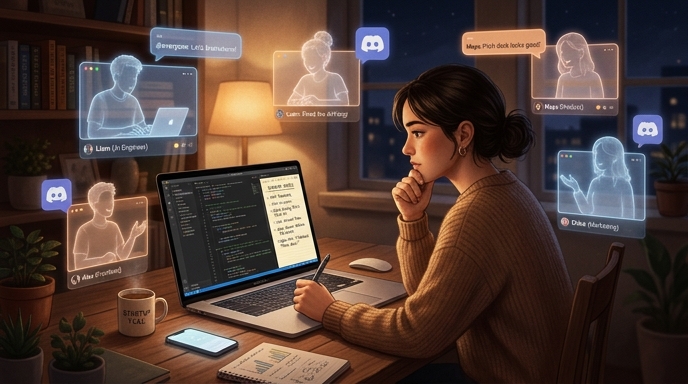
Jampala told Business Insider that working on her startup can feel isolating because she does not know many people her age nearby doing the same thing. She said she has connected with other young builders online, including through Discord, and recommended that other young founders look for community.
That detail cuts through the hype.
The public loves prodigy stories. They are neat. They sparkle. They make excellent headlines. But being unusually early at anything can be lonely. A 12-year-old founder is not just competing with technical challenges. She is also operating in a world built for adults.
Potential customers ask obvious questions. How old are you? Are your parents helping? Can you support this product? Will this still exist in six months? Those are not unfair questions. They are business questions.
Business Insider reported that Jampala encountered age-focused reactions when pitching local businesses in person. Online outreach, she said, tended to receive more product-focused responses.
That difference is revealing. In person, her age becomes part of the pitch whether she wants it to or not. Online, the product gets more room to stand on its own.
The lesson is not “ignore age.” The lesson is simpler: customers care about trust. If Voxa works, businesses may listen. If it fails, no charming founder story will save it.
The Sales Problem May Be Harder Than the Tech
The hardest part of Voxa may not be building the AI receptionist. It may be convincing small businesses to use it.
Jampala told Business Insider that she has tried cold-calling and using her network for introductions. She also had a call with the CEO of her city’s Chamber of Commerce. Her current strategy focuses on warm introductions because they convert better than cold outreach.
That is classic startup reality. Distribution beats elegance. A product can be clever, but if nobody pays, it becomes a science fair project with a nicer landing page.
Small businesses may also hesitate because phone calls are sensitive. A missed call hurts. A badly handled call can hurt more. If a customer calls a local restaurant and gets a robotic mess, that restaurant may lose the order and the customer’s patience.
Jampala acknowledged that some businesses worry customers may feel ignored when AI enters the workflow. She said she believes people will become more comfortable with this over the next few months to a year as more businesses adopt AI.
That may happen. But adoption will depend on quality. The AI needs to know when to answer, when to ask clarifying questions, when to summarize, and when to hand off to a human.
A receptionist is not just a voice. It is judgment wearing a headset.
Why AI Receptionists Are Suddenly Everywhere
Voxa is part of a broader shift toward voice agents for small-business operations. Let’s Data Science described the story as a signal that hosted coding assistants, voice stacks, and prompt-driven agent builders are making it easier to ship customer-facing automation.
That is the real trend. AI is moving from text boxes into workflows. It is answering calls, scheduling appointments, qualifying leads, generating summaries, and handling repetitive front-office tasks.
The appeal is obvious. A small business cannot always hire another receptionist. It may not have the budget, workload consistency, or management bandwidth. But software that handles overflow calls? That is easier to consider.
Still, there is a gap between “AI can do this sometimes” and “AI can do this safely every day.” Let’s Data Science points to reliability, privacy, escalation, and paid-customer traction as the important factors to watch.
That is where the market will separate toys from tools.
A useful AI receptionist must do more than sound polite. It needs low-latency speech recognition. It needs accurate dialogue handling. It needs integrations with calendars, order systems, or customer records. It needs clear call-recording policies. It needs a human fallback when confidence drops.
In other words, the demo is the easy part. Operations are the dragon.
Voxa Agents Expands the Idea
Jampala has also launched Voxa Agents, a platform that lets users create AI agents through prompts, according to Business Insider. The idea is that customers can use plain language to build the kind of agent they need.
That expands the story beyond phone calls.
Prompt-built agents are becoming a major theme in AI software. Instead of asking users to code workflows from scratch, platforms increasingly let them describe what they want. “Answer customer questions.” “Summarize calls.” “Book appointments.” “Send follow-ups.” The software then turns the instruction into an agent-like workflow.
This is powerful because it changes who can build automation. A nontechnical business owner may not know APIs, backend logic, or routing systems. But they do know their own workflow. They know what customers ask. They know which calls matter. They know when a human needs to step in.
The best AI tools will turn that domain knowledge into working systems without forcing every user to become a software engineer.
But again, caution. Prompt-built agents can create brittle workflows if users overtrust them. A system that handles real customers needs guardrails. It needs testing. It needs limits. It needs logs. It needs humans who check whether the thing is helping or quietly making a mess in the corner.
Automation without accountability is just chaos with a subscription fee.
The Bigger Meaning: AI Is Changing Who Gets to Build
The Voxa story is not mainly about replacing receptionists. It is about who gets to create software now.
Jampala’s path shows how AI coding tools can help young founders build faster, especially when they use those tools carefully. Business Insider reported that she reviewed and tested small pieces of AI-generated code rather than outsourcing the whole codebase to a model.
That is the serious lesson.
AI does not make expertise irrelevant. It changes how expertise develops. A young builder can now learn by doing at higher speed. They can ask for code, test it, break it, fix it, and gradually develop a mental model of the system.
This resembles apprenticeship, except the apprentice has access to a tireless assistant that can explain syntax, suggest fixes, and generate scaffolding. Sometimes it will be wrong. Sometimes spectacularly wrong. But even then, debugging becomes part of the education.
The startup world should pay attention. The next wave of founders may not wait for college, corporate experience, or permission. They may start with a real-world annoyance, wire together AI tools, and test products directly with users.
Most will fail. That is normal. Startups are failure machines with occasional fireworks.
But some will learn faster than the market expects.
The Hard Questions Still Matter
The story is fun. It is also easy to overinflate.
Voxa has reportedly handled hundreds of calls, but Business Insider says Jampala is still pursuing her first paying customer. That puts the company in the early validation stage. The product may be promising, but it has not yet proven durable commercial demand.
The next questions are obvious.
Will small businesses pay for it? Will customers tolerate AI answering the phone? Can the system handle unusual calls? Can it protect customer information? Can it escalate gracefully? Can it work across industries with different needs? Can a young founder support customers while continuing school and normal life?
None of those questions kill the story. They make it real.
Let’s Data Science framed Voxa as a low-scale but useful signal rather than proof that small-business voice agents are already solved. That is the right reading.
The hype version says: a 12-year-old built the future.
The sober version says: accessible AI tools helped a young founder build an early customer-facing product for a real business problem, and now the market will test whether it works.
The sober version is less sparkly. It is also more interesting.
What Comes Next for Jampala
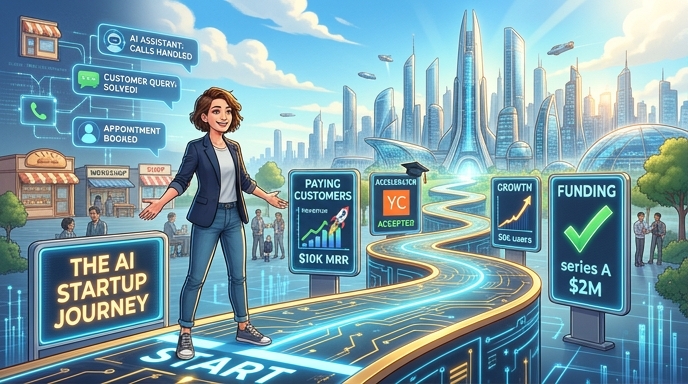
Jampala has ambitious plans. She told Business Insider that her ideal path would involve bootstrapping for a year or two, then getting into an accelerator such as Y Combinator or Andreessen Horowitz’s accelerator ecosystem, followed by steady growth and eventually venture capital when the company reaches the right stage.
That is a very startup-coded roadmap. Bootstrap. Accelerate. Scale. Raise. Repeat until either the rocket launches or the spreadsheet catches fire.
For now, though, the immediate milestone is simpler: paying customers.
That is where every young company gets its first real report card. Usage is encouraging. Demos are useful. Press is nice. But revenue changes the conversation. A paying customer says, “This solves a problem badly enough that I will trade money for it.”
If Voxa gets there, the story becomes much more serious. If it does not, Jampala still gains something valuable: experience building, selling, testing, and learning in public at an age when most people are still figuring out how to survive group projects.
Either way, the larger signal remains strong. AI is giving younger builders sharper tools. Some will use them for homework shortcuts. Others will use them to build companies.
The second group is where things get spicy.
A Small Startup Story With a Big Signal
Mana Jampala’s Voxa is not proof that AI receptionists will take over every small business. It is not proof that every 12-year-old should launch a startup. It is not proof that coding assistants magically turn ideas into companies.
It is proof that the distance between noticing a problem and building a working product has shrunk.
That matters.
A 12-year-old saw missed calls at a small workplace and built an AI receptionist to answer them. She used ChatGPT, then Claude, tested code piece by piece, moved toward her own backend, handled early outreach, encountered skepticism, and kept going.
That is the story.
It is charming, yes. But it is also practical. The future of AI may not arrive first as some grand machine overlord with glowing eyes and dramatic music. It may arrive as a polite phone agent booking a haircut while the human receptionist is busy sweeping the floor.
Small businesses do not need AI to sound futuristic. They need it to pick up the phone.
And if a 12-year-old can build that, the rest of the software industry should maybe drink a coffee and sit up straight.
Sources
- Business Insider — “This 12-year-old founder created an AI-powered receptionist to help small businesses build clientele.”
- AOL — “This 12-year-old founder created an AI-powered receptionist to help small businesses build clientele.”
- Let’s Data Science — “12-year-old founder launches AI receptionist for small businesses.”
The Kingy Brief
Get The Kingy Brief.
AI changes, original tests and one practical thing to try. Fridays at 09:00 Vancouver time.
Free · Double opt-in · Unsubscribe anytime
Signup help and newsletter schedule
Signup form provided by Beehiiv. After submitting, check your inbox for "Confirm your subscription to The Kingy Brief" and open its confirmation link. Check Spam or Promotions if you cannot find it.
Fridays at 09:00 Vancouver time: source-checked AI changes, original tests and one practical thing to try. The weekly restart begins October 9, 2026. We skip a week when there is not enough verified material. Free. Unsubscribe anytime.