
China’s AI race is no longer just about who builds the smartest chatbot.
That was the old story. Simple. Clean. A little too cute.
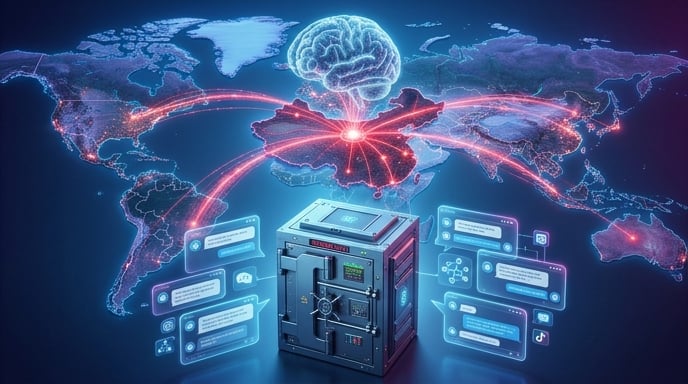
The new story is bigger and more uncomfortable. Beijing appears to be moving toward a strategy that treats advanced AI models as national power tools, not ordinary tech products. At the same time, analysts warn that China is using AI and information channels to shape political debates overseas.
So, two things are happening at once.
China may restrict foreign access to its best AI models. And China-linked actors appear interested in influencing how the rest of the world talks about AI.
That is not a coincidence. That is strategy.
The core idea is blunt: control the strongest systems, then shape the conversation around them.
Beijing Wants a Tighter Grip on Top AI Models
Chinese authorities have reportedly held talks with major tech firms about limiting overseas access to China’s most advanced AI models. Reuters reported that officials met with companies including Alibaba, ByteDance, and Z.ai to discuss possible restrictions on frontier AI systems, including models that have not yet been released.
No final policy has been announced. That matters. This is not yet a finished export-control regime.
But the direction is clear.
Beijing is looking at AI through a national-security lens. The discussions reportedly included possible penalties for leaks of protected AI technology and tighter scrutiny of foreign funding in Chinese AI startups.
That changes the character of the AI race.
For years, software moved around the world with few borders. Download it. Fork it. Fine-tune it. Build something weird on top of it. That openness helped Chinese models gain attention fast.
Now Beijing seems less willing to let its most powerful systems travel freely.
The reason is obvious. A top AI model is not just an app. It can write code, analyze documents, automate workflows, assist research, support cyber operations, and help companies move faster. In the wrong hands, it can also create risk.
China knows this. So does the United States.
The Open-Model Era Just Hit a Wall
Chinese AI companies gained momentum partly because they offered strong models at attractive prices. Alibaba’s Qwen, ByteDance’s Doubao, DeepSeek’s systems, and Z.ai’s GLM models helped prove that China could compete on performance, cost, and speed.
That shook the market.
American AI firms still dominate the top tier in many areas. But China has become very good at building models that are cheap enough, capable enough, and flexible enough to tempt developers outside the U.S. The Atlantic recently described Z.ai’s GLM-5.2 as a cheaper Chinese alternative that has caught attention as companies worry about the rising cost of AI agents.
That matters because cheap capability spreads quickly.
Developers love useful tools. Businesses love lower costs. Governments love alternatives to U.S. dependence. Europe, especially, has been searching for ways to avoid becoming permanently tied to American AI infrastructure.
Chinese models offered one possible route.
Now that route looks less stable.
If Beijing decides that its best models must stay under domestic control, foreign companies may still get access to older, weaker, or tightly managed systems. But the real prize the frontier layer could become harder to reach.
That would turn Chinese AI from an open bargain into a managed export.
Europe Is Stuck in the Middle
Europe has a problem. It wants AI sovereignty, but it does not yet have enough of the full AI stack.
It has talent. It has regulation. It has research. It has serious companies.
But it still depends heavily on foreign cloud providers, foreign chips, foreign models, and foreign platforms. That dependence creates a strategic headache.
If Europe leans on U.S. models, it remains exposed to American pricing, American export rules, and American corporate priorities. If it leans on Chinese models, it faces another set of risks: censorship concerns, data-security worries, political pressure, and now possible Chinese access restrictions.
That is not sovereignty. That is vendor roulette with flags attached.
The Decoder has argued that China’s possible model curbs could put Europe in an especially awkward position, because low-cost Chinese models had become attractive alternatives to expensive U.S. systems.
This is the brutal lesson.
You cannot rent strategic independence forever.
If Europe wants real AI sovereignty, it needs compute, chips, energy, data centers, model labs, deployment infrastructure, and competitive applications. Speeches will not do the job. Neither will committees with elegant acronyms.
AI sovereignty needs machines. Lots of them.
China Is Also Fighting Over the Narrative
The second part of the story is not about model access. It is about message control.
The Atlantic reported that China-linked actors have used AI tools to support influence operations abroad. The report described efforts involving political content around U.S. AI data centers and other sensitive issues.
That is where the story gets spicy.
AI data centers have become a major political target in the U.S. They require huge amounts of land, electricity, water, and local infrastructure. Many communities do not want them nearby. Gallup found in May 2026 that 70% of Americans opposed building an AI data center in their local area.
Those concerns are not fake. People have real reasons to worry about power grids, environmental impact, noise, tax breaks, and corporate giveaways.
But influence campaigns do not need to invent anger. They only need to amplify it.
That is the oldest trick in the propaganda cookbook. Find a real fracture. Pour gasoline into it. Then act shocked when the room catches fire.
AI Makes Propaganda Cheaper and Faster

Old propaganda took work.
You needed writers, translators, fake accounts, local research, graphic designers, and time. Lots of time.
AI compresses that process.
A small team can now generate posts, comments, slogans, images, scripts, and localized talking points at scale. It can test different messages. It can mimic local language. It can turn one political grievance into a dozen content formats before lunch.
That does not make every anti-data-center protest suspicious. That would be lazy analysis.
Local opposition can be completely legitimate. Many communities simply do not want giant industrial computing facilities dropped into their neighborhoods.
But AI changes the speed and scale of manipulation. Foreign actors can enter existing debates and make them louder, uglier, and more divisive.
The National Interest and AEI have both argued that China has an incentive to stir U.S. controversy over AI infrastructure because slowing American data-center construction could weaken U.S. AI competitiveness.
That argument is plausible. It is also difficult to prove in every individual case.
The stronger point is this: China benefits when America fights itself into paralysis over infrastructure.
That is true whether Beijing directly causes the fight or simply cheers from the balcony.
The Training Data Problem Is Worse
The messiest issue is not fake posts. It is training data.
Modern chatbots learn from huge bodies of text. If the information environment gets polluted, the model may absorb that pollution. It may not “believe” propaganda like a person does. But it can reproduce patterns from the material it learned.
The Atlantic reported concerns that Chinese state media and state-aligned content can influence chatbot responses, especially in Chinese-language contexts.
This is a major problem.
If independent reporting sits behind paywalls while state-backed content remains free and widely available, AI crawlers may ingest more of the state-backed material. Over time, a chatbot may produce an answer that sounds neutral but quietly reflects a filtered information diet.
That is propaganda with a clean user interface.
No red banner. No shouting. No clunky slogan.
Just a smooth answer in a calm tone.
That may be more effective than old-school state media because users often treat chatbot answers as synthesized knowledge rather than partisan messaging.
The danger is not that every answer becomes fake. The danger is subtler. The answer may become tilted.
A little softer on Beijing. A little harsher on critics. A little vague around repression. A little more generous toward official narratives.
Small distortions scale beautifully.
Chinese AI Models Can Be Strong and Censored
Here is the point many people keep missing: a Chinese AI model can be technically excellent and politically constrained at the same time.
Those ideas do not conflict.
A model can write great code and avoid Tiananmen. It can summarize business documents and dodge questions about Xi Jinping. It can help with math, translation, and software development while carrying political boundaries that users may not fully understand.
That is the real risk.
Not that Chinese AI is useless. It is not.
Not that every Chinese model is propaganda. That is false.
The risk is that useful systems spread widely while their limits remain hidden, normalized, or ignored.
Chinese AI companies operate under domestic rules that require alignment with state priorities. That shapes what systems can say, what they avoid, and how they handle sensitive political topics.
For enterprise users, this creates a practical question. Do you know what your model refuses to discuss? Do you know how it frames geopolitical issues? Do you know whether it treats state-approved narratives as neutral background?
Most companies do not ask those questions until the problem is already embarrassing.
The U.S. Is Playing the Same Control Game
China is not acting in a vacuum.
The United States has already used export controls to limit China’s access to advanced chips. U.S. companies have also tightened access to powerful AI tools. The Financial Times reported that Anthropic moved to close loopholes that allowed Chinese companies to access Claude through overseas subsidiaries and cloud workarounds.
That is the new AI battlefield.
Not just model versus model.
Access versus access.
Chip versus chip.
Cloud versus cloud.
API key versus national-security review.
Reuters also reported that DeepSeek is developing its own inference chip as China tries to reduce reliance on Nvidia and other outside suppliers.
This is what strategic competition looks like when software becomes infrastructure.
The U.S. wants to stop China from using American chips and frontier models to accelerate its own capabilities. China wants to prevent its best models, talent, and technical secrets from leaking abroad.
Both sides call it security.
Both sides also call it fairness when they do it and protectionism when the other side does it.
Geopolitics: the world’s least charming mirror.
The New AI Race Is About Control
The old question was: who has the smartest AI?
The better question now is: who controls the stack?
That stack includes chips, data centers, power supply, model weights, APIs, training data, developer tools, app ecosystems, cloud platforms, payment rails, export rules, and information channels.
A country that controls only one layer does not control the system.
China understands this. The U.S. understands this. Europe is learning it the hard way.
That is why Beijing’s reported export-curb discussions matter. They suggest China may classify AI models by sensitivity, allowing broader access to basic systems while keeping the most advanced tools closer to home. Reuters reported that officials have discussed restrictions that could affect powerful future models and related technology transfers.
This would not end Chinese AI globalization. It would reorganize it.
China could still export useful models. It could still court developers. It could still offer cheaper alternatives to U.S. platforms.
But it may keep the crown jewels locked down.
That is not retreat. That is selective openness.
The Bigger Story: AI Is Becoming State Power
These two article sets point to one larger conclusion.
AI has become state power.
Not in some abstract think-tank way. In a practical way.
Governments now care who can access frontier models. They care who trains them. They care where the chips come from. They care which narratives appear in chatbot answers. They care which political fights get amplified online.
That makes AI different from normal software.
A word processor does not reshape national-security policy. A spreadsheet does not become a geopolitical battleground. A chatbot that writes code, summarizes intelligence, assists research, generates propaganda, and mediates public knowledge absolutely can.
China’s emerging strategy looks clear.
Build powerful systems. Protect the most advanced ones. Export enough to gain influence. Control domestic narratives. Push favorable narratives abroad. Reduce dependence on foreign chips. Make Chinese AI hard to ignore but easy for Beijing to govern.
That is not a side quest.
That is the main campaign.
What Happens Next

Do not expect China to slam the door shut on foreign AI users.
That would waste the global momentum Chinese models have built.
A more likely path is controlled access. Basic and mid-tier models may remain widely available. More advanced models may require approval, identity checks, security reviews, or domestic hosting. Frontier systems may stay inside China or go only to trusted partners.
The U.S. will keep tightening its own access rules. American AI labs will keep trying to block unauthorized Chinese use. China will keep building domestic chips. Europe will keep talking about sovereignty while racing to build enough infrastructure to make the word mean something.
And users will keep asking chatbots political questions without knowing what invisible hands shaped the answer.
That is the quiet part of the AI race.
The battle is not only over who builds intelligence.
It is over who controls intelligence, who rents it, who filters it, and who gets filtered by it.
Sources
- Reuters — Beijing is looking at curbing overseas access to China’s top AI models
- The Decoder — China eyes export curbs on its top AI models
- TIME — China AI models, Alibaba, ByteDance
- The Atlantic — China Is Abusing AI
- The Atlantic — China’s Answer to AI Sticker Shock
- The National Interest — How China Is Meddling in America’s AI Debate
- AEI — How China Is Meddling in America’s AI Debate
- Reuters — China’s DeepSeek developing its own AI chip
- Financial Times — Anthropic moves to close loopholes that allow Chinese access to Claude
- Gallup — Americans Oppose AI Data Centers in Their Area
The Kingy Brief
Get The Kingy Brief.
AI changes, original tests and one practical thing to try. Fridays at 09:00 Vancouver time.
Free · Double opt-in · Unsubscribe anytime
Signup help and newsletter schedule
Signup form provided by Beehiiv. After submitting, check your inbox for "Confirm your subscription to The Kingy Brief" and open its confirmation link. Check Spam or Promotions if you cannot find it.
Fridays at 09:00 Vancouver time: source-checked AI changes, original tests and one practical thing to try. The weekly restart begins October 9, 2026. We skip a week when there is not enough verified material. Free. Unsubscribe anytime.