
The Moment Everything Changes in Your Car

Picture this. You’re stuck in traffic, running late, and your stomach is growling. You don’t want to fumble with your phone, You don’t want to bark a rigid command at a voice assistant that barely understands you. You just want to talk, naturally, like you would to a co-pilot sitting right next to you.
That moment is here. General Motors just announced it’s rolling out Google Gemini to approximately 4 million vehicles across the United States. This isn’t a small pilot program. It isn’t a luxury-only feature. It’s one of the biggest AI deployments in automotive history, and it’s coming to your driveway via an over-the-air software update.
Buckle up. This is a big deal.
So, Which Cars Are Getting the Upgrade?
Let’s get straight to the question everyone’s asking: Is my car on the list?
If you own a model year 2022 or newer Cadillac, Chevrolet, Buick, or GMC vehicle equipped with Google built-in, you’re in. That covers a massive swath of GM’s lineup, from everyday Chevy Equinoxes to premium Cadillac Escalades. According to GM Authority, the rollout will happen in phases over several months.
When your vehicle is ready, you’ll get a notification right on your infotainment screen. There are a few requirements to keep in mind. You’ll need an active OnStar connection. You’ll need a signed-in Google account. And you’ll need to opt into the Gemini experience. Simple enough.
The update will initially launch in US English, with GM planning to expand to additional markets and languages over time. So if you’ve been waiting for your car to actually get you, your wait is almost over.
From “Hey Google” to Full-On Conversation
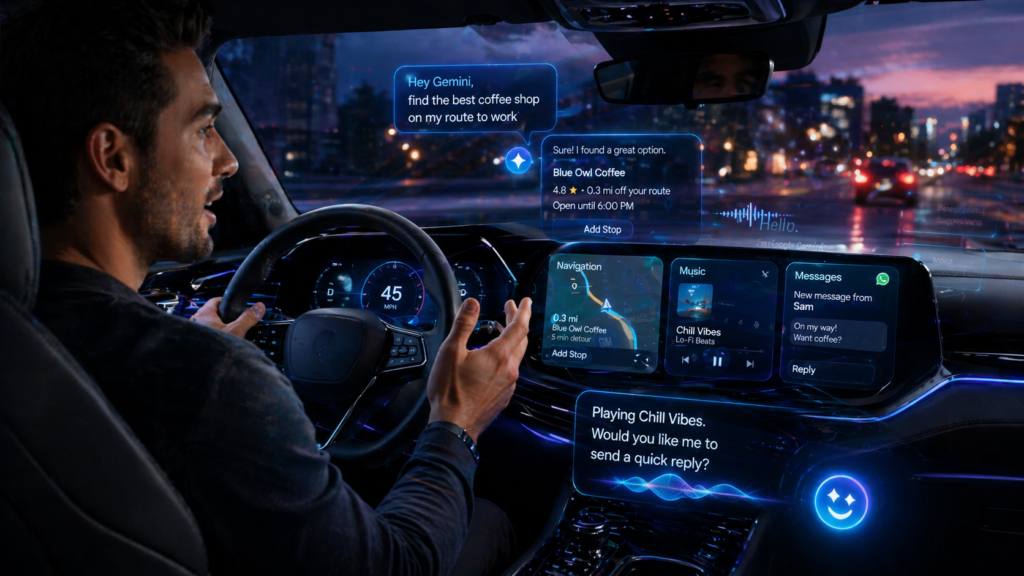
Here’s where things get genuinely exciting. The current Google Assistant in these vehicles works. But let’s be honest, it’s not exactly a joy to use. You have to phrase things just right. One wrong word and it stares back at you blankly. It’s like talking to someone who only speaks in formal legal documents.
Gemini changes that completely.
The Verge describes it as a “smarter, more intuitive AI assistant that continues to improve over time.” The key word there is conversational. Gemini lets you speak naturally. You can ask follow-up questions, you can change your mind mid-sentence. You can refine your request without starting the whole interaction over from scratch.
Think about what that actually looks like in practice. You ask for directions to a restaurant. Then you remember you need coffee first. You just say, “Actually, add a coffee stop on the way.” Done. No re-launching. No repeating yourself. The system holds the context of your conversation and rolls with it.
That’s not a small improvement. That’s a completely different experience.
What Can Gemini Actually Do in Your Car?
Okay, so it’s conversational. But what can it do? Quite a lot, as it turns out.
Autoweek breaks down the feature set, and it’s genuinely impressive. Here’s a taste of what Gemini brings to the cabin:
Navigation gets smarter. You can build multi-stop routes, refine them while driving, and even optimize for fuel costs or minimal detours. Ask it to find trailer-friendly parking or locate the nearest fuel stop, it handles it.
Messaging gets easier. Gemini can read your texts, draft replies, translate messages, and even toss in an emoji if you ask. All hands-free. All voice-driven.
Entertainment gets personal. Want a playlist that matches your mood? Ask for it. Want a quick summary of a podcast before you commit to an hour-long episode? Gemini’s got you. It tailors suggestions to your trip length, your vibe, and your preferences.
Your commute gets productive. This one’s underrated. Gemini can help you brainstorm ideas, prep for a meeting, or learn about a destination in real time. Your morning drive suddenly becomes useful time instead of wasted time.
For commercial drivers, truckers, delivery drivers, fleet operators, this is especially powerful. Route planning, fuel stop logistics, trailer-friendly parking searches. Gemini turns the cab into a mobile command center.
The OnStar Connection: 30 Years in the Making
Here’s something worth appreciating. This rollout didn’t happen overnight. It’s built on three decades of connected vehicle infrastructure.
GM’s Global Vice President of Product Management, Tim Twerdahl, put it perfectly: “Gemini delivers AI assistance to millions of drivers across every segment and price point for a wide range of everyday needs. That kind of scale is only possible because of the connected vehicle foundation GM has built through OnStar over the past 30 years.”
OnStar has been quietly building the backbone for this moment since 1996. Real-time connectivity. Emergency services. Remote diagnostics. That infrastructure is now the launchpad for one of the most ambitious AI deployments in the auto industry.
Automotive Addicts frames it well, GM isn’t just handing off the experience to a generic voice assistant. It’s using Gemini as a stepping stone toward something even bigger. A custom AI assistant, shaped by vehicle data, OnStar connectivity, and deep system knowledge, is reportedly coming later this year.
In other words, Gemini is the opening act. The headliner is still warming up backstage.
Why This Matters Beyond the Cool Factor
Let’s zoom out for a second. Why does this actually matter?
Voice assistants in cars have had a credibility problem for years. They promised convenience and delivered frustration. Drivers tried them once, got burned by a misunderstood command, and went back to tapping their phones at red lights, which is, you know, dangerous.
GM is betting that Gemini finally breaks that cycle. And the bet makes sense. When an AI assistant actually works, when it understands context, handles follow-ups, and doesn’t make you repeat yourself, people use it. And when people use it, they keep their eyes on the road.
That’s not just a tech win. That’s a safety win.
GM Authority also notes that GM crossed another milestone alongside this announcement, customers in nearly 750,000 Super Cruise-enabled vehicles have now driven one billion hands-free miles. That’s a staggering number. It shows that GM drivers are genuinely embracing advanced tech when it works well. Gemini is the next chapter in that story.
The Bigger Picture: GM’s AI-Forward Vision
This Gemini rollout isn’t a standalone move. It’s part of GM’s broader GM Forward strategy, a long-term vision for making vehicles smarter, more connected, and more useful in everyday life.
The company isn’t just slapping a chatbot onto an infotainment screen and calling it innovation. It’s building toward a future where the car knows you. Where it understands your preferences, your schedule, your routes, and your habits. Where it proactively helps instead of reactively responding.
The custom AI assistant coming later this year, the one that will tap into OnStar data and vehicle-specific knowledge, is the clearest signal of where this is heading. Imagine an assistant that knows your car’s maintenance schedule, your usual commute, your favorite gas station, and your preferred music for Monday mornings. That’s not science fiction anymore. That’s the roadmap.
As Automotive Addicts puts it, GM sees AI “not as a novelty feature, but as a core part of the future cabin experience.” The next version of talking to your car may feel less like issuing commands and more like having an informed co-pilot along for the ride.
What Drivers Are Saying
Not everyone is throwing a party, of course. Some GM owners have already voiced skepticism online. A few commenters on GM Authority’s coverage said they have zero interest in AI features and plan to skip the update entirely. Others raised valid concerns about accuracy, pointing out that AI systems can sometimes confidently deliver wrong information.
Those concerns are fair. No technology is perfect. Gemini, like any AI, can make mistakes. GM and Google both acknowledge this, and the system includes appropriate disclaimers. The key is using it as a helpful tool, not an infallible oracle.
But for drivers who are open to it? The early enthusiasm is real. One commenter who uses a similar AI assistant in a Tesla wrote that it “makes trips easier, more fun, is entertaining and actually can make driving safer.” That’s the experience GM is chasing, and with Gemini’s capabilities, it has a real shot at delivering it.
How to Get It When It Arrives
So what do you actually need to do? Not much, honestly.
Keep your OnStar subscription active. Make sure you’re signed into your Google account through your vehicle’s infotainment system. When the update becomes available for your vehicle, you’ll see a notification on your screen. Opt in, and you’re off to the races.
The rollout happens in phases over several months, so don’t panic if your neighbor’s Silverado gets it before your Tahoe does. It’s coming. Patience, fellow GM driver.
The Bottom Line
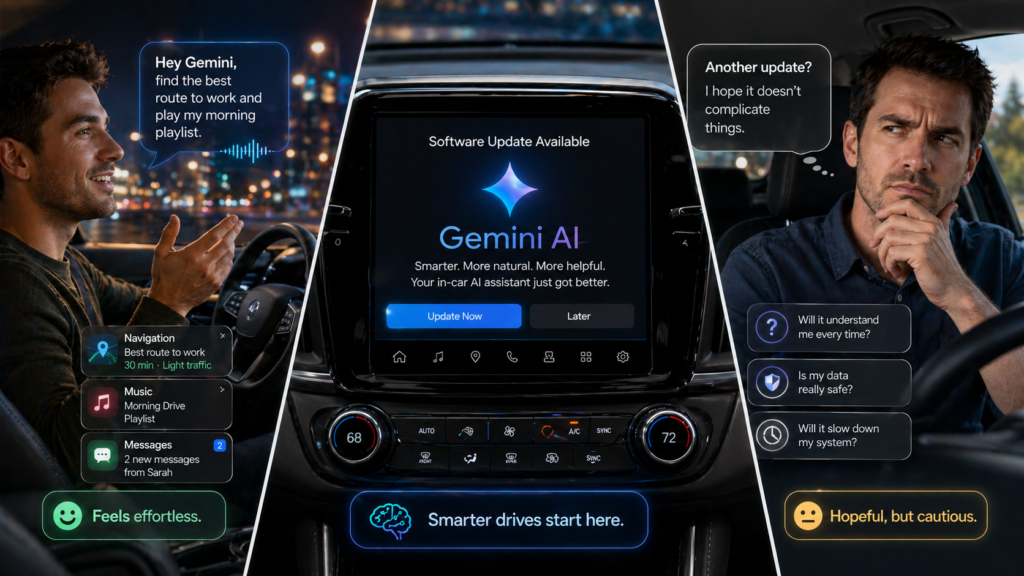
General Motors just made a move that the auto industry will be talking about for a long time. Bringing Google Gemini to 4 million vehicles, across every price point, across four major brands, is a statement. It says that AI in the car isn’t a premium add-on anymore. It’s the new standard.
The days of shouting rigid commands at a confused voice assistant are numbered. Gemini brings real conversation to the cabin. It brings productivity to the commute. It brings a smarter, more natural way to interact with your vehicle, without ever taking your hands off the wheel.
And if GM’s roadmap holds, this is just the beginning. The custom AI assistant on the horizon promises something even more personal, even more capable, and even more integrated into the driving experience.
Your car is getting smarter. And honestly? It’s about time.
Sources
- GM Trucks — GM Google Gemini Truck Update
- Automotive Addicts — GM Brings Google Gemini to Millions of Vehicles
- Autoweek — GM Rolls Out Google Gemini AI to 4 Million Vehicles
- GM Authority — These GM Vehicles Are Getting Google Gemini Conversational AI Through Software Update
- The Verge — General Motors Is Adding Gemini to Four Million Cars
The Kingy Brief
Get the next Kingy Brief.
Source-checked AI changes, original tests and one practical thing to try.
Free · Choose your subjects · Double opt-in · Unsubscribe anytime