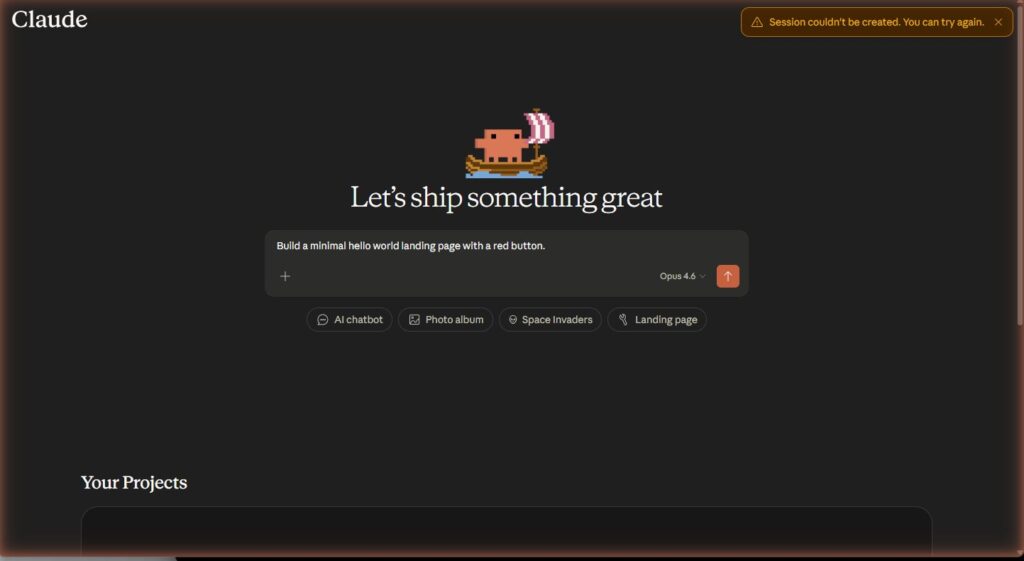
Screenshots shared on X this week have ignited a conversation that the AI and developer tools industry has been quietly dreading. Leaked images, first surfacing on April 12, 2026, appear to show an unreleased feature inside Claude — Anthropic’s AI assistant — that looks less like a coding helper and more like a full-stack application platform. Sifted broke the story with the headline “Anthropic plots Lovable challenger, leak suggests,” and since then, the images have spread across developer circles, founder Twitter, and startup Slack channels with a mixture of awe and alarm.
Anthropic has not officially confirmed the feature. But the leaked screenshots, and the company’s broader product trajectory, suggest something worth taking seriously: Anthropic may be moving Claude from “AI that helps you code” to “AI that is the app platform.”
That is a much bigger story than “Claude gets a Lovable clone.”
What the Leak Actually Shows
The screenshots circulating on X — posted by multiple accounts including @marmaduke091, @k1rallik, @kimmonismus, and others — appear to show a new in-chat builder interface with a header that reads: “Let’s ship something great.”
That tagline alone was enough to set off the discourse. But the specifics of what the screenshots reportedly show are what make this genuinely interesting.
According to the leaked images:
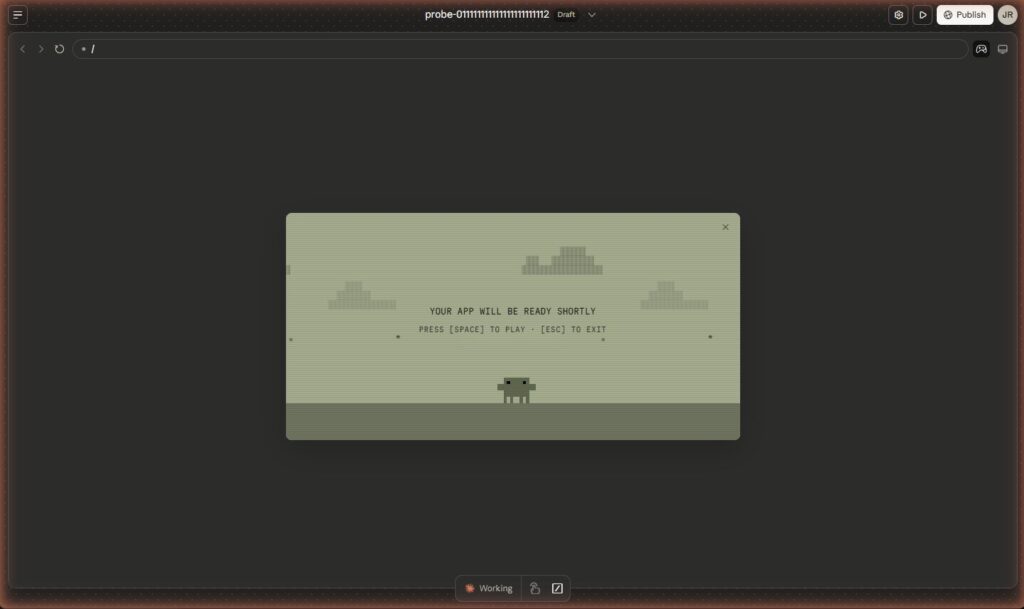
- There is a prompt bar for app creation — type what you want, and Claude builds it.
- A live app preview appears in a built-in browser pane alongside the chat, letting you see the app render in real time.
- There is a one-click Publish button — suggesting Anthropic intends to handle deployment, not just code generation.
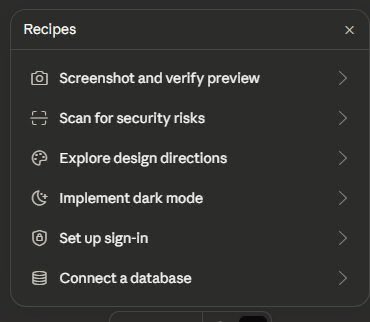
- A “Recipes” section appears to offer pre-built setup flows for common app primitives: dark mode, sign-in, security scanning, and database setup.
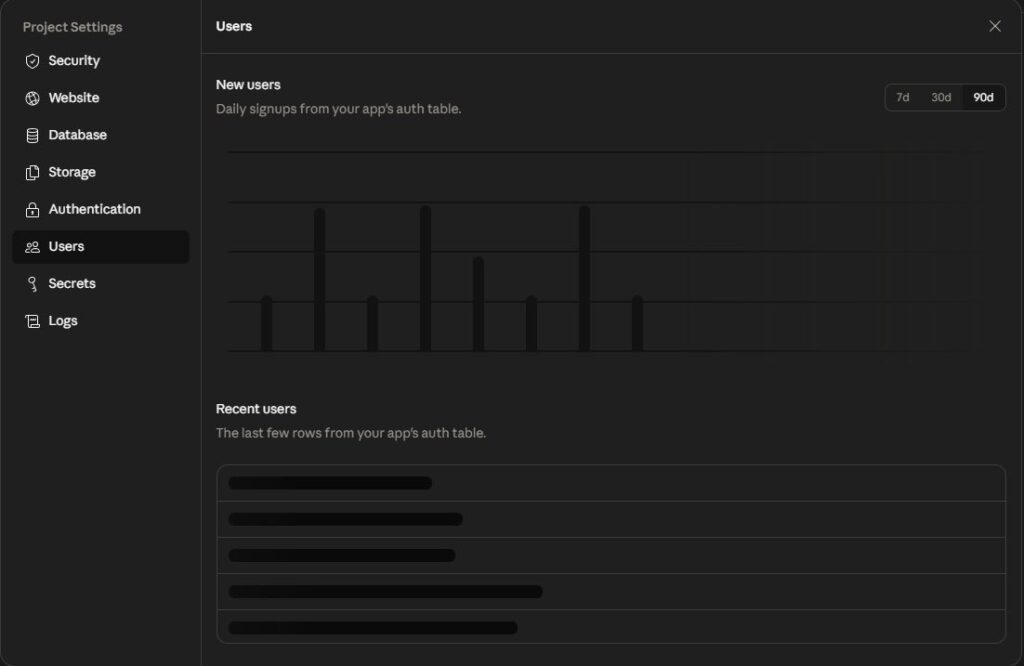
- Project Settings reportedly include tabs for Database, Storage, Auth, Users, and Logs — an admin-style backend dashboard that looks nothing like a chat interface.
The types of applications reportedly shown include AI chatbots, photo albums, and landing pages — all generated from simple text prompts.
If authentic, each of these elements represents a distinct move up the software stack. This isn’t Claude writing you a React component to paste into your own project. This is Claude provisioning the infrastructure, deploying the app, and handling operational concerns — within a single product surface. As Sifted noted, the feature would position Claude as “a full-stack app creation platform,” putting Anthropic squarely in competition with dedicated vibe-coding companies.
The important caveat: Anthropic has not publicly confirmed any of this. The leak suggests, rather than proves, that a product is coming. The screenshots are circulating publicly and have been reported by credible outlets, but there is no formal Anthropic launch post confirming the full feature set. Everything that follows is analysis based on what appears to be real — with that uncertainty held firmly in mind.
Why This Rumor Is Entirely Plausible
Here is the thing about this leak: it is not a bolt-from-the-blue pivot. It is the next logical step in a direction Anthropic has been walking for well over a year.
Start with Artifacts. Launched in June 2024, the Artifacts feature allowed Claude to generate and display code, documents, and UI mockups in a live side pane — the first move toward a “chat plus canvas” interface. Anthropic upgraded Artifacts significantly in mid-2025, extending them to allow users to build, host, and share AI applications directly from text prompts. When the upgrade landed, the reaction from developers was telling. AI developer Chris O’Halloran wrote: “I think it will be really strong for micro apps that are currently being built in v0, lovable etc.” That was not hyperbole — it was a builder recognizing the competitive arc of what Anthropic was building.
Then came Claude Code, released in February 2025 and made generally available in May 2025 alongside Claude 4. Claude Code is not just a code-writing assistant — it’s a command-line agent that can read files, write files, run commands, navigate entire codebases, and execute multi-step engineering tasks autonomously. Based on enterprise adoption, Anthropic reported a 5.5x increase in Claude Code revenue by July 2025. By March 2026, according to reporting by the Medium publication Automate X, Claude Code had reached $2.5 billion in annualized recurring revenue, with Anthropic as a company running at a reported $19 billion annualized revenue run rate.
In August 2025, Anthropic released Claude for Chrome — a browser extension allowing Claude Code to directly control the browser, read console logs, inspect network requests, and interact with DOM state. That is the kind of debugging integration that matters deeply if you are building, testing, and deploying real applications.
In January 2026, Anthropic released Claude Cowork as a research preview — described as “a tool similar to Claude Code but with a graphical user interface, aimed at non-technical users.” According to developers at Anthropic, Cowork was itself mostly built by Claude Code — a notable piece of dogfooding that signals how seriously Anthropic is taking the non-technical-builder market.
And then, in March 2026, a source code leak changed the picture even further. A UC Berkeley researcher named Chaofan Shou discovered that a missing *.map line in Anthropic’s .npmignore file had accidentally exposed 512,000 lines of TypeScript — the internal source code for Claude Code. Buried inside version 2.1.88 of the @anthropic-ai/claude-code npm package were 44 hidden feature flags, 20 of which have not yet shipped publicly. Among them: KAIROS, an always-on autonomous background agent that monitors your codebase while idle, decides when there is something worth doing, and executes tasks that won’t block your workflow. References to a full-stack app builder appeared throughout the leaked code. The separation between “AI assistant” and “AI builder,” already thin, was collapsing in writing.
The leaked screenshots from this week, then, are not a surprise to anyone paying close attention. They look like the consumer-facing front end of a build-and-deploy platform that Anthropic has been assembling — piece by piece, in public — for the past eighteen months.
Why Lovable, Bolt, and v0 Should Be Paying Attention
Let’s name the incumbents clearly. Lovable, founded in 2023 by Anton Osika and Fabian Hedin in Stockholm, is the vibe-coding darling of European tech. It generates full-stack web applications — React frontends, Supabase backends, deployed and hosted — from natural language prompts. In December 2024, it raised $330 million at a valuation of $6.6 billion, more than tripling its price tag from July 2025, with backers including Accel, Creandum, Evantic, CapitalG, and Melo Ventures’ Anthology fund.
Bolt.new, from StackBlitz, offers a similar prompt-to-app experience with a focus on instant in-browser development environments. Vercel’s v0 focuses on UI generation from prompts, tightly integrated with the Next.js and Vercel deployment ecosystem.
These are legitimate, well-funded, product-focused companies. They have built meaningful moats in user experience, template libraries, and integrations. But they share a structural vulnerability that this leak makes impossible to ignore: they are all built on top of models they don’t own.
Here is the detail that makes this existential rather than merely competitive: Lovable itself runs on Claude. As Lovable’s own comparison documentation states, the platform uses Anthropic’s Claude models as its underlying intelligence. The layer Lovable built — scaffolding, infrastructure, deployment, auth, visual editing — is exactly the layer that the leaked screenshots suggest Anthropic is now building for itself.
Lovable’s head of growth, Elena Verna, saw this coming. Last month, she told the 20VC podcast: “I always worry about the big boys and girls in the world. So OpenAIs, Anthropics, Googles, Apples — more so than our competitors that spring up from the bottom or sideways.”
That was not a defensive deflection. It was an accurate diagnosis of where the threat actually sits.
The core competitive dynamic here is not about feature parity. Lovable may be better at visual editing, or template selection, or a specific integration. That is almost beside the point. The threat is distribution. Claude already has tens of millions of users. It is already where people go to generate code, write documents, build things, think through problems. If users can move from idea to prompt to live preview to deployed app without leaving Claude, then the question stops being “which builder tool is best” and starts being “why would I open a separate tab at all?”
That is the surface-area collapse that dedicated vibe-coding startups cannot easily counter. They are apps. This would be the platform those apps were meant to serve.
Jackson Ader, an analyst at KeyBanc, captured the broader pattern when Anthropic launched a legal AI tool that put European legal tech startups on the defensive: “While today it’s legal tech, tomorrow it might be sales or marketing or finance.” Developer tools, it turns out, are next.
This Is More Than Vibe Coding
The term “vibe coding” — popularized in early 2025 to describe prompt-based app generation by non-technical builders — has become somewhat elastic. A lot of tools now claim to belong in the category. Not all of them should.
There is a meaningful difference between a code generator and an application platform, and that difference is exactly what makes this leak significant.
A code generator creates files. It might scaffold a UI, stub out some API routes, generate a schema. But when it finishes, you have code — and you are responsible for everything that happens next: the server, the database, the auth provider, the deployment pipeline, the logs, the environment variables, the SSL certificates.
An application platform handles all of that. It turns the output of generation into a live, working product. It owns the runtime. It is where software gets born, deployed, and operated — not just where it gets written.
The leaked Anthropic feature, if authentic, sits firmly in the second category. Database, storage, auth, users, and logs are not code generation concerns. They are operational infrastructure. The presence of those tabs in a Project Settings panel is a declaration of intent: Anthropic wants to own the full lifecycle, not just the creation phase.
This is the same insight that made Lovable successful in the first place. The gap between “Claude gave me code” and “I have a working app” is exactly where most non-technical builders get stuck. Lovable built a platform layer to close that gap. According to the leaked screenshots, Anthropic appears to be building a nearly identical layer — inside Claude itself.
What changes when that layer lives inside Claude is the question of entry point. Lovable is a destination you navigate to. Claude is a surface you are already on. The first product to offer prompt-to-app-to-deploy inside the interface a user already trusts changes the default behavior of an enormous number of people.
The Strategic Picture for Anthropic
Zoom out from the feature-level details, and a strategic arc becomes visible.
Anthropic started as an AI safety research lab. It launched Claude as a conversational assistant. It added Projects for grounded, organized workspaces. It built Artifacts for side-by-side creation and live previews. It shipped Claude Code for autonomous, agentic coding across terminal, IDE, and browser environments. It released Claude Cowork to bring that power to non-technical users through a graphical interface. And now, leaked screenshots suggest it is building a publish-and-deploy layer on top of all of it.
The trajectory is not hard to see: chatbot → work surface → coding agent → app builder → application platform.
Each step expands the surface area Claude occupies in a user’s workflow. Each step makes it harder to substitute a different tool. And each step moves Anthropic closer to owning not just the model layer, but the product layer, the infrastructure layer, and the distribution layer.
This has significant commercial logic. API revenue is real, but it is also inherently competitive — any model can be swapped for a better or cheaper one. Platform revenue is stickier. If your database lives in Claude, if your deployed app is hosted by Anthropic, if your users authenticate through Claude’s auth primitives — switching costs become real and significant. The business becomes defensible in ways that model APIs are not.
There is also a moat-building dimension in the data. Every app built on this platform, every deployment, every log, every user interaction — that is feedback that helps Anthropic understand real-world usage at a level no API provider can access. Building the platform means building the feedback loop.
The endgame, if this trajectory holds, is that Claude is not just where software gets written — it is where software gets born, tested, deployed, and managed.
What Anthropic Still Has to Prove
This is the part of the analysis that matters for anyone evaluating the threat seriously, rather than just reacting to it.
Demos are not products. Leaked screenshots are not launched features. And the distance between “one-click publish” and “production-grade application infrastructure” is enormous.
The existing vibe-coding platforms have spent years working through the hard problems: what happens when a generated app breaks at 3 AM? How does database schema migration work when a non-technical user tries to add a column to a live product? How do you handle auth edge cases, rate limiting, storage costs, compliance requirements? These are not prompt engineering problems — they are engineering and operations problems that take time and investment to solve at scale.
Anthropic will face all of these if the app platform is real. A few specific concerns are worth naming:
Quality at the edges. Generated apps work in demos. They break in production when users do unexpected things. The quality of the runtime layer — not the model, but the infrastructure surrounding it — matters as much as the quality of the code Claude writes. Lovable has invested deeply in this layer. Anthropic would be starting later.
Security and observability. The more Claude owns of the infrastructure stack, the more responsibility it carries for what runs on it. Auth systems get exploited. Databases get misconfigured. Storage buckets get exposed. Anthropic’s February 2026 release of Claude Code Security — which reviews codebases for vulnerabilities — suggests the company is aware of this. But owning the deployment layer raises the stakes considerably.
“One-click publish” can create a lot of shallow apps. The ease of creation is the point, and also the risk. If publishing is trivial, the web gets flooded with low-quality, insecure, unmaintained applications. This is not just a Anthropic problem — it is an industry problem — but Anthropic would be on the hook for the infrastructure these apps run on.
Productionization is hard. Demos of auth and database setup are one thing. Making those primitives robust enough for real business applications — with the compliance, audit logging, enterprise SSO, and reliability requirements that come with them — is a multi-year engineering effort. Lovable has been building this. Anthropic would be entering that work later, with more surface area to cover.
None of these concerns mean the product cannot succeed. Anthropic has shown repeatedly that it can ship at speed. But the challenge is real, and anyone expecting a Lovable-killer to drop fully-formed should temper their expectations. What’s more likely is a product that is genuinely capable for a wide swath of use cases, while the hard edges get worked out over time.
What Founders and Builders Should Watch For
Whether you are building on one of the existing vibe-coding platforms, considering which tool to use for your next project, or running one of the companies in Anthropic’s crosshairs, here is what to watch:
Official product announcements from Anthropic. The leak is real enough that a formal announcement feels close. Watch Anthropic’s blog, changelog, and any Claude.ai UI changes around deploy and publish functionality.
Pricing signals. If Anthropic launches hosting, storage, and compute as part of a Claude subscription or add-on, that will tell you everything about their business model intentions. A per-seat SaaS with infrastructure bundled in is a very different proposition from API pricing.
The Recipes and Templates surface. The “Recipes” mentioned in the leak — dark mode, sign-in, security scan, DB setup — are the rough equivalent of Lovable’s templates and standard integrations. Watch how this category expands. If Anthropic starts offering app-category templates (e-commerce, SaaS, internal tools), the competitive pressure on incumbents becomes acute.
Backend primitives becoming first-class Claude features. Database, storage, auth, and logs showing up in Claude’s official feature set — not just in leaked screenshots — would confirm that the platform thesis is real.
Lovable’s response. The company has already begun moving. Founder Anton Osika recently announced plans to acquire teams and startups. Théo Daniellot, a Revolut and Ledger veteran, has been hired to lead M&A. That is a company preparing for a harder competitive environment, not a company that believes the status quo will hold.
The open-source and GitHub integration question. One thing the leaked feature set does not obviously include is deep integration with existing codebases, GitHub repositories, or development workflows. Claude Code handles that use case. Whether the new app builder connects to GitHub — allowing iteration on existing projects rather than only greenfield generation — will determine how much of the professional developer market it can address.
The Conclusion: Collapsing the Stack
Here is the synthesis.
If the leaked screenshots are authentic, Anthropic is not building a Lovable feature. It is attempting to collapse the entire vibe-coding stack into a single AI product surface.
The move is logical given Anthropic’s position. It has the model. It has the users. It has the distribution. It has been building the supporting infrastructure — Artifacts, Claude Code, Cowork, Chrome integration — piece by piece. The app builder, if real, is where those pieces converge into a product layer that goes well beyond code generation.
That convergence is what makes this a genuine strategic moment, not just a product launch. The vibe-coding category has so far operated on the assumption that specialized, product-focused startups could hold their own against larger AI labs because they moved faster and thought harder about the builder experience. That assumption held as long as the labs were focused on the model layer.
If Anthropic is now moving into the platform layer, that assumption needs to be revisited.
Lovable’s Elena Verna was right to worry about the big players more than the horizontal competitors. The threat from a startup with better templates is manageable. The threat from the model provider building the platform that makes templates unnecessary is categorically different.
To be clear: this is still a rumor. Anthropic has not confirmed any of this. The screenshots are circulating, Sifted has reported on them, and the product direction they suggest is consistent with everything Anthropic has been building publicly. But “consistent with public direction” and “confirmed product launch” are different things, and the distinction matters.
What is not a rumor is the direction. Anthropic has been moving from chatbot to work surface to coding agent to app builder for eighteen months. The leak, if real, is simply the next step on a road that has been visible for anyone paying attention.
Claude may not be an app platform yet. But the evidence suggests it is trying to become one. And when it does — if it does — the question for Lovable, Bolt, v0, and every other dedicated vibe-coding platform will be simple: how do you compete with the surface where users already start?
That question doesn’t have an easy answer. But the fact that it now needs to be asked tells you everything.
Anthropic has not publicly confirmed the app builder feature. The leaked screenshots described in this article are circulating publicly and have been reported by Sifted, but have not been verified by Anthropic. All analysis of the product’s potential is based on reported features and publicly available information about Anthropic’s product direction.
The Kingy Brief
Get The Kingy Brief.
AI changes, original tests and one practical thing to try. Fridays at 09:00 Vancouver time.
Free · Double opt-in · Unsubscribe anytime
Signup help and newsletter schedule
Signup form provided by Beehiiv. After submitting, check your inbox for "Confirm your subscription to The Kingy Brief" and open its confirmation link. Check Spam or Promotions if you cannot find it.
Fridays at 09:00 Vancouver time: source-checked AI changes, original tests and one practical thing to try. The weekly restart begins October 9, 2026. We skip a week when there is not enough verified material. Free. Unsubscribe anytime.