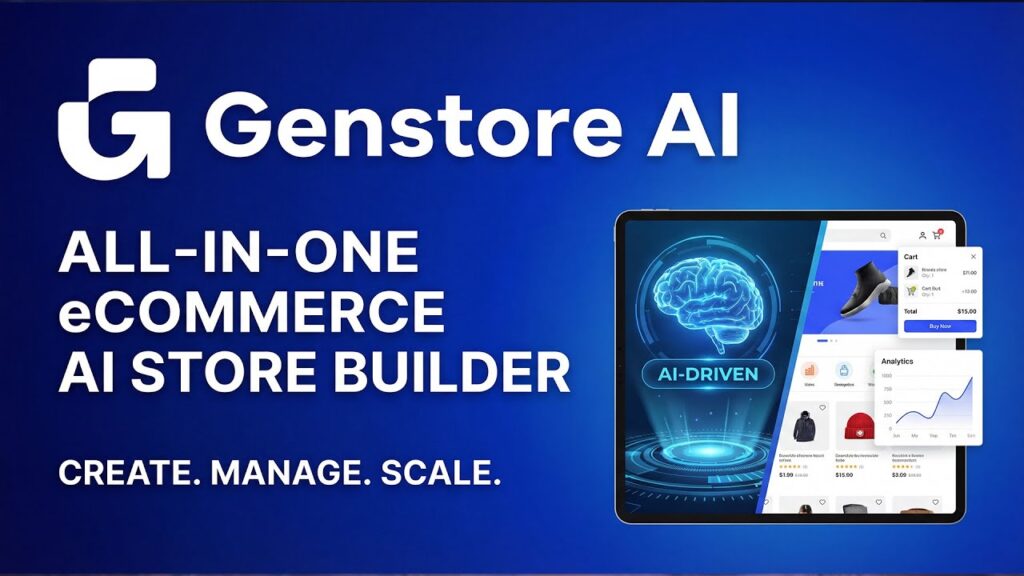
From zero to a live, mobile-ready storefront in minutes — but is the AI doing real work, or just putting on a show?
E-commerce has a dirty secret. Building a store has never been easier — and yet, most people never launch. Not because they lack a product idea or a desire to sell, but because the sheer operational weight of setting one up and running it day-to-day is genuinely overwhelming. You need to design a homepage, write product descriptions, figure out dropshipping logistics, manage campaigns, handle customer support, and somehow keep an eye on what’s actually working. For most aspiring sellers, this isn’t a technology problem. It’s a bandwidth problem.
Genstore AI is making a bold claim: it has solved that problem. Not by giving you better tools to do the work yourself, but by fielding an entire team of AI agents that handles the work for you. The platform bills itself as “the first full-stack AI agent team,” and its homepage tagline is refreshingly direct — “Turn your idea into a ready-to-sell storefront with one prompt.”
That’s an extraordinary promise. After spending time with the platform, watching it build a complete luxury watch store in real time, and digging into everything from its agent roster to its pricing structure, here’s the honest breakdown of what Genstore AI actually delivers, who it’s genuinely built for, and where it still has room to grow.
What Exactly Is Genstore AI?
Before getting into the demo, it’s worth establishing what Genstore AI actually is — because calling it a “store builder” undersells it in some ways and misrepresents it in others.
On the surface, yes, it builds e-commerce storefronts. But the architecture beneath that surface is what makes it distinct. Genstore doesn’t operate like a template-based drag-and-drop tool where you slot in your content and press publish. Instead, it deploys a coordinated team of AI agents — each with a specific domain of responsibility — that work in parallel to construct, launch, and then continue operating your store over time.
This is the key distinction. Traditional store builders hand you a store and step back. Genstore AI, at least in theory, stays in the loop. Its agents don’t just generate your homepage once — they’re continuously analyzing trends, writing campaign copy, flagging performance gaps, and supporting customers. The store isn’t a finished product you maintain. It’s an ongoing operation that the AI co-manages with you.
That’s either a revolutionary idea or an ambitious claim, depending on how well it executes. But the philosophy itself is sound. The bottleneck in modern e-commerce has never been the technology for building stores. It’s always been the sustained human effort required to run them. Genstore is attacking that bottleneck directly.
Getting Started: The Onboarding Experience
One of the first things you notice when you sign up at genstore.ai is what doesn’t happen. You’re not immediately bombarded with settings panels, integration wizards, payment gateway configurations, or shipping zone setups. Other platforms tend to front-load so much setup friction that many users abandon the process entirely before they’ve added a single product.
Genstore takes the opposite approach. Sign-up is frictionless — you can authenticate with Google, Apple, or Facebook — and the first thing you’re asked is beautifully simple: What kind of products do you plan to sell? The options are Products I buy or make myself, Dropshipping products, Digital products, or simply “I’ll decide later.” That last option is a small but meaningful design decision. It lowers the barrier for people who are still figuring things out, rather than forcing a commitment before they’re ready.
From there, you’re directed into what Genstore calls the “Design with AI” experience — and this is where things get genuinely interesting. Rather than presenting you with a blank canvas or a library of templates to scroll through, the AI opens a conversation. It asks about your goals, the type of store you want, the style and tone you’re going for. In the demo walkthrough, a simple input — “I want to build a store for luxury watches” — is enough to kick the entire engine into motion.
The AI doesn’t just confirm your input and move on. It immediately begins populating context: Core product category (Watches > Luxury Watches), Shop style (Elegant & High-end), Shop language (English). You can see this summary building in real time on the left-hand panel as the conversation progresses. It’s a small touch, but it communicates something important — the system is listening, understanding, and translating your intent into actionable parameters that will shape every subsequent design and product decision.
Within moments, product recommendations begin appearing. In the luxury watch demo, Genstore immediately surfaced relevant dropshipping products — actual items with images, prices, and sourcing information — that users could add to their store with a single click. You can also refresh the suggestions or upload your own products if the AI’s picks don’t quite hit the mark. From there, the system executes a three-step process: Product Selection, Store Setup, and Publishing. The entire sequence from initial prompt to live store preview takes just a few minutes.
The AI Agent Team: Who’s Actually Doing the Work?
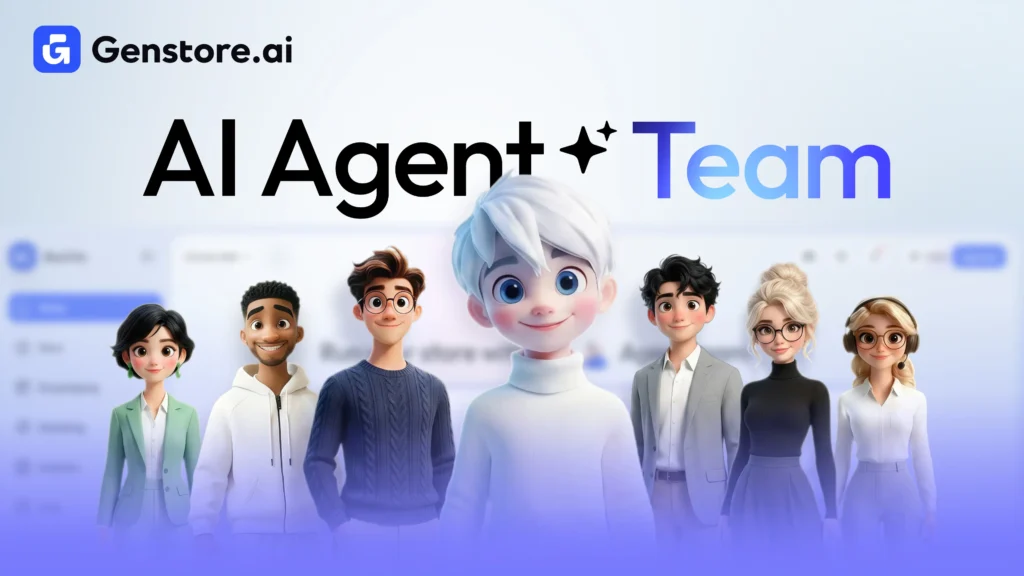
The most compelling and differentiating element of Genstore AI is its multi-agent architecture. This isn’t a single AI model handling everything sequentially — it’s a team of purpose-built agents, each assigned a specific function, running in parallel. Understanding who these agents are is key to understanding the platform’s value proposition.
You can watch the agents being dispatched in real time during the store build. Code lines generate on screen. Agent identifiers flash as each one picks up its task. It reads less like software running and more like a team being briefed for a project. Here’s a breakdown of the agents Genstore AI deploys:
Genius Super Agent functions as the orchestrator — the project lead, if you will. It coordinates the other agents, ensures their outputs are coherent with each other, and manages the overall logic of the store build. When you submit your prompt, the Super Agent is the one routing tasks to the appropriate specialists.
Sara, the Product Agent, handles product discovery and validation. Sara’s job is to analyze trends, surface product ideas, and help you understand what’s likely to sell in your chosen niche. For a dropshipping store, this is enormously valuable — the difference between stocking products people actually want and products that sit unsold often comes down to research that most sellers either skip or do poorly.
Deon, the Design Agent, takes ownership of the visual layer. Deon generates the global styles, color palette, typography, and layout decisions that give your store its aesthetic identity. In the luxury watch demo, the result — a store named “Refined Wrist” — was polished, minimalistic, and visually coherent. Sections like “Eternal Elegance” and “Timeless Sovereignty” felt curated, not generic. That’s Deon at work.
Olivia, the Campaign Agent, is responsible for how your store communicates. She writes campaign copy, structures messaging, and handles the narrative layer of your store’s customer-facing content. In an environment where product descriptions and marketing copy are often either painfully bland or awkwardly keyword-stuffed, having a dedicated agent whose entire job is compelling communication is a genuine differentiator.
Harvey, the Analytics Agent, monitors performance and surfaces actionable insights. Harvey flags what’s working, identifies where customers are dropping off, and points to optimization opportunities. The value here isn’t just in reporting — it’s in the interpretation. Most e-commerce analytics tools give you data. Harvey is supposed to tell you what the data means and what to do about it.
Ella, the Support Agent, assists merchants from within the platform. She handles questions about store setup, operational workflows, and day-to-day platform navigation. Think of her as an always-on onboarding resource that never gets tired of explaining how things work.
Critically — and this is the point emphasized most strongly in the video demonstration — these agents aren’t just making suggestions. They’re executing work in the background. The distinction matters. Plenty of AI tools will generate a recommendation and expect you to implement it. Genstore’s agents are designed to act, not advise.
Store Design, Customization, and the Live Preview
Once the agents have done their initial work, the result is a complete, navigable storefront. In the luxury watch demo, “Refined Wrist” emerged as a fully structured site with a header navigation (Home, Collections, Products, Contact Us), multiple curated sections on the homepage, lifestyle imagery, a video section, and a thoughtfully composed footer.
The store preview experience is impressive. The design doesn’t feel like it was generated by an AI filling in a template — it feels like it was made by someone who understood the category. The “Commitment to Excellence” footer icons (In-Store Experience, Seamless Returns, Complimentary Delivery, Personalized Service) are exactly the kind of trust-building elements that luxury brand buyers expect to see. That level of category awareness built into the design output is a meaningful capability.
For users who want to move beyond the AI-generated defaults, Genstore includes a manual editor. You can click into individual segments — slideshows, collections, product grids — and make direct adjustments. The themes library offers additional design directions if the initial AI-generated aesthetic isn’t quite right for your brand. This hybrid approach — AI does the heavy lifting, but you retain manual control — is the right philosophy for a store builder. It respects the fact that some users will want to customize extensively, while not forcing that on users who just want something clean and ready to publish.
The platform also emphasizes mobile readiness as a built-in feature, not an afterthought. Given that a substantial share of online shopping now happens on mobile devices, this isn’t optional — it’s table stakes. Genstore’s mobile-optimized output is part of the automated build, meaning you don’t need to separately test and adjust for mobile layouts.
The App Ecosystem: Extending What the Agents Start
Beyond the core AI agents, Genstore AI has built out an app ecosystem that covers the full operational surface of running an online store. These aren’t third-party bolt-ons you have to hunt down and configure — many are developed by Genstore and its certified partners, and they’re accessible directly from the admin dashboard.
The DSers Dropshipping app provides a direct connection to AliExpress for faster, smarter product sourcing. The TikTok integration connects your store to TikTok’s advertising and sales channel ecosystem — a crucial feature for social creators who want to monetize their audience without building separate purchase infrastructure. Email marketing is covered through native integrations with Klaviyo, Mailchimp, and Omnisend, meaning you can sync your customer data and trigger campaigns without manually exporting lists.
On the conversion side, Wishlist, Free Shipping Upsell, and Sales Growth Booster add behavioral nudges and urgency mechanisms that are proven drivers of purchase completion. The Search & Discovery app handles intelligent filtering and site search — often a neglected feature that has an outsized impact on conversion rates.
For international sellers, the Genstore Translate app localizes store content into multiple languages, and the platform explicitly supports global store launches with multi-currency, multi-language, and multi-market capabilities. The Migration Tool enables one-click data migration for sellers moving from other platforms.
The breadth of this ecosystem is genuinely impressive for a platform that’s still relatively young. It signals that Genstore is building for serious merchants, not just hobbyists.
Pricing: What Does It Actually Cost?
Genstore AI’s pricing follows a freemium model with four tiers, and the free tier is meaningfully functional rather than just a teaser.
Free ($0/month) gives you access to over 10 AI agents, up to 20 products, up to 10 dropshipping products, a single inventory location, a single localized market, 5 free credits, and 5 daily credits. You can build a real store and explore the platform’s capabilities without spending a dollar. The limitation is that payment acceptance requires upgrading, which means the free tier is best suited for exploring and building before you’re ready to go live.
Lite ($25/month) unlocks payment acceptance, unlimited products, 1 additional staff account, 2 inventory locations, 2 localized markets, and 50 monthly credits. Card processing rates start at 2.8% + 30¢ USD, with a 2% fee on third-party payment providers. For a solo seller just getting started, Lite is a reasonable entry point into real commerce.
Growth ($75/month) is marked as the most popular tier and unlocks up to 100 dropshipping products, 10 additional staff accounts, 15 inventory locations, 3 localized markets, and 200 monthly credits. Card rates improve to 2.6% + 30¢ USD with a 1% third-party provider fee. The Growth tier is clearly aimed at sellers who are past the testing phase and building toward scale.
Scale ($199/month) is the top tier, offering up to 1,000 dropshipping products, 20 additional staff accounts, 25 inventory locations, 5 localized markets, and 700 monthly credits. Card rates drop further to 2.5% + 30¢ USD with a 0.6% third-party fee. For high-volume operators running a serious dropshipping or multi-product operation, the Scale tier provides the headroom needed.
Annual billing saves 20% across all paid tiers, and at launch, Genstore is running a limited-time promotion doubling credits for your first month on any paid plan — worth considering if you’re planning to experiment heavily with the AI features early on. The credit-based system for AI usage is worth understanding before you commit — more AI-intensive activities will draw down your monthly credits, and the Growth and Scale plans both allow you to add credits as needed beyond the monthly allocation.
Who Is Genstore AI Actually Built For?
The platform itself identifies four target audiences, and it’s worth examining each honestly.
New store owners are the most obvious fit. The onboarding experience is designed around removing barriers for people who have never built an online store before. No coding knowledge is required, the AI scaffolds the entire setup process, and the guided prompts mean you don’t need to know what questions to ask — the platform asks them for you.
Part-time sellers — people running a store alongside a job, school, or other commitments — benefit most from the automation layer. The AI agents handling product discovery, campaigns, and analytics means you’re not stuck manually monitoring and updating your store in the limited hours you have available.
Social creators are a growing and underserved segment in e-commerce. Genstore’s TikTok integration and social channel connectivity make it possible to turn an existing audience into paying customers without building separate commerce infrastructure from scratch. The platform’s ability to generate a store quickly is particularly valuable here — creators don’t want to spend weeks configuring e-commerce backends when their core skill is content creation.
Early product adopters — trend-forward sellers who want to test products quickly without holding inventory — are well-served by the dropshipping infrastructure and Sara’s product discovery capabilities. The ability to add trending products to a store in a few clicks, without upfront inventory commitment, aligns well with a test-and-iterate selling strategy.
Limitations and Considerations
No platform review is complete without an honest look at where the gaps are.
The credit system deserves careful attention. On the free tier, you receive 5 daily credits. On the paid tiers, monthly credit allocations vary from 50 (Lite) to 700 (Scale). The practical implications of how quickly AI actions consume credits aren’t fully transparent on the pricing page, and for power users running multiple AI-driven campaigns and product research sessions simultaneously, it’s worth understanding the consumption model before choosing a tier.
The free tier’s payment restriction is a meaningful limitation. You can build a complete store, add products, and explore the full design and agent experience without spending anything — but you can’t actually transact until you upgrade to at least the Lite plan. This is a common freemium constraint, but it’s worth flagging for users who want to test the full end-to-end purchase flow before committing.
The agent execution depth — specifically, how much of the ongoing store management is truly autonomous versus guided — remains something the platform will need to demonstrate over time. The agents are compelling in the store-building phase. Their sustained value in the day-to-day operation of a live store, particularly for the Analytics and Campaign agents, will become clearer as more merchants use the platform at scale.
For merchants migrating from established platforms, the migration tool covers the data transfer, but the process of rebuilding institutional knowledge — custom workflows, specific app configurations, audience segments built over years — requires real investment regardless of how good the tooling is.
The Bottom Line
Genstore AI is doing something genuinely new. Not just in the sense of using AI — every platform claims to do that now — but in the architectural decision to decompose the work of running an online store into distinct agent responsibilities and let those agents execute rather than advise.
The store-building experience, as demonstrated in the walkthrough, delivers on its headline promise. A complete, visually polished, mobile-ready storefront with curated products, coherent branding, and fully built-out navigation pages emerges from a single conversational prompt in minutes. That’s not a slight improvement on existing tools — it’s a fundamentally different relationship between the seller and the platform.
The app ecosystem adds serious depth for merchants who need marketing automation, social selling, and operational management beyond the core AI features. The pricing is accessible, with a genuinely usable free tier and paid plans that scale reasonably alongside business growth. And the target audience identification — new store owners, part-time sellers, social creators, early adopters — reflects a real understanding of who is most underserved by existing tools.
The open question is whether the AI agent team delivers sustained value over months and years of operation, not just in the first exciting minutes of store creation. Can Harvey actually flag the right optimization opportunities? Does Olivia’s campaign copy drive real engagement? Does Sara’s product discovery meaningfully improve sell-through rates? These are the performance questions that will define Genstore AI’s long-term standing.
For now, what’s clear is that Genstore AI has correctly identified the problem — the relentless operational burden of solo commerce — and built a product that takes direct aim at it. If you’ve had a store idea sitting dormant because the launch process felt like too much, Genstore AI is the most compelling reason yet to finally do something about it.
Start free at genstore.ai and see the agent team in action for yourself.
Watch the full platform walkthrough on YouTube. Explore pricing options at the Genstore AI pricing page. Join the Genstore community on Discord to connect with other sellers and get answers directly from the team.
Continue Reading
- BuildYourStore AI Shopify store builder review
- AI agents and the future of commerce
- AI dropshipping store campaign breakdown
Latest News
Recent Launches
Related Companies
Compare
The Kingy Brief
Get The Kingy Brief.
AI changes, original tests and one practical thing to try. Fridays at 09:00 Vancouver time.
Free · Double opt-in · Unsubscribe anytime
Signup help and newsletter schedule
Signup form provided by Beehiiv. After submitting, check your inbox for "Confirm your subscription to The Kingy Brief" and open its confirmation link. Check Spam or Promotions if you cannot find it.
Fridays at 09:00 Vancouver time: source-checked AI changes, original tests and one practical thing to try. The weekly restart begins October 9, 2026. We skip a week when there is not enough verified material. Free. Unsubscribe anytime.