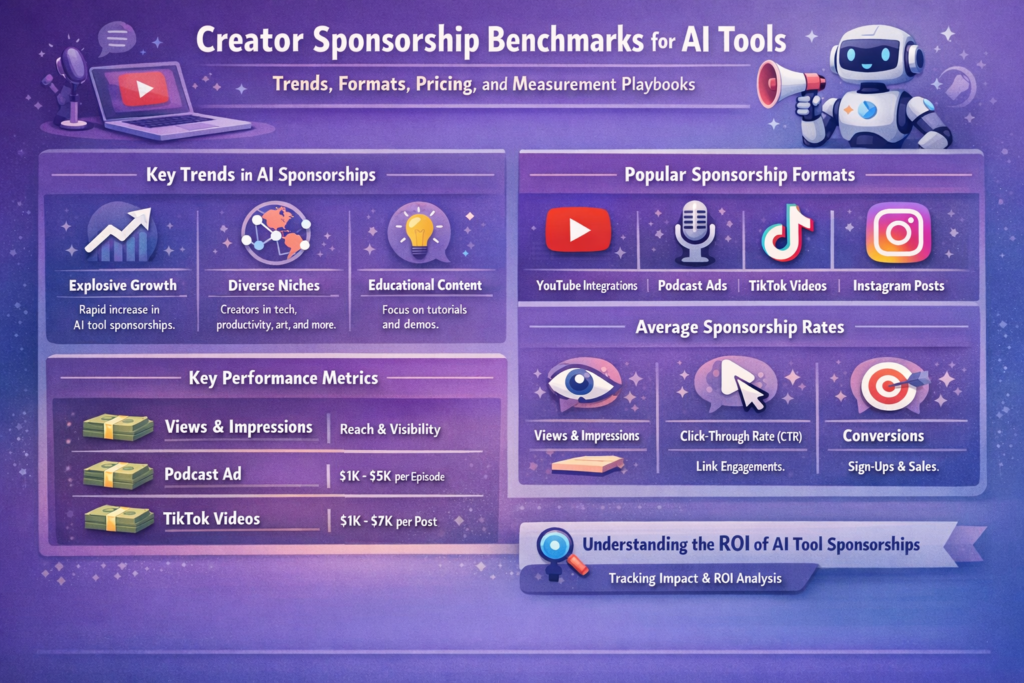
A practical, cited benchmark report for AI marketers buying creator distribution — built to reduce measurement uncertainty and accelerate internal alignment.
Published by Kingy AI | Research Edition 2026
Executive Summary
There is a specific and consequential problem that sits at the center of almost every AI go-to-market team’s planning cycle right now: the internal alignment gap. Product marketing managers, demand generation leads, and growth teams often already believe that creator sponsorships are worth investing in. They have seen the views, watched the comment threads, and felt the intuition that a trusted voice explaining a complex AI product is worth more than a retargeted banner ad. What they lack is not conviction — it is forwardable evidence.
This report is designed to provide exactly that. It is built for the PMMs, demand gen leads, and creator marketing practitioners at AI companies who need third-party-quality benchmarks, cited methodology, and decision-support frameworks that can be shared with finance, legal, and executive stakeholders who are not yet convinced that creator sponsorships deserve a dedicated line in the media plan.
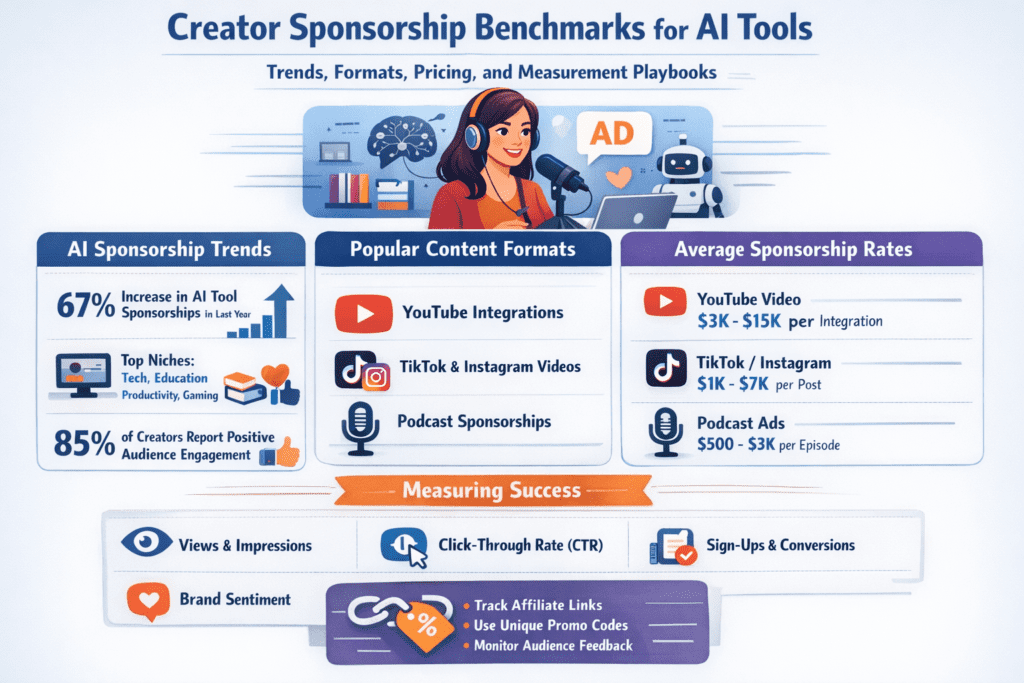
The timing for this report is not accidental. The data supporting creator sponsorships as a serious, scalable, and measurable media channel has never been stronger. Tubefilter’s Gospel Stats platform tracked 65,759 sponsored videos uploaded to YouTube in the first half of 2025 alone — a 54% year-over-year increase, with total views on those videos rising to 19.1 billion.
Simultaneously, the Interactive Advertising Bureau reports that U.S. creator ad spend reached $29.5 billion in 2024, more than doubling from $13.9 billion in 2021, and is projected to reach $37 billion in 2025 — a growth rate roughly four times faster than the broader media industry.
This is no longer a niche channel. It is a media category that nearly half of all brand ad buyers now classify as a “must buy.”
For AI products specifically — generative AI applications, code assistants, IDE integrations, developer tools, and enterprise AI platforms — the creator channel carries a distinctive strategic advantage: it converts skepticism. AI products are often complex, frequently misunderstood, and subject to high buyer skepticism, both from individual users and from the procurement and finance stakeholders who must approve adoption decisions. Creator-driven content, when executed correctly, addresses all three of these challenges simultaneously. It explains, it demonstrates, and it builds trust in a format that audiences have already chosen to engage with.
The report is organized into six substantive chapters:
- Market Reality: Why budgets are moving into creator sponsorships and what the data actually says
- Format Benchmarks: What formats work best for AI products and why
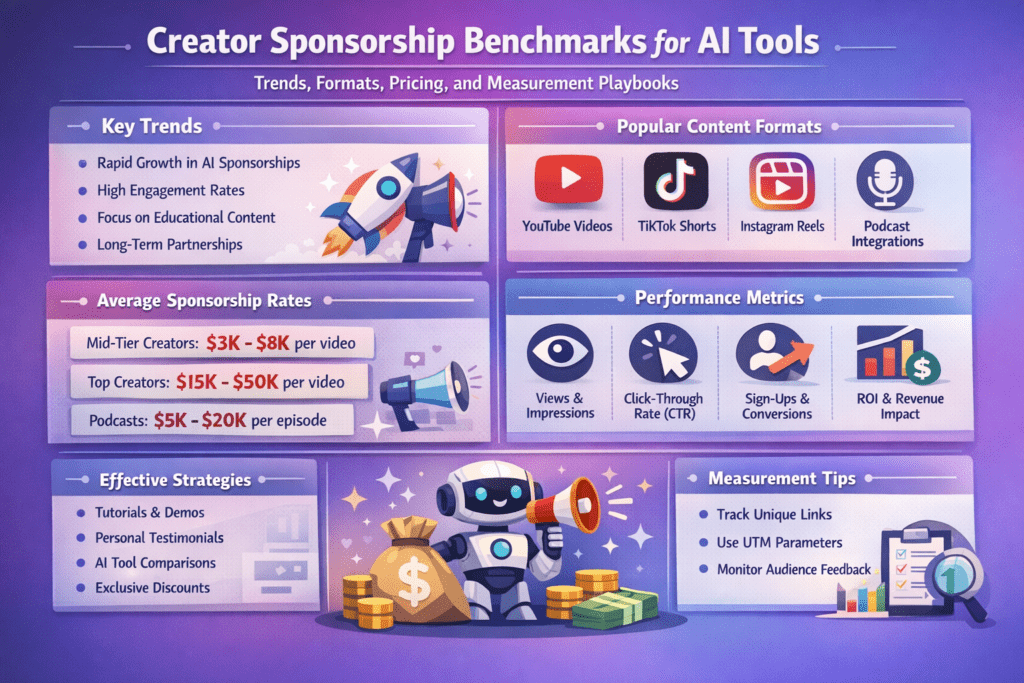
- Pricing Heuristics: How to build a defensible pricing model with confidence bands
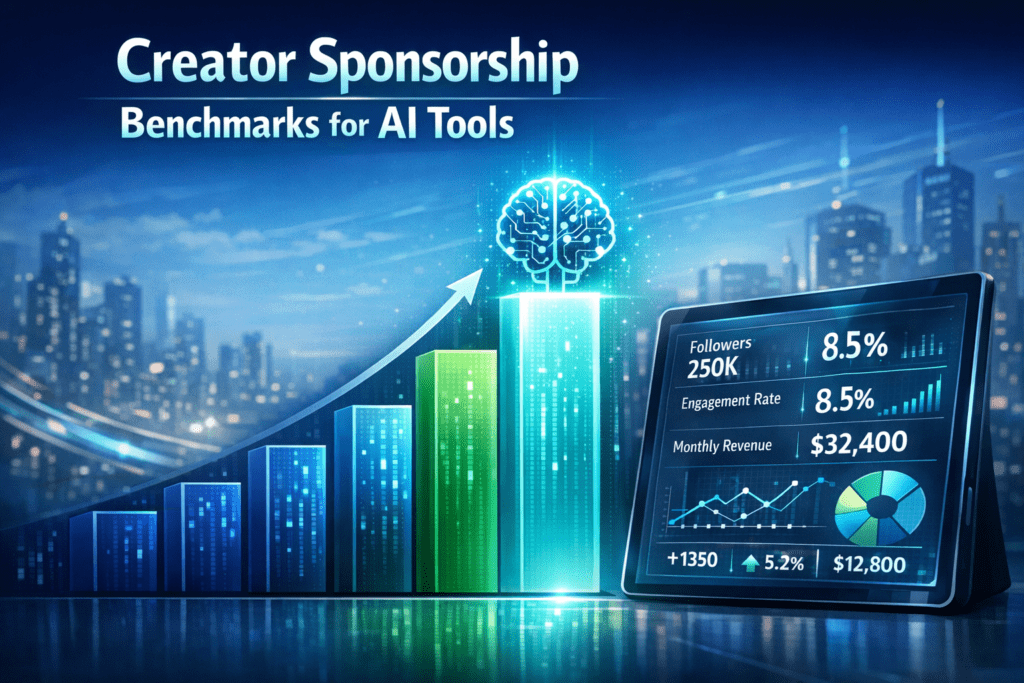
- Measurement and Attribution: A triangulated measurement stack for privacy-constrained environments
- Creative Patterns: What creative structures reliably move AI-skeptical audiences from curiosity to trial
- Publishing and Distribution: How to turn this report format into a repeatable lead engine
Throughout, we will clearly distinguish between (a) what is substantiated by third-party primary research, (b) what is grounded in platform guidance and industry frameworks, and (c) what is presented as hypotheses and recommended experiments. Intellectual honesty is not just a philosophical preference here — it is the mechanism by which this report earns the trust of the finance directors and legal reviewers who will be its hidden readers.
Chapter One: Market Reality — Why Budgets Are Moving and What the Data Actually Says
The supply-side shift: sponsorship volume on YouTube
The most important “why now” signal for AI marketers considering creator sponsorships is not a trend prediction — it is a count. Tubefilter’s Gospel Stats, the first dedicated intelligence platform for YouTube sponsorship tracking, published its inaugural YouTube Sponsorship Landscape Report in October 2025. The headline finding: 65,759 sponsored videos were uploaded to YouTube in the first half of 2025, representing a year-over-year increase of approximately 54%.
More significant than the raw volume is what is driving it. As Axios reported in its coverage of the Gospel Stats launch, the viewership on those sponsored videos rose approximately 28% year-over-year to reach 19.1 billion total views. And the growth is being fueled not by mega-creators with nine-figure subscriber counts, but by what Gospel Stats identifies as the “middle class” of the creator economy — channels averaging between 100,000 and 500,000 views per video. This is a critical structural detail for AI marketers: the sponsorship opportunity is scaling in precisely the creator tier where audience trust is highest and audience specificity is most achievable.
There is also a structural feature of YouTube sponsorships that makes them particularly important to understand at the budget level: they are not counted in Google’s official ad revenue reporting. As Gospel Stats founder Joshua Cohen noted at the platform’s launch, the most successful marketing on YouTube is not even counted as official advertising by Google.
This means that when you analyze YouTube as a media channel based on its disclosed revenue figures, you are systematically undercounting the total economic activity and audience exposure that brands are actually purchasing through it. For AI marketers building internal business cases, this represents both an insight and a framing opportunity: the creator sponsorship channel is large, growing, and structurally invisible to conventional media analysis tools.
A brief methodological note on the Gospel Stats data, which you should reproduce verbatim in any internal-forward deck or summary you share: Gospel Stats counted videos with at least 25,000 views in the seven days after upload, from English-speaking channels, and video count is taken from the 90-day view count of each video. These constraints mean the data is directionally strong but should not be generalized beyond its defined scope — particularly for non-English-language markets or channels in the earliest phase of growth.
The demand-side shift: creator ad spend as “must-buy” media
If the Gospel Stats data tells you what is happening at the supply level — more brands buying more creator inventory — the IAB’s 2025 Creator Economy Ad Spend and Strategy Report tells you what is happening at the demand and budget-allocation level. The findings are significant enough that they deserve careful, precise citation rather than casual paraphrase.
U.S. creator ad spend has more than doubled in three years: from $13.9 billion in 2021 to $29.5 billion in 2024. The IAB projects creator ad spend will reach $37 billion in 2025, a 26% year-over-year increase, growing approximately four times faster than the total media industry’s projected growth rate of 5.7%. Nearly half — 48% — of all creator ad buyers now consider creators a “must buy” channel, ranking behind only paid search and social media.
Two points require emphasis for the AI marketing audience. First, the IAB’s definition of “creator ad spend” is intentionally narrow. The IAB methodology focuses on brand-directed, intentional creator ad spend through direct partnerships for sponsored content, amplified sponsored content, and planned creator adjacencies. It explicitly excludes non-advertising revenue streams like affiliate links, subscriptions, and merchandise, as well as incidental ad placements alongside creator content.
This conservative framing actually makes the figures more useful for budget justification: when you cite $37 billion in creator ad spend, you are citing a number that represents deliberate, brand-directed investment — not a total addressable market estimate that conflates all monetization within the creator economy.
Second, the IAB data is explicit about what buyers are using the creator channel for across the marketing funnel. Among the top campaign goals cited by brand buyers: building brand awareness (43%), reaching new audiences (41%), enhancing brand reputation and trust (35%), and driving online sales and conversions (32%). This distribution matters for AI companies, because it validates using creators for both awareness and performance objectives — not just for top-of-funnel impression-buying, but as part of a lower-funnel trial and adoption strategy.
The IAB also reports that 40% of creator ad buyers rank overall ROI as their top KPI for creator campaigns. This is the number that matters most in budget conversations with finance. Creator sponsorships are no longer being evaluated primarily on reach and brand lift — they are being held to ROI standards. This is both a challenge and an opportunity: it raises the bar for measurement sophistication (addressed in Chapter Four) and simultaneously provides a natural hook for why the measurement frameworks in this report matter.
The boardroom plausibility signal: major brand budget shifts
Two additional signals are worth citing as “boardroom plausibility” anchors — evidence that large, institutional advertisers are making structural (not experimental) commitments to creator channels.
The first is Unilever’s disclosed intent to significantly increase its social media investment. At its 2024 investor event, Unilever described a planned shift toward approximately 50% of its media investment in social, up from approximately 20%. While Unilever’s media mix is not perfectly analogous to an AI company’s, the signal is unambiguous: one of the world’s largest advertisers is making a structural bet on the creator and social media ecosystem that goes far beyond incremental budget adjustment.
The second is the picture that emerges from CreatorIQ’s annual survey-based research, which consistently documents rising creator marketing budgets alongside operational maturation — the development of centers of excellence, systematic repurposing of creator content across owned and paid channels, and expanding creator rosters. The transition from “we tried some influencer campaigns” to “we have a structured creator marketing function” is happening across brand categories, and that transition is what the IAB’s “must buy” finding captures at the aggregate level.
Why the internal alignment gap persists despite the data
If the data is this strong, why does the internal alignment gap still exist? The answer lies in what the IAB report identifies as the top buyer anxieties: measuring business outcomes, choosing the right creators, improving standards and measurement tooling. These are not skepticism about the channel’s value — they are legitimate operational concerns about execution and accountability.
This is the precise gap that a benchmark research report is designed to fill. The B2B buyer who is already intuitively convinced that creator sponsorships work does not need more advocacy for the channel. They need something they can put in front of their CFO, their legal team, or their CMO that answers three questions: How do we know what we’re buying? How do we know if it worked? How do we know we paid a fair price? The following chapters answer each of those questions in turn.
Chapter Two: Format Benchmarks for AI Sponsorships
A taxonomy of creator sponsorship formats
Before you can evaluate which format works best for an AI product, you need a shared vocabulary. The IAB’s creator ad spend methodology provides a useful starting taxonomy, distinguishing between sponsored content (direct brand integrations within creator-owned content), amplified sponsored content (creator content that the brand also promotes through paid media), and creator adjacencies (brand placements near but not within creator content). For AI marketers buying YouTube inventory specifically, the more operationally useful taxonomy maps onto four format types:
Integrated sponsorships are the brand segment embedded within a longer video — typically 60 to 120 seconds of creator-generated content presenting the product, positioned at a natural break point within the video’s main topic. The creator’s framing, tone, and narrative context carry the brand message. This is the dominant format in the market and the one captured by the Gospel Stats data.
Dedicated videos are creator-produced content where the entire video is focused on the brand, product, or use case. These are less common in the YouTube ecosystem for technology products, but highly effective for complex AI tools where a full workflow demonstration requires more than 90 seconds. The tradeoff is higher cost relative to impression volume and the risk of lower view counts compared to a creator’s typical content on their established niche.
Amplified sponsored content combines the creator integration with paid media distribution — the brand takes the sponsored segment (or the full video) and runs it as a YouTube ad, extending reach beyond the creator’s organic audience. The IAB explicitly identifies this as a distinct spend category, and it is increasingly relevant for AI companies that want to use creator content both for organic trust-building and for paid reach extension.
Creator adjacencies are the brand safety play — appearing in content by or adjacent to specific creators without a direct integration, through YouTube’s targeting capabilities rather than direct deals. These are relevant context for understanding spend category definitions but are less directly actionable for AI brands seeking the trust signal that direct creator relationships provide.
Format selection by objective: what each format does best for AI products
The fundamental creative challenge for AI products is cognitive: the product is abstract until it is demonstrated, and the demonstration must be credible to be persuasive. This shapes format selection in ways that differ meaningfully from consumer goods or B2C subscription products.
For awareness and category education, integrated sponsorships within topically adjacent channels are the highest-efficiency format. A developer-focused creator who covers code review, system design, or career growth in software engineering has already pre-qualified their audience as likely users of a code assistant. The sponsorship does not need to overcome audience relevance — it starts from a position of high contextual trust. The IAB’s funnel data supports this: awareness and new-audience reach are the top two goals for creator campaigns, and the integration format serves both simultaneously.
For product understanding and trust-building, longer-form integrations and dedicated videos outperform short segment integrations. AI products suffer from a specific credibility problem: claims that seem impressive in a 30-second ad (“it writes better code,” “it cuts debugging time by half”) are exactly the kind of claims that technically sophisticated audiences are most likely to dismiss. Creator-led workflow demonstrations — where a real user works through a real problem and the AI tool is shown solving or assisting with it in real time, including its limitations — carry a trust signal that cannot be replicated by brand-produced creative.
For conversion and trial, the combination of an integrated sponsorship with a dedicated landing page, promo code, and well-structured CTA is the highest-performing format configuration, based on the operational logic of direct response tracking (detailed in Chapter Four). The key insight, supported by IAB’s finding that 32% of creator ad buyers are using the channel to drive online sales and conversions, is that creators can perform conversion roles — but only when the CTA structure, landing page experience, and measurement architecture are designed to capture that performance.
For enterprise AI and developer-tool categories specifically, the credibility of the creator matters more than their raw audience size. A channel with 200,000 subscribers who are all senior software engineers or AI practitioners is more valuable for an enterprise AI product than a channel with 2 million subscribers whose audience is a mix of general technology enthusiasts. This is the “audience alignment” challenge that the IAB identifies as the top selection criterion for 56% of brand buyers.

What the Gospel Stats data tells us about format trends
The Gospel Stats finding that mid-tier creators — those averaging between 100,000 and 500,000 views per video — are driving much of the sponsorship volume growth is structurally significant for AI marketers. It suggests the market is discovering what direct-response advertisers in other categories already know: that concentrated, highly relevant audiences frequently outperform massive but diffuse ones on a cost-per-action basis, even when the absolute impression count is lower.
For AI companies evaluating creator partnerships, this mid-tier finding validates a portfolio approach over a celebrity-concentration strategy. Rather than anchoring your creator budget to one or two top-tier creators with massive reach but diluted audience specificity, the emerging market pattern supports building a roster of five to twenty mid-tier creators whose audiences have demonstrable relevance to your product category — and running consistent, always-on integration campaigns rather than periodic high-visibility activations.
Chapter Three: Pricing Heuristics and Negotiation Anchors
Why there is no single market price for creator sponsorships
Any benchmark report that presents a single, definitive price for a creator sponsorship is making a claim it cannot support. The creator sponsorship market is not an exchange where prices are transparent and standardized — it is a negotiated market where price is determined by the intersection of multiple variables, each of which can shift the final number significantly. The value of being transparent about this is not just intellectual honesty — it is practical. If you present a point estimate and a creator or agent quotes something different, you lose credibility. If you present a range and a methodology, you have a negotiation framework.
The variables that drive creator sponsorship pricing include:
Deliverable type and complexity. A 60-second integrated segment in a talking-head vlog requires less production coordination than a live workflow demonstration of a code assistant in a real development environment. More complex deliverables — live demos, multi-tool comparisons, workflow walkthroughs with honest evaluation — command higher fees because they impose higher creative risk and production burden on the creator.
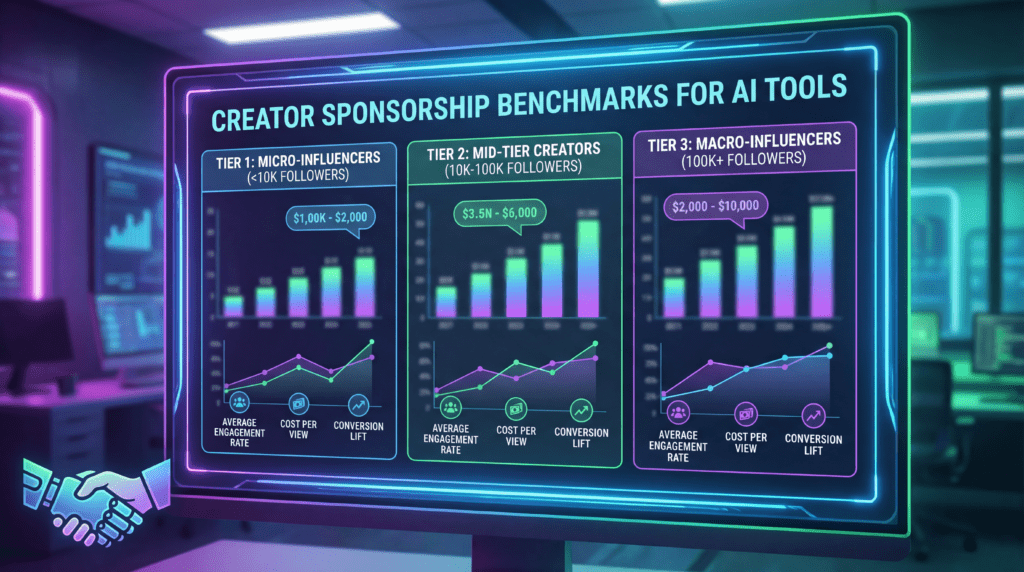
Expected reach. Pricing in the creator market often anchors to some version of CPM — cost per thousand views — applied to expected viewership at a defined time horizon (30 days and 90 days are the most commonly used windows). Modash, which publishes benchmark CPM data across deliverable types, documents meaningful variance across creator tiers and content categories.
Their data reflects that YouTube integrations typically command different CPM benchmarks than Instagram stories or TikTok videos, and that CPMs vary substantially by creator niche. Applying any CPM benchmark to a specific creator requires adjusting for their channel’s historical view retention and their sponsorship track record — neither of which is visible in aggregate statistics.
Usage rights and amplification. When a brand wants to repurpose creator content — running it as a paid YouTube ad, embedding it in email sequences, using clips in sales decks — that usage right is a separate licensing consideration that adds to base cost. The IAB explicitly identifies “amplified sponsored content” as a distinct spend category, and the pricing premium for amplification rights is a real and frequently negotiated component of creator deals.
For AI companies that want to use creator content both for organic reach and for paid media distribution, building amplification rights into the initial negotiation is almost always cheaper than returning to license content after the fact.
Exclusivity windows. Category exclusivity — the creator’s agreement not to sponsor competing products during a defined window — is a meaningful value driver for AI products in competitive categories. If you are a code assistant and you want the creator to not sponsor a direct competitor for 90 days, that exclusivity carries a price premium. The appropriate premium depends on how crowded the category is and how much of the creator’s total sponsorship revenue the exclusivity commitment would affect.
Claims substantiation burden. This is a variable that is specific to AI products and is systematically underpriced in standard rate card discussions. AI products often make performance claims — accuracy rates, time savings, error reduction — that require substantiation under FTC endorsement guidance. When a creator makes a claim on behalf of an AI product, both the creator and the brand have compliance obligations.
The more specific and quantitative the claims in the brief, the higher the creator’s legal and reputational risk, and the more that risk should be reflected in the negotiated fee or the creative latitude you grant the creator to speak in their own voice.
A defensible pricing model for internal use
Rather than a rate card, what AI marketing teams need is a pricing model — a structured methodology that produces a range, not a point estimate, and that can be explained and defended to finance. The following framework is designed to be used as a negotiation anchor, not as a substitute for market intelligence.
Step one: Establish an expected view estimate. Start with the creator’s recent average views per video (use their last 10 to 20 videos, excluding obvious outliers). Apply a conservative discount of 15–25% to account for sponsorship-tagged videos typically performing below average organic content. Choose a time horizon — 30-day views for direct-response campaigns, 90-day views if you are buying for long-term search and discovery traffic.
Step two: Apply a base CPM band. Use a published benchmark source — Modash publishes CPM ranges by deliverable type and platform — and select the band appropriate for the deliverable you are buying. Apply the lower bound of the range as your opening anchor and the midpoint as your target.
Step three: Apply multipliers, explicitly and transparently. Present the following multipliers as named adjustments rather than baking them silently into a single number:
- Complexity multiplier (1.0x–1.5x): Applied when the deliverable requires live software demonstration, multi-tool comparison, or real workflow integration rather than a simple verbal recommendation.
- Usage rights multiplier (1.1x–1.4x): Applied when amplification rights are included, scaled by the scope of repurposing.
- Exclusivity multiplier (1.1x–1.3x): Applied for category exclusivity, scaled by window length and category competitiveness.
- Claims multiplier (1.0x–1.2x): Applied when the brief includes specific, quantitative AI performance claims that increase the creator’s substantiation risk.
Step four: Convert to a range and document your assumptions. Present the output as a range — base CPM × expected views at lower and upper multiplier bounds — and document which assumptions drove the range width. The range is not a weakness in the analysis; it is a feature that prevents pricing disputes from becoming credibility disputes.
This approach draws on the CPM benchmarking methodology published by platforms like Modash and CreatorIQ, both of which provide frameworks for pricing creator partnerships while explicitly acknowledging that pricing drivers — audience niche, deliverable scope, goals, and content type — produce wide variance across specific deals.
What the market data says about pricing trends
The Gospel Stats finding that Ground News ran 1,862 integrations in the first half of 2025 — up 202% year-over-year — offers an important contextual signal for AI marketers thinking about pricing strategy. Ground News, a news aggregation app, has demonstrated that high-frequency, distributed creator sponsorship campaigns (many mid-tier creators, consistent presence) can generate substantial reach and brand recognition without dependence on a small number of premium creator relationships.
For AI companies, the pricing implication is that frequency and distribution often generate better ROI than prestige concentration. Distributing your sponsorship budget across ten mid-tier creators in your product’s target audience will typically yield more favorable CPMs, more content diversity, and more risk distribution than spending the equivalent amount on a single top-tier creator — even if the aggregate impression count is similar.
Chapter Four: Measurement and Attribution
Why last-click undercounts creator impact
The measurement challenge for creator sponsorships is both technical and political. Technically, creator content generates awareness and consideration signals that do not cleanly convert to clicks — a viewer might watch a sponsorship segment, remember the product name, and come back to search for it three days later, converting through a direct search visit that a last-click attribution model assigns entirely to organic search. The creator’s role in initiating the journey is invisible in the data.
Politically, the measurement challenge is that finance and CFO stakeholders are accustomed to evaluating media spend through attribution models designed for direct-response digital advertising. Creator sponsorships do not slot neatly into those models, and a failure to address this proactively tends to result in post-campaign conversations where the creator channel appears to have underperformed relative to paid search or paid social — not because it actually did, but because the measurement architecture credited other channels for conversions that creator content initiated.
The IAB’s 2025 Creator Economy Ad Spend report is explicit about this dynamic: buyers cite measuring business outcomes as one of their top challenges, and they specifically call for advanced attribution, consistent reporting, and better tooling as the highest-priority improvements needed in the creator marketing ecosystem. This is not a niche measurement problem — it is the defining operational challenge of the category.
A triangulated measurement stack
The solution to attribution uncertainty in creator sponsorships is triangulation — using multiple, methodologically distinct measurement approaches simultaneously and building a coherent business story from their convergence. This approach is consistent with the IAB’s Marketing Mix Modeling best practices guidance, which emphasizes auditable inputs, scenario planning, and integrating MMM with attribution and experimentation to provide a coherent business narrative.
Layer one: Deterministic direct-response tracking
The foundation of any creator sponsorship measurement stack is UTM-based tracking with disciplined URL construction. Every creator partnership should have a dedicated UTM structure that uniquely identifies the creator, the campaign, the specific video, and the time period. Google’s Analytics guidance on UTM parameters explicitly calls out standardized UTM strategy as a prerequisite for attribution accuracy and reporting consistency — and yet it is among the most frequently underdisciplined elements of creator campaign execution.
Alongside UTMs, promo codes provide a second deterministic tracking mechanism that captures conversions from viewers who did not click a link — people who heard a code in the audio of a video, remembered it, and converted through direct navigation or search. Promo codes are especially valuable for audio-heavy content consumption (background listening, commute watching) where link-clicking behavior is structurally suppressed. The tradeoff is that promo codes introduce a discount incentive structure that may or may not be appropriate for your product’s pricing model.
Layer two: Lift and incrementality testing
Deterministic tracking tells you what happened to the users you can observe. Incrementality testing tells you how much of what happened would have happened anyway — which is the number that actually matters for evaluating whether the creator investment drove incremental value.
Google’s Think with Google content on incrementality testing explains the fundamental structure: by creating a holdout group of users who are not exposed to the creator campaign and comparing their conversion behavior to users who were exposed, you can calculate the incremental lift attributable to the campaign. In a privacy-constrained environment, this typically means geo-based holdouts (running the campaign in some regions but not others, then comparing outcomes) or time-based holdouts (suspending the campaign in certain periods and measuring the gap).
For AI companies with existing YouTube advertising, the incremental lift framework can be extended using Google’s Brand Lift study tools, which measure brand awareness, consideration, and intent lift through survey-based measurement. Brand Lift studies do not directly measure trial or conversion, but they provide statistically grounded evidence of the brand metric movement that precedes conversion — evidence that is particularly useful in internal reporting when you are making the case that creator content builds the trust infrastructure that enables downstream conversion.
Layer three: Finance-aligned decision outputs
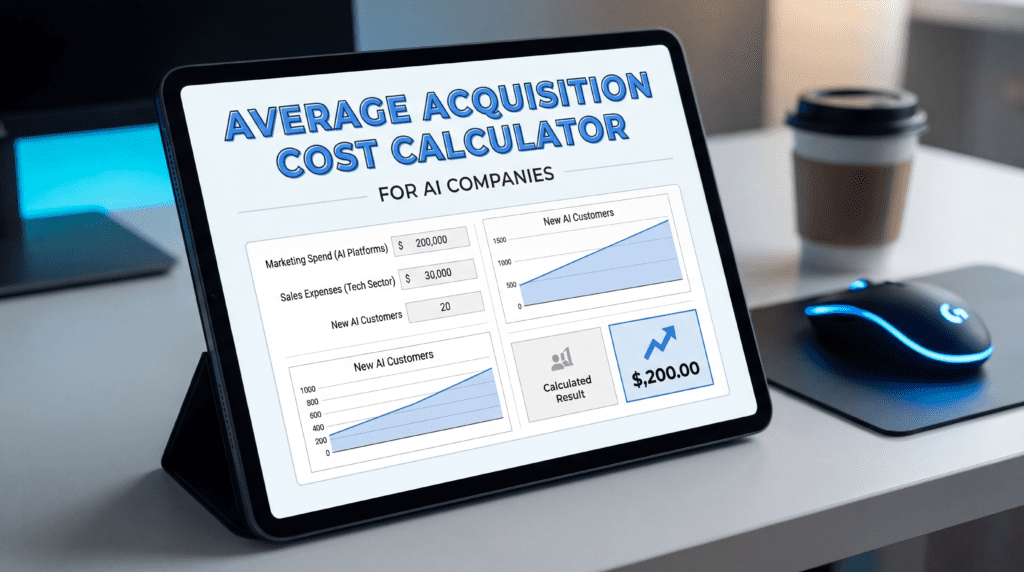
The final layer of the measurement stack is the translation of campaign data into CFO-readable outputs. This means expressing results not in CPM, CPC, or even ROAS, but in incremental revenue, incremental trial rate, and incremental payback period. The IAB’s Marketing Mix Modeling best practices guidance emphasizes that the output of any measurement framework should be expressed in the financial language of business decisions — scenario comparisons, confidence bands, and P&L alignment — rather than marketing-specific metrics that require translation before they can inform budget decisions.
Practically, this means that your post-campaign reporting for a creator sponsorship should include: a point estimate of incremental conversions driven by the campaign (derived from your geo or time holdout test), a confidence interval around that estimate, a cost per incremental conversion compared to your other acquisition channels, and a recommended budget scaling decision based on the relative efficiency of the creator channel. When finance reviewers see creator sponsorship results presented in this format, the conversation shifts from “why are we spending on influencers” to “what is the optimal allocation between this and paid search.”
A measurement checklist for AI sponsorship campaigns
Before launching any creator sponsorship campaign, the following measurement requirements should be confirmed:
- Dedicated UTM parameters constructed and validated for each creator partnership
- A promo code assigned uniquely to each creator (not shared across the campaign)
- A dedicated landing page (or at minimum, a unique URL) for each creator’s CTA
- A holdout plan defined before launch (geo holdout, user holdout, or time-based holdout)
- Baseline conversion rate documented for the holdout period
- Clear primary KPI established: incremental trials, incremental demo bookings, incremental pipeline
- Post-campaign reporting timeline committed (typically 30-day, 60-day, and 90-day windows)
This checklist is not complex, but it is surprisingly frequently incomplete in practice. The measurement problems that cause creator campaigns to be written off as unaccountable are almost always traceable to gaps in pre-launch infrastructure, not to fundamental limitations of the channel.
Chapter Five: Creative Patterns That Convert for AI Tools
The trust gap and why it is worse for AI products
Nielsen’s 2021 Trust in Advertising Study — conducted with over 40,000 respondents across 56 countries — found that 88% of consumers trust recommendations from people they know more than any other advertising channel. The gap between trusted-person recommendations and other channel types is not marginal; Nielsen notes that recommendations from known individuals are trusted by 50% more people than lesser-ranked channels like online banner ads, mobile ads, and SMS.
For AI products, this trust dynamic is amplified by a specific and well-documented consumer anxiety: AI skepticism. Technically sophisticated users — and the developer and enterprise audiences that most AI companies target — approach AI product claims with a calibrated suspicion that is entirely rational given the history of AI marketing overclaiming. A banner ad that says “our AI cuts code review time by 40%” is not just ignored; it is actively discounted. The same claim, delivered by a trusted creator who demonstrates the functionality live and acknowledges its limitations, occupies an entirely different position in the audience’s credibility hierarchy.
This is the mechanism that makes creator sponsorships uniquely valuable for AI products specifically — not just the reach or the format novelty, but the trust transfer that occurs when a credible voice within a specific technical community explains and demonstrates a product in their own context and their own language.
The ABCD framework adapted for AI sponsorships
Google’s ABCD creative framework — Attract, Brand, Connect, Direct — was developed as a research-backed structure for effective YouTube advertising creative. While it was designed for traditional video ad formats, it adapts cleanly to creator sponsorship segments, providing a structured template that creators can follow while retaining the authentic voice that makes their content trustworthy.
Here is the sponsorship-native translation of ABCD for AI products:
Attract — anchor in a real, recognizable pain point. The first 10 to 15 seconds of the sponsorship segment should establish a specific, credible problem that the target audience has actually experienced. For a code assistant, this might be the experience of a context-switching cost during a complex refactor, the frustration of a debugging session that has dragged into hour three, or the overhead of reviewing a large pull request on a Friday afternoon. The pain must be specific enough to be instantly recognizable to the intended audience and not so generic that it sounds like it was written by a brand briefing document (which it should not be — this is where creator latitude is most valuable).
Brand — establish category and differentiated claim, with disclosure. Once the pain is established, the creator introduces the sponsor in the context of addressing that specific pain. This is where the paid promotion disclosure must appear — either verbally (“this segment is sponsored by [Brand]”) or through YouTube’s built-in paid promotion label disclosure system. The differentiated claim should be specific but not overclaimed: “this is what it does” rather than “this is better than every alternative” — because the audience will see through the latter and lose trust in the former.
Connect — live demonstration with honest caveats. This is the most important and most frequently underexecuted element of AI sponsorship creative. The demonstration should be live or appear live (pre-recorded walkthroughs are fine, but clearly staged demos are not). It should show the product working on a real task — not a contrived ideal-case prompt — and it should include at least one moment where the creator either acknowledges a limitation or shows the output requiring human review or iteration. That moment of honest imperfection is not a weakness in the sponsorship; it is the trust signal that separates credible creator content from brand ad copy. Audiences who see a creator engage authentically with a product’s limitations are more likely to trust the overall presentation, not less.
Direct — one CTA, one destination, one clear offer. The most common CTA failure in creator sponsorships is complexity: multiple CTAs, ambiguous landing page destinations, or a call to action that requires more than one step. For AI products specifically, the optimal CTA is almost always a trial invitation — “start a free trial,” “sign up for early access,” “get your first month free with my code” — that leads to a landing page designed for a specific audience’s entry point. A developer audience should land on a page that speaks in technical language, shows a code example within the first viewport, and minimizes the steps between landing and first value. An enterprise audience should land on a page that immediately offers a demo booking, not a self-serve trial signup.
The “information-first” creative pattern for AI content
There is a specific creative pattern that consistently outperforms in technically sophisticated audiences: leading with information rather than with sentiment or brand aspiration. This pattern runs counter to much of the conventional wisdom in consumer marketing, which emphasizes emotional connection before rational justification. For AI products targeting developers and technical decision-makers, the sequence is more productively reversed: the information establishes credibility, and credibility creates the emotional conditions for consideration.
Practically, this means that the most effective AI sponsorship content is structured around a workflow explanation, not a product pitch. The creator explains what they are doing and why, introduces the tool as part of that workflow rather than as the headline of the content, demonstrates it in action on a real task, and contextualizes its value in terms the audience can map to their own work. The result is that the audience finishes the segment feeling like they received genuinely useful information about a tool that might help them — not like they watched an advertisement.
This information-first structure also reduces the regulatory and reputational risk of the sponsorship. Creators who explain products through demonstrated functionality are making fewer absolute claims than creators who deliver scripted superlatives. And while the brand should still review the content for accuracy and compliance, a creator who walks through a real workflow has more latitude to speak in their own voice than a creator who reads from a brand-written script.
What not to do: creative patterns that reliably underperform for AI products
Overclaiming in the brief. When a brand brief specifies performance statistics — “users are 40% more productive” or “reduces debugging time by half” — without providing substantiated evidence for those specific claims, the creator is being asked to make a claim they cannot personally verify and the brand is creating FTC compliance risk. If you have first-party data supporting a performance claim, provide it with context. If you do not, omit the specific statistic from the brief and instead ask the creator to speak to their personal experience.
Generic scripted delivery. The trust value of creator sponsorships is entirely dependent on the audience’s perception that the creator’s endorsement reflects genuine experience or considered evaluation. A creator who reads from a visibly brand-written script destroys this trust signal. Brief for outcomes and constraints (“show a real use case, disclose the partnership, include our trial CTA”) rather than scripts.
Mismatched audience targeting. A general technology creator with a broad audience demographic is not the same as a developer-specific creator with a highly concentrated audience of software engineers, even if both channels have similar subscriber counts. For AI products with specific target user profiles — front-end developers, data scientists, DevOps practitioners, enterprise AI evaluators — audience alignment is worth more than audience size.
Disappearing CTAs. For products where trial adoption is the conversion goal, a sponsorship that drives views but does not generate trackable conversion activity is often a sign of CTA failure rather than channel failure. If your promo code was never mentioned in the audio, if the link in the description used a generic URL, or if the landing page was not designed for the creator’s audience profile, the measurement failure is in the execution, not the channel.
Chapter Six: Compliance, Disclosure, and Risk Management
Why AI marketers need to take FTC disclosure seriously
The compliance dimension of creator sponsorships is not primarily a brand protection issue — it is a trust infrastructure issue. Audiences who discover that a creator failed to disclose a paid partnership appropriately do not just lose trust in the creator; they retroactively re-evaluate every endorsement that creator has made, including those that were genuine. For AI companies that are building their brand credibility through creator relationships, a disclosure failure by one creator on your roster can create reputational contagion that affects all of your creator partnerships.
The FTC’s revised endorsement guides, which took effect in 2023 with an effective date in the Federal Register, set clear expectations for disclosure of material connections between endorsers and brands. The FTC’s business guidance on endorsements — available at ftc.gov — emphasizes that disclosures must be clear and conspicuous, meaning they must be visible, audible, and positioned where they are likely to be seen by audiences before they engage with the endorsement content, not buried in a YouTube description or mentioned at the end of a long segment.
YouTube’s own paid promotion disclosure system — the platform-level setting that adds an automatic “Includes Paid Promotion” label to videos — is necessary but not sufficient. The FTC expects endorsers to make their own verbal or visual disclosure in the content itself, not to rely exclusively on platform-level labeling. The practical implication for AI brands running creator partnerships is that every creator brief should include an explicit disclosure instruction: require the creator to verbally identify the sponsorship relationship at or near the beginning of the sponsored segment, using clear language (“this section is sponsored by [Brand]” or “I’m partnering with [Brand] for this”).
AI-specific compliance considerations
AI products carry compliance dimensions that consumer goods or software-as-a-service products typically do not. These include:
Performance claim substantiation. If a creator makes a quantitative claim about an AI product’s performance (“this writes code 3x faster than doing it manually”), that claim is subject to the same substantiation standards as any advertising claim — meaning the brand needs evidence to support it at the time the claim is made. For AI tools where performance is highly context-dependent and user-skill-dependent, quantitative claims should be avoided in briefs unless you have robust, statistically defensible first-party data to support them.
AI disclosure in AI-generated content. As AI-assisted content creation becomes more common, the question of whether creator content was produced with AI assistance becomes relevant both for platform compliance (some platforms are developing disclosure requirements for AI-generated material) and for audience trust. Brands should have a clear position on whether AI-assisted creator content is acceptable and, if so, what disclosure is appropriate.
Data privacy and tracking transparency. UTM-based tracking and promo code attribution are straightforward from a privacy compliance perspective. More sophisticated tracking approaches — user-level attribution, cross-device tracking, or identity-resolved measurement — may require privacy compliance review depending on your operating jurisdictions and the data residency of your users.
Chapter Seven: Publishing, Gating, and Distribution Architecture
Why the report itself is the product
The benchmark report described in the preceding chapters is not merely content — it is a B2B lead generation instrument designed around a specific buyer psychology. As research on B2B thought leadership consistently notes — including LinkedIn’s synthesis of Edelman’s B2B Thought Leadership Impact research — thought leadership is among the most trusted mechanisms for evaluating vendor capability, and hidden buyers who influence purchase decisions can be reached through high-quality research content in ways that conventional advertising cannot reach them.
The architecture for publishing this report should therefore be designed not just for external visibility, but for the specific internal journey that a B2B marketing buyer takes from awareness to purchase decision. That journey typically involves: one person finding the report, sharing it with one or two internal stakeholders, a decision to send it to finance or legal for review, and ultimately a request for a call with the team that produced it.
The three-asset publishing stack
High-performing B2B benchmark reports are typically released as three synchronized assets:
The ungated summary page serves as the search and sharing surface. It publishes the headline findings, the executive summary, and the methodology overview without a gate — earning backlinks, organic search traffic, and the trust signal of transparency. This page is optimized for sharing in Slack channels, LinkedIn posts, and creator marketing community forums.
The gated full PDF is the primary lead capture asset. It contains all of the chapters outlined in this report, formatted for print and internal distribution, including the benchmark tables, measurement frameworks, and creative blueprint. The gate should be a single-screen form with qualifying fields that provide marketing intelligence while remaining short enough not to cause abandonment.
The gated data appendix provides the raw benchmark tables, methodology documentation, and any first-party data that is being shared — formatted as a Google Sheet or CSV that finance and operations stakeholders can work with directly. This asset has the highest value signal for serious buyers and the highest internal shareability.
Lead capture and nurture architecture
The form fields for PDF download should balance friction (qualifying the lead) with conversion rate (keeping the form short enough that interested buyers complete it). Based on the IAB’s documented buyer priorities — creator selection, ROI proof, measurement standards — a well-structured qualifying form should capture:
- Work email (qualifying field; non-business emails signal lower intent)
- Role (PMM, demand gen, growth, founder, agency)
- Company size band (1–50, 51–200, 201–1,000, 1,000+)
- AI product category (GenAI application, code/IDE assistant, developer tool, enterprise AI platform)
- Primary campaign objective (trials, demos, pipeline, awareness)
- Investment timeline (this quarter, next quarter, exploring)
The nurture sequence following download should be organized around the specific anxieties that the IAB research documents — measurement uncertainty, creator selection friction, and standards gaps — rather than generic product marketing content. A three-email sequence structured as: (1) methodology and how to use the benchmarks, (2) measurement kit including UTM setup and incrementality testing guidance, and (3) creative blueprint and compliance checklist — addresses the specific knowledge gaps that prevent internal alignment in AI marketing teams.
Campaign KPIs for the report itself
Because the report is a lead generation asset, it should be instrumented and measured with the same rigor applied to any other campaign:
- Top-of-funnel: Organic sessions to the summary page, backlinks earned, and average time on page (tracked through Google Search Console and Google Analytics)
- Conversion: PDF download rate, data appendix download rate, and percentage of downloads from business email addresses
- Sales outcomes: Booked calls from report downloads, sponsor proposals sent, conversion rate to closed deals, and time-to-close for report-sourced leads
- Assisted conversions: Report-view events attributed within 30 and 90-day windows to subsequent contact form submissions
Chapter Eight: Risk Register and Mitigation
The four risks that can undermine benchmark report credibility
Every benchmark report carries four primary risks that, if not managed explicitly and proactively, will undermine its value as a trust and lead-generation asset.
Risk one: Data disputes. If you publish pricing benchmarks or performance statistics without clear methodology, defined scope, and confidence intervals, a sufficiently skeptical reader — or a competitor — can credibly challenge the figures. The mitigation is methodological transparency: publish your definitions, your data sources, your scope limitations, and your confidence intervals explicitly. The IAB’s creator ad spend definition is itself a model of this approach — it explicitly defines what it includes and excludes, which makes the figures more defensible even though (or precisely because) they are more conservative than broader estimates.
Risk two: Claims substantiation failure. If the report includes performance benchmarks for AI product creator campaigns — conversion rates, trial rate lifts, CAC impacts — without either first-party evidence or clearly cited third-party sources, you are making claims you cannot support. The mitigation is to separate what you can substantiate from what you are presenting as hypotheses and experiments. A measurement framework that yields those answers is more valuable to a serious buyer than a claimed benchmark that they cannot verify.
Risk three: Benchmark fatigue. There is a category of content called “benchmark reports” that delivers nothing more than high-level trend commentary wrapped in a form gate. Sophisticated marketing buyers recognize this format immediately and discount it. The mitigation is operational specificity: the pricing model, the measurement checklist, the creative blueprint, the compliance framework — these are the elements that distinguish a decision-support asset from a trend summary. The IAB explicitly identifies measurement and tooling gaps as the top opportunity areas for improvement in the creator marketing category. A report that is designed to fill those gaps specifically will be shared internally; one that only documents the opportunity will not.
Risk four: Rapid obsolescence. The creator marketing landscape is moving fast enough that a report published in one quarter may contain outdated figures or superseded platform features within two to three quarters. The mitigation is a planned update cadence: releasing quarterly two-to-three-page “Benchmark Pulse” updates that refresh the key figures and note changes in platform capabilities or IAB guidance, while keeping the full report’s framework chapter stable. This approach also creates a natural re-engagement mechanism for nurture sequences and gives your content calendar a recurring anchor.
As Axios reported in its Gospel Stats coverage, Gospel Stats itself plans to release quarterly reports — signaling that the industry already understands the need for a regular cadence on sponsorship tracking data, and validating a quarterly update rhythm for this benchmark report as well.
Chapter Nine: Production Blueprint — A Defensible Research Workflow
The minimum viable first edition
The pressure to publish a benchmark report quickly often creates a tradeoff between speed and credibility. The following minimum viable research stack resolves that tradeoff by defining the floor for what must be present to make the report trustworthy, and what can be added in subsequent editions as first-party data accumulates.
For the market chapter: The IAB’s 2025 Creator Economy Ad Spend and Strategy Report provides the spend trajectory, “must buy” finding, and funnel goal distribution. The Tubefilter/Gospel Stats YouTube Sponsorship Landscape Report provides the supply-side volume and growth data. Both are primary sources from credible research institutions, and both are publicly citable. These two sources together can support a well-grounded market chapter without any additional data.
For the measurement chapter: Google’s Think with Google content on incrementality testing and Google’s UTM parameter guidance are freely available, authoritative, and directly actionable. The IAB’s Marketing Mix Modeling best practices provide the financial-alignment framing. These sources together support a comprehensive measurement chapter.
For the compliance chapter: YouTube’s paid promotion disclosure documentation and the FTC’s business guidance on endorsements are primary regulatory sources that are both freely available and directly applicable. A compliance section built on these sources elevates the report from marketing opinion to procurement-ready documentation.
For the pricing chapter: Modash’s published CPM benchmark data and CreatorIQ’s pricing driver frameworks support the benchmark ranges and variance explanation methodology. These should be cited with explicit acknowledgment that they represent platform-level benchmarks and that specific deals will vary based on the factors described in the pricing model chapter.
For the creative chapter: Google’s ABCD framework and Nielsen’s 2021 Trust in Advertising Study provide the trust mechanism and creative structure foundations. Everything AI-specific in the creative chapter that goes beyond these foundations should be clearly labeled as hypothesis or recommended experiment.
What first-party data changes in edition two
If you are running or have run creator sponsorship campaigns for AI products, first-party data from those campaigns is the most valuable addition to a second edition of the report. Specifically, what transforms a benchmark report from good to exceptional is:
- Anonymized campaign outcomes by format: Did integrated sponsorships outperform dedicated videos on a cost-per-trial basis? At what creator audience size did the efficiency curve peak for your product category?
- Creative pattern performance data: Did information-first content outperform product-pitch content in your measured campaigns? By how much?
- Measurement methodology validation: What did your incrementality testing yield? What was the gap between last-click attribution and holdout-adjusted attribution for your creator campaigns?
If you have this data and it is statistically meaningful, it transforms the pricing and measurement chapters from “here is what third-party research says” to “here is what we observed in AI product campaigns, cross-referenced against industry benchmarks.” That combination is the highest-trust version of a benchmark report.
The four-week production timeline
For teams building this report from scratch with the research stack described above, a four-week production timeline is realistic:
- Week one: Define thesis and scope; lock definitions; draft table of contents; build data dictionary documenting each source, its methodology, and its scope limitations
- Week two: Extract and cite third-party data from IAB, Tubefilter/Gospel Stats, CreatorIQ, Google, FTC, and Nielsen; write market and measurement chapters
- Week three: Build benchmark tables including pricing ranges with citations and calibration model; draft creative blueprint chapter and compliance section; complete first-party data integration if available
- Week four: Design PDF for print-ready distribution; publish ungated summary page with form gate for PDF and appendix; implement UTM tracking on all download links; launch distribution sequence
Conclusion: The Report as the Business Case
There is a specific irony embedded in the challenge of selling creator sponsorships to AI companies: the most effective way to make the internal case for creator marketing investment is to produce exactly the kind of decision-support content that creator marketing excels at creating. A well-constructed benchmark report — cited, methodologically transparent, operationally specific, and built around the real anxieties of AI marketing buyers — is itself a demonstration of the content-driven trust strategy it advocates.
The data environment supporting this report has never been stronger. Gospel Stats’ inaugural YouTube Sponsorship Landscape Report provides the clearest supply-side view of the creator sponsorship market ever published — 65,759 sponsored videos, 19.1 billion views, mid-tier creators driving growth. The IAB’s 2025 Creator Economy Ad Spend and Strategy Report provides the demand-side validation — $37 billion in projected 2025 creator ad spend, 48% “must buy” adoption, and explicit buyer demand for exactly the measurement and standards frameworks this report describes.
What has been missing, and what this report attempts to provide, is the translation layer: the frameworks, models, and operational specificity that take the macro market data and make it actionable for the AI marketing practitioner sitting in front of a budget allocation spreadsheet and a skeptical CFO.
The measurement stack in Chapter Four, the pricing model in Chapter Three, the creative blueprint in Chapter Five, and the compliance framework in Chapter Six are not supplementary material. They are the answer to the IAB’s documented finding that buyers consider measuring business outcomes, choosing creators, and improving standards to be their top challenges. A report that addresses those challenges directly, with cited evidence and defensible methodology, does not just educate — it converts.
The final recommendation is one of urgency. The creator sponsorship market for AI tools is in a state of rapid competitive consolidation. The brands that establish measurement capabilities, creative playbooks, and creator relationships in this window will have a structural advantage over those that wait for the channel to mature further before investing. The data suggests the window is not closing — it is accelerating.
Methodology Note and Source Disclosure
This report draws on the following primary sources, each cited at the point of use in the text:
- Tubefilter / Gospel Stats YouTube Sponsorship Landscape Report (October 2025)
- Axios coverage of Gospel Stats launch (October 2025)
- IAB 2025 Creator Economy Ad Spend & Strategy Report (November 2025)
- IAB press release: Creator Economy Ad Spend to Reach $37 Billion in 2025 (November 2025)
- Nielsen: Beyond Martech — Trust in Advertising Study 2021 (November 2021)
- FTC Endorsement Guides — Business Guidance (Revised 2023)
- YouTube Paid Promotion Disclosure Documentation
- Google Think with Google: ABCD Framework
- Google Think with Google: Incrementality Testing
- Google Analytics: UTM Parameter Guidance
- Modash: Influencer Marketing Pricing Benchmarks
- CreatorIQ: Creator Marketing Resources
- LinkedIn / Edelman B2B Thought Leadership Impact Study
Scope limitations: The Gospel Stats data covers English-speaking YouTube channels with at least 25,000 views within seven days of upload. The IAB’s creator ad spend definition is intentionally narrower than total-creator-economy-monetization estimates. Where pricing benchmarks are presented, they are ranges derived from third-party platform data and should not be interpreted as definitive market rates. Performance benchmarks specific to AI product creator campaigns (trial conversion rates, CAC, incremental ROAS) are not presented in this report, as no sufficiently reliable, citable third-party dataset covering AI-specific creator campaign performance exists at time of publication; these will be incorporated in future editions as first-party data becomes available.
This report will be updated quarterly. The next edition will be published following the IAB’s Q2 2026 creator economy updates and Gospel Stats’ Q1 2026 sponsorship landscape release.
The Kingy Brief
Get The Kingy Brief.
AI changes, original tests and one practical thing to try. Fridays at 09:00 Vancouver time.
Free · Double opt-in · Unsubscribe anytime
Signup help and newsletter schedule
Signup form provided by Beehiiv. After submitting, check your inbox for "Confirm your subscription to The Kingy Brief" and open its confirmation link. Check Spam or Promotions if you cannot find it.
Fridays at 09:00 Vancouver time: source-checked AI changes, original tests and one practical thing to try. The weekly restart begins October 9, 2026. We skip a week when there is not enough verified material. Free. Unsubscribe anytime.