When most generative AI startups think about marketing, they default to comparisons like product vs product, features vs features, or ads vs ads.
But here’s the hard truth:
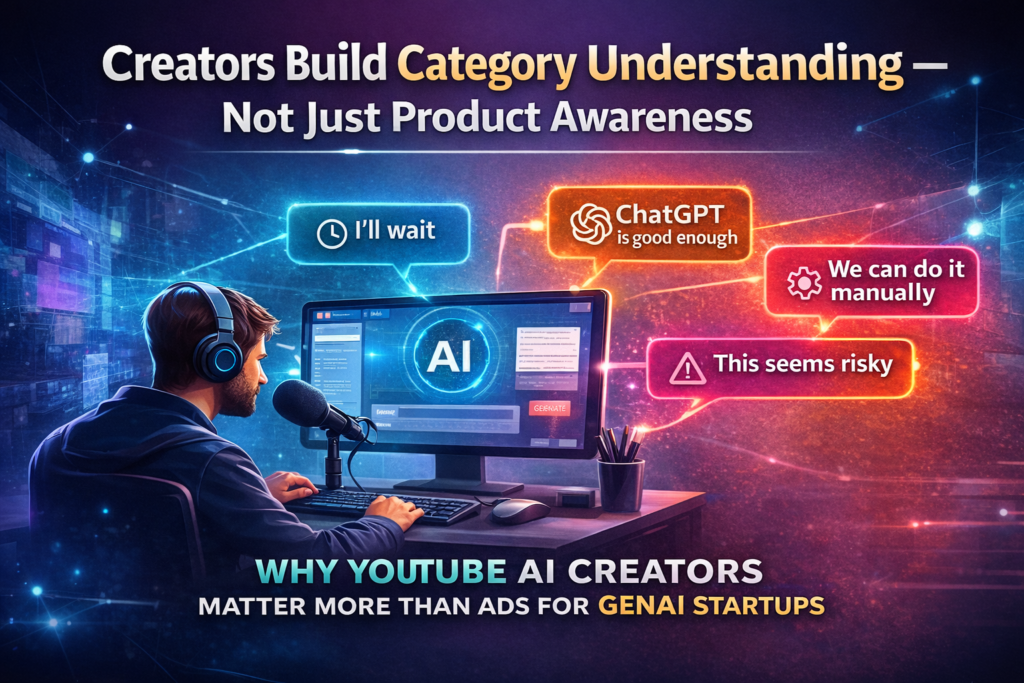
Most GenAI startups aren’t actually competing with other products — they’re competing with the buyer’s default mindset
— inertia, skepticism, “I’ll wait,” “ChatGPT is good enough,” “we’ll build it ourselves,” and “this seems too risky.”
Paid ads can interrupt attention.
Creators — especially YouTube AI creators — educate the market.
And in generative AI, market education = category formation = real distribution.
In this article, we’ll deep-dive into how and why creators build category understanding in ways paid ads simply cannot — backed by industry data, surveys, and real behavioral trends.
The Adoption Challenge: AI Isn’t Another SaaS Tool
Traditional software categories often rely on existing mental models:
“I know what CRM means.”
“I’ve used project management tools before.”
Generative AI startups don’t have that luxury.
Buyers often ask questions like:
- “Is this reliable enough for business use?”
- “What does ‘better’ even mean in an AI context?”
- “Do I need AI or just better processes?”
- “Why not just use ChatGPT for free?”
- “What’s the ROI here?”
Those are category questions. They require understanding, not persuasion.
Paid ads aren’t designed to teach, educate, or explain. They’re built to capture attention. But attention alone doesn’t drive adoption when the technology itself is unfamiliar or includes perceived risks.
That’s where YouTube creators come in.
YouTube Is the Classroom the AI Market Actually Uses
People don’t go to YouTube to be sold — they go to learn, compare, evaluate, and resolve uncertainty.
Recent research shows that brands are increasingly shifting spend toward creator-led content because audiences trust creators and view their recommendations as more meaningful than traditional ads. According to the Interactive Advertising Bureau’s 2025 Creator Economy Ad Spend & Strategy Report, creator ad spend in the U.S. is projected to reach $37 billion in 2025 — growing roughly four times faster than the overall media industry. Nearly half of brands now treat creators as a “must buy” media channel, behind only search and social ads.
Why? Because creators help prospective buyers understand, not just see.
Here are the factors at play:
1. Viewers Seek Explanation, Not Interruption
YouTube isn’t a place people go because an algorithm decided they should watch an ad. They go because they have a question or problem — e.g.,
“How does this AI tool actually fit into my workflow?”
“What’s better: fine-tuned model vs. off-the-shelf?”
“Is this safe to use in a business context?”
Where ads interrupt, creators answer.
2. Long-Form Demonstration Converts Skeptics
Unlike a 15-second ad blurb, AI creators often produce 10–30 minute walk-throughs, comparing tools side-by-side, showing failures, workarounds, and real use cases. That depth builds comprehension around the category itself.
This maps directly to how AI decision cycles actually happen — with research, comparison, and skepticism.
3. YouTube Is Where AI Learners Already Go
Even technical audiences use YouTube as a learning platform. According to developer survey data, while many developers now use AI tools, trust in those tools is low. In fact, more respondents say they distrust AI output than trust it, and many continue to rely on human communities and shared knowledge (like Stack Overflow and YouTube) to interpret and validate AI results.
This signals a broader reality: for generative AI, adoption isn’t just a transaction — it’s a learning process.
Creators Do What Ads Cannot: They Shape How the Category Is Understood
Paid ads are optimized for short attention — clicks, impressions, and conversions.
But category understanding isn’t linear.
It’s a layered journey:
- Confusion
- Search and learning
- Comparison
- Hands-on trial
- Internal approval
- Adoption
Creators influence every step:
1. Creators Build Shared Language
When AI creators define terms like “agents,” “RAG (Retrieval-Augmented Generation),” “prompt engineering,” and “workflow automation,” they give buyers a vocabulary to think with — not just a tagline to remember.
This shared vocabulary is essential if a market is going to move past confusion and toward structured evaluation.
Ads don’t create vocabulary. Creators do.
2. Demonstrations Establish Practical Value
Ads can claim value.
Creators show value.
Creators demonstrate workflows on screen:
- how to set up a pipeline
- where errors occur
- what a realistic output looks like
That level of transparency invites trust.
3. Creators Reveal Limitations and Context
One of the most significant barriers for AI adoption is fear of failure. Tools that “work sometimes” are often worse than tools that fail consistently and explainably.
Instead of hiding limitations (like many ads do), effective creators expose failures — and then show workarounds. That’s category context, not product positioning.
And in AI, that distinction matters.
Why Ads Struggle With Category Education
Paid ads interrupt attention:
- Short format
- Designed for awareness or click
- Optimized for placement, not comprehension
People almost always skip ads they don’t find immediately relevant.
But they linger on long-form creator content because they entered with intent to learn.
This is especially true for complex purchase decisions, where the buyer isn’t just asking “what’s the best product?” but “what is this thing and how do I know I need it?”
YouTube creator content answers that question — ads usually do not.
Real Data: Trust, Skepticism, and the Need for Education
One of the most striking AI insights in 2025 was the disconnect between usage and trust. According to the Stack Overflow 2025 Developer Survey, 84% of developers use or plan to use AI tools, but trust in AI output accuracy is low. Only a small fraction of respondents report high trust, while a much larger share actively distrusts AI results.
In other words:
People use AI more than ever — but they don’t trust it.
That creates a huge education gap.
Creators help close that gap by illustrating:
- what works
- what doesn’t
- where tools fail
- how to verify and correct results
This is category education — not product amplification.
Creators Help Buyers Cross the Most Common Category Barriers
Let’s examine the most pervasive objections GenAI startups face — and how creators uniquely overcome them:
Barrier 1: Inertia — “Not now.”
People procrastinate because AI feels abstract, unfamiliar, or risky.
Creators reduce inertia by:
- showing how to get started
- breaking complex ideas into steps
- lowering the psychological barrier to trial
Barrier 2: Skepticism — “AI tries to hallucinate.”
Real demos from creators tackle skepticism head-on:
- they show real input/output
- they describe verification processes
- they compare output to alternative tools
Trusted creators can show trade-offs without damaging credibility — something ads rarely accomplish.
Barrier 3: “I can do it manually.”
With AI, manual methods often feel safer because buyers understand them.
Creators demonstrate exact gains — not just claims — by walking through real use cases. That’s why category education directly influences perceived ROI.
Barrier 4: “ChatGPT is Good Enough.”
Generative AI startups often die by the “ChatGPT is enough” death sentence.
Creators combat this by explaining:
- where general-purpose tools plateau
- which workflows benefit from a specialized tool
- where pipelines matter
This isn’t vendor messaging — it’s comparative insight.
Barrier 5: Internal Build vs Buy Debate
Builders often assume in-house solutions will save money or control.
Creators expose the hidden costs of DIY:
- maintenance overhead
- evolving model drift
- security and compliance
- integration complexity
This helps business buyers make tough internal decisions.
Barrier 6: Perceived Risk
For tools handling sensitive workflows, buyers need assurance.
Creators build trust by:
- showing real risk patterns
- describing mitigation techniques
- offering realistic expectations
Again — education, not interruption.
Why YouTube Creators Matter More Than Other Channels
Yes, blogs and podcasts matter too — but YouTube holds a special place in tech education.
According to Oxford Economics, YouTube has created an economic impact ecosystem where creators help businesses grow, build skills, and foster community connections.
YouTube uniquely combines:
- search intent (people looking for answers)
- visual demonstration
- extended runtime (10–30 mins)
- comparison context
- commentary and community feedback
These features make it the single most relevant long-form channel for deep category learning.
YouTube is not a billboard.
It’s a search classroom.
Creators Create Durable Narrative — Ads Create Temporary Noise
Think of paid ads as a one-off interruption:
- They appear — then they vanish.
- They drive clicks — not comprehension.
- They win attention — but not trust.
Creators build perennial assets:
- videos that rank on search
- content that people share
- evidence that persists
- narratives that clarify a category
When creators educate a market, they generate evergreen distribution — and that matters more for GenAI startups than any ad campaign.
The Takeaway: Ads Interrupt. Creators Educate.
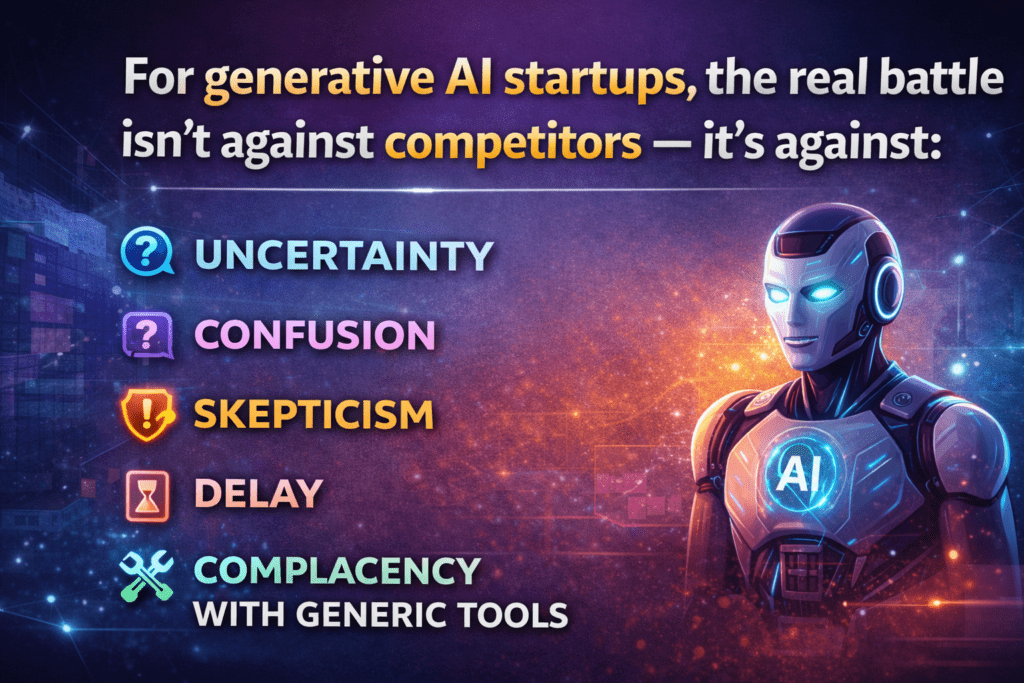
For generative AI startups, the real battle isn’t against competitors — it’s against:
- uncertainty
- confusion
- skepticism
- delay
- complacency with generic tools
Creators help buyers transition from ignorance → comprehension → evaluation → adoption.
Ads can help with short-term visibility.
Creators build the understanding that makes adoption possible.
That’s why GenAI distribution isn’t about awareness.
It’s about category comprehension.
And if your startup wants real adoption, you don’t buy distribution — you teach it.
AI Distribution
- creator distribution stack for AI tools
- creator economy as the front door for AI adoption
- sponsored YouTube videos for generative AI companies
- why AI startups should not skip YouTube
- creator collaborations for AI startup reviews
Startup Marketing
The Kingy Brief
Get The Kingy Brief.
AI changes, original tests and one practical thing to try. Fridays at 09:00 Vancouver time.
Free · Double opt-in · Unsubscribe anytime
Signup help and newsletter schedule
Signup form provided by Beehiiv. After submitting, check your inbox for "Confirm your subscription to The Kingy Brief" and open its confirmation link. Check Spam or Promotions if you cannot find it.
Fridays at 09:00 Vancouver time: source-checked AI changes, original tests and one practical thing to try. The weekly restart begins October 9, 2026. We skip a week when there is not enough verified material. Free. Unsubscribe anytime.