
A massive multiyear chip deal signals a new era, not just for two Silicon Valley giants, but for the entire AI industry.
The Deal That Shook the Market

On February 17, 2026, two of the most powerful names in tech made it official. Meta and Nvidia announced a sweeping multiyear chip deal that sent shockwaves through Wall Street and the broader tech world. The agreement covers millions of Nvidia chips current Blackwell GPUs, upcoming Rubin GPUs, and, for the very first time, standalone Grace and Vera CPUs. Neither company disclosed the exact price tag. But analysts weren’t shy about estimating it.
Ben Bajarin, CEO and principal analyst at Creative Strategies, put it plainly: “The deal is certainly in the tens of billions of dollars.” According to The Register, the agreement could contribute tens of billions to Nvidia’s bottom line over its lifetime. That’s not a deal. That’s a statement.
Shares of Meta and Nvidia both climbed in extended trading after the announcement. AMD, on the other hand, sank about 4%. The market read the room fast.
Zuckerberg’s $135 Billion Vision
This deal doesn’t exist in a vacuum. It’s the direct result of Meta CEO Mark Zuckerberg’s audacious AI ambitions. In January 2026, Meta announced plans to spend up to $135 billion on AI infrastructure in 2026 alone nearly double what it spent the year before. That’s a staggering number. And this Nvidia deal is a central pillar of that strategy.
Zuckerberg framed the partnership in sweeping terms. He said the expanded deal continues Meta’s push “to deliver personal superintelligence to everyone in the world” a vision he first announced in July 2025. That’s not just corporate speak. It’s a declaration of intent.
Meta has committed to spending $600 billion in the U.S. by 2028 on data centers and the infrastructure they require. The company has plans for 30 data centers, 26 of which will be based in the U.S. Two of its largest AI data centers are already under construction: the Prometheus 1-gigawatt site in New Albany, Ohio, and the Hyperion 5-gigawatt site in Richland Parish, Louisiana. A significant portion of the new Nvidia chips will land in these facilities.
The scale is almost hard to comprehend. As The Verge noted, this year’s AI spending from Meta, Microsoft, Google, and Amazon combined is estimated to cost more than the entire Apollo space program.
The CPU Twist Nobody Saw Coming
Here’s where things get genuinely interesting. The GPU purchase is big news. But the real story is the CPUs.
Meta is becoming the first company to deploy Nvidia’s Grace central processing units as standalone chips at large scale. That’s a first. Until now, Nvidia’s Grace processors were almost exclusively available as part of so-called “Superchips” modules that combine a CPU and GPU together. Nvidia officially changed its sales strategy in January 2026 and began offering the CPUs separately. The first named customer at that time was neocloud provider CoreWeave. Now Meta is taking it to an entirely different scale.
Why does this matter? Because it signals a fundamental shift in how AI workloads are being handled. The industry spent years obsessed with GPUs for training massive models. That era isn’t over but it’s evolving. The focus is increasingly shifting toward inference: the process of actually running trained models in the real world. And for many inference tasks, GPUs are overkill.
“We were in the ‘training’ era, and now we are moving more to the ‘inference era,’ which demands a completely different approach,” Bajarin told the Financial Times.
CPUs are more cost-effective and energy-efficient for these kinds of workloads. Ian Buck, Nvidia’s VP and General Manager of Hyperscale and HPC, said the Grace processor can “deliver 2x the performance per watt on those back-end workloads” such as running databases. He added that “Meta has already had a chance to get on Vera and run some of those workloads, and the results look very promising.”
Grace and Vera: The Chips Powering the Future
So what exactly are these chips? Let’s break it down.
The Grace CPU features 72 Arm Neoverse V2 cores and uses LPDDR5x memory, which offers advantages in bandwidth and physical space. It’s built for efficiency. It’s built for inference. And Meta is deploying it at a scale nobody has attempted before.
The Vera CPU is next-generation. It brings 88 custom Arm cores with simultaneous multi-threading and confidential computing capabilities. That last part is significant. According to The Decoder, Meta plans to use Vera specifically for private processing and AI features in its WhatsApp encrypted messaging service. Vera deployment is planned for 2027.
The deal also includes Nvidia’s Spectrum-X Ethernet switches networking technology used to link GPUs together within large-scale AI data centers. Meta will also leverage Nvidia’s security capabilities as part of AI features on WhatsApp. This isn’t just a chip deal. It’s a full-stack infrastructure partnership.
Bajarin summed it up well: “Meta doing this at scale is affirmation of the soup-to-nuts strategy that Nvidia’s putting across both sets of infrastructure: CPU and GPU.”
Nvidia Enters the CPU Wars
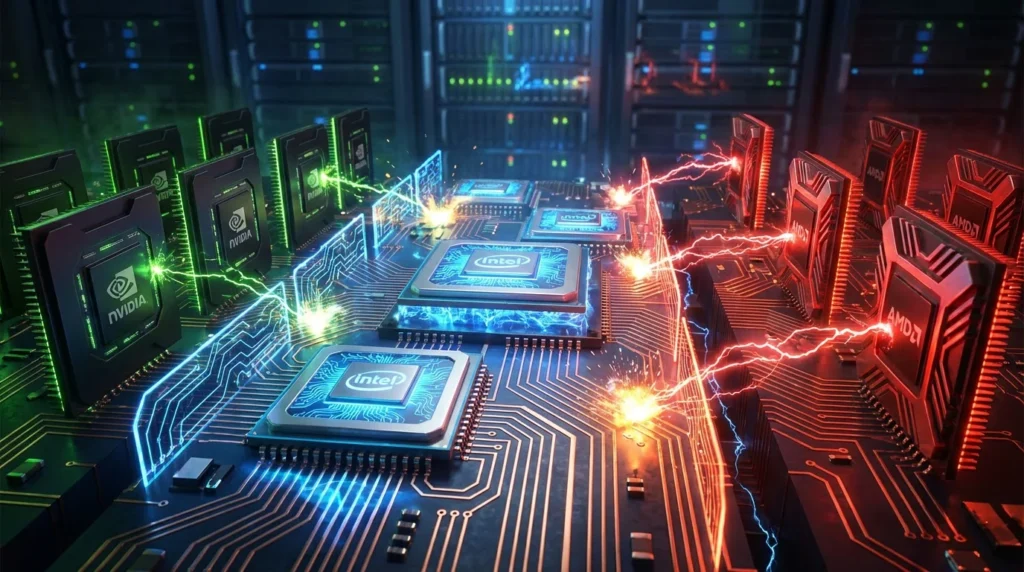
This deal does something else that’s easy to overlook. It officially puts Nvidia in direct competition with Intel and AMD in the server CPU market.
For decades, Intel dominated server CPUs. AMD clawed back significant market share with its EPYC processors. Then Arm-based chips like Amazon’s Graviton and Google’s Axion started disrupting the space. Now Nvidia is entering the ring with Grace and Vera, backed by one of the biggest customers in the world.
This is a bold move. Nvidia built its empire on GPUs. Expanding into CPUs means taking on entrenched competitors in a market they know well. But Nvidia has something most CPU vendors don’t: a deeply integrated AI ecosystem. When you buy Nvidia CPUs, you’re buying into a platform that works seamlessly with Nvidia GPUs, networking, and software. That’s a powerful pitch.
The Meta deal validates that pitch in the most public way possible. And it sends a clear message to Intel and AMD: the GPU king is coming for your territory.
Meta Bucks the Hyperscaler Trend
Here’s something worth noting. Most major hyperscalers are moving away from external chip vendors. Amazon relies on its own Graviton processors. Google uses its Axion CPUs. Microsoft is developing its own silicon too. The trend is clear: build your own chips, control your own destiny.
Meta is doing the opposite. It’s doubling down on Nvidia even as it simultaneously works on its own in-house AI chips called MTIA processors. According to SiliconANGLE via 4sysops, Meta’s in-house chip strategy has “suffered some technical challenges and rollout delays.” A training-focused version of MTIA was planned for a future rollout, but those delays make the guaranteed supply from Nvidia crucial for Meta’s immediate AI ambitions.
The Financial Times reported that Meta’s in-house chip strategy had “suffered some technical challenges and rollout delays.” That’s a polite way of saying the backup plan isn’t ready yet. So Meta is leaning hard on Nvidia to keep its AI roadmap on track.
This doesn’t mean Meta is abandoning in-house silicon. But it does mean Nvidia remains the critical lifeline for now.
Meta Isn’t Exclusively Nvidia’s Either
Let’s be clear about something. Meta isn’t putting all its eggs in one basket. The company also operates a fleet of AMD Instinct GPUs. According to The Register, Meta was directly involved in the design of AMD’s Helios rack systems, which are due out later in 2026.
And in November 2025, Nvidia’s stock fell 4% after reports emerged that Meta was in talks with Google about using Google’s Tensor Processing Units in its data centers in 2027. No such deal was announced. But the fact that Meta was even exploring it tells you everything about how these companies operate. They keep their options open. They play multiple vendors against each other. It’s smart business.
The Nvidia deal, then, isn’t a declaration of exclusivity. It’s a declaration of scale. Meta is buying Nvidia chips because Nvidia has the best chips for what Meta needs right now and because Nvidia can deliver them.
Nvidia Under Pressure
Don’t mistake this deal for a sign that Nvidia is coasting. The company faces mounting pressure from every direction.
Google, Amazon, and Microsoft have all announced new in-house chips in recent months. OpenAI co-developed a chip with Broadcom and struck a significant deal with AMD. Startups like Cerebras are offering specialized inference chips that could chip away at Nvidia’s dominance. In December 2025, Nvidia acquired talent from inference chip company Groq in a licensing deal a move that looked a lot like a defensive acquisition.
The Meta deal is a massive win. But it’s also a reminder of why Nvidia needs wins like this. The competitive landscape is shifting fast. The company that dominated the AI training era now has to prove it can dominate the inference era too.
The standalone CPU strategy is part of that proof. If Nvidia can establish Grace and Vera as the go-to processors for inference workloads and Meta’s deployment is the proof of concept it creates a new revenue stream and a new moat.
What This Means for the AI Industry
Step back and look at the big picture. This deal is about more than two companies. It’s a signal about where the entire AI industry is heading.
The training era was about raw GPU power. Throw more compute at a problem, train a bigger model, get better results. That approach worked. It still works. But it’s expensive. It’s energy-intensive. And it’s not sustainable at the scale AI is now operating.
The inference era demands something different. Efficiency. Cost-effectiveness. The ability to run AI models at massive scale without burning through power budgets. That’s exactly what Nvidia’s standalone CPUs are designed to deliver.
Meta’s decision to deploy Grace CPUs at scale and to plan for Vera in 2027 is a bet on this future. It’s a bet that inference will define the next chapter of AI infrastructure. And it’s a bet that Nvidia has the right hardware to win that chapter.
Engineering teams from both Nvidia and Meta will work together “in deep codesign to optimize and accelerate state-of-the-art AI models” for the social media giant. That kind of collaboration doesn’t just produce better chips. It produces better AI.
The Bottom Line

The Meta-Nvidia deal is one of the biggest chip agreements in tech history. It’s worth tens of billions of dollars. It covers GPUs, CPUs, networking, and security. It marks the first large-scale standalone deployment of Nvidia’s Grace processors. And it sets the stage for Vera in 2027.
For Meta, it’s a lifeline that keeps its AI ambitions on track while its in-house chip program catches up. Nvidia on the other hand, it’s validation of a bold new CPU strategy and a massive revenue boost in the face of growing competition. For the industry, it’s a clear signal: the inference era is here, and the companies that adapt fastest will win.
The handshake happened. Now the real work begins.
Sources
- CNBC — Meta expands Nvidia deal to use millions of AI chips in data center build-out
- The Verge — Meta’s new deal with Nvidia buys up millions of AI chips
- The Decoder — Nvidia lands massive Meta deal and pushes into CPU market
- 4sysops / SiliconANGLE — Meta agrees to buy millions more AI chips for Nvidia
- Financial Times — Meta’s chip strategy and Nvidia deal
- The Register — Meta and Nvidia CPU deal details
AI Market Strategy
NVIDIA AI Strategy
NVIDIA AI Infrastructure
- NVIDIA AI growth and market impact
- NVIDIA Vera CPU infrastructure bet
- NVIDIA US Blackwell manufacturing strategy
NVIDIA AI Systems
Related Companies
The Kingy Brief
Get The Kingy Brief.
AI changes, original tests and one practical thing to try. Fridays at 09:00 Vancouver time.
Free · Double opt-in · Unsubscribe anytime
Signup help and newsletter schedule
Signup form provided by Beehiiv. After submitting, check your inbox for "Confirm your subscription to The Kingy Brief" and open its confirmation link. Check Spam or Promotions if you cannot find it.
Fridays at 09:00 Vancouver time: source-checked AI changes, original tests and one practical thing to try. The weekly restart begins October 9, 2026. We skip a week when there is not enough verified material. Free. Unsubscribe anytime.