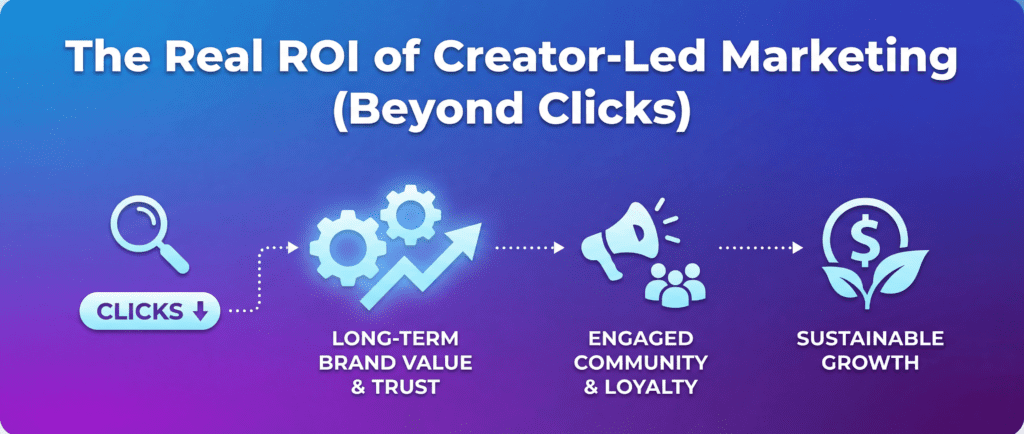
What AI companies actually care about: brand search lift, demo quality, pipeline velocity, CAC payback, and “time-to-belief”
If you sell AI, you already know the dirty secret of modern growth:
The most valuable outcomes don’t look like conversions at first.
They look like belief.
Someone watches a creator tear apart a workflow, show the product in the wild, compare it to competitors, and call out what’s real vs. marketing fluff. They don’t click. They don’t even open a new tab.
But three days later they:
- type your brand name into Google
- ask their team “have you seen this?”
- forward the video to procurement
- book a demo… already convinced you’re on the shortlist
If you’re measuring creator-led campaigns primarily by clicks (or even last-touch signups), you’re grading a movie by the opening credits.
This article is a practical, CFO-friendly breakdown of the outcomes AI companies actually care about—and how creator-led marketing moves those needles:
- Brand search lift (demand creation you can see)
- Demo quality (fewer tire-kickers, more real buyers)
- Pipeline velocity (faster movement from interest → revenue)
- CAC payback (cashflow efficiency, not just “CAC”)
- Time-to-belief (how quickly the market trusts your product)
Along the way, I’ll show why working with focused YouTube channels such as Kingy AI, which currently reaches 2M+ subscribers, changes the math. Audience fit and trust matter more than reach alone.
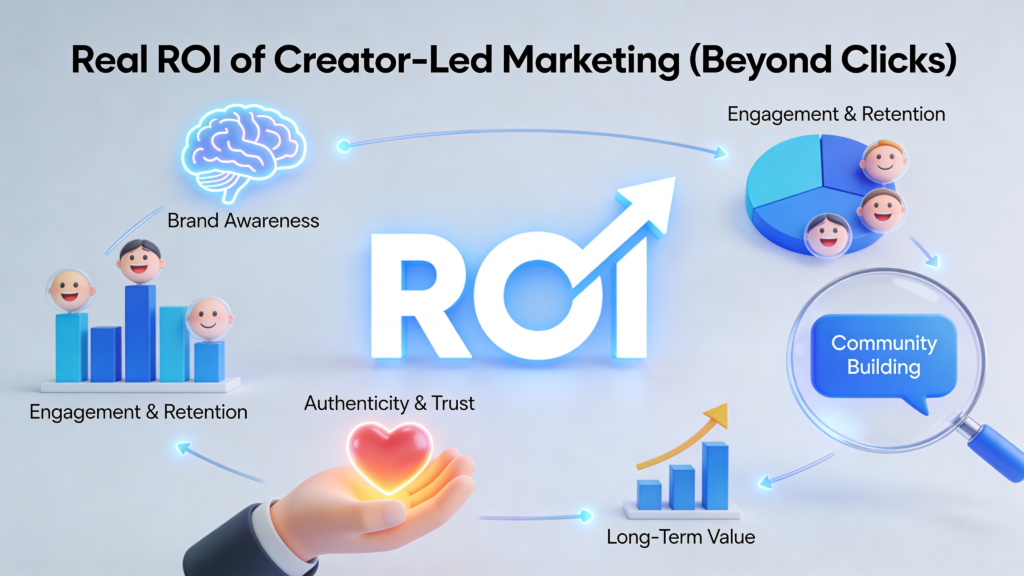
Why “click ROI” breaks for AI
AI products aren’t impulse buys. Even “cheap” AI tools often trigger:
- security reviews
- data/privacy questions
- stakeholder buy-in
- workflow disruption
- internal champions + internal skeptics
- proof that the thing actually works in your context
Google’s “messy middle” research describes the real purchase journey as a loop between exploration and evaluation, shaped heavily by biases like social proof and authority (trusted experts).
That’s exactly where creators win: they don’t just generate awareness—they compress exploration + evaluation into a credible narrative.
Creator-led marketing is not “influencer marketing” (in the shallow sense)
For AI companies, the best creator partnerships behave like:
- product education
- sales enablement
- third-party validation
- workflow demonstrations
- objection handling
- category positioning
- and “proof of competence” content that your own ads can’t ethically claim
YouTube’s own creator partnership tooling (BrandConnect / partnership ads) explicitly frames creator work as a way to amplify credibility and link authentic creator videos into ad campaigns.
And in B2B specifically, Google notes a Gartner finding that 65% of B2B buyers were influenced by YouTube during a recent purchase decision—which is a polite way of saying: your buyers are watching YouTube whether your media plan admits it or not.
So if clicks aren’t the scoreboard, what is?
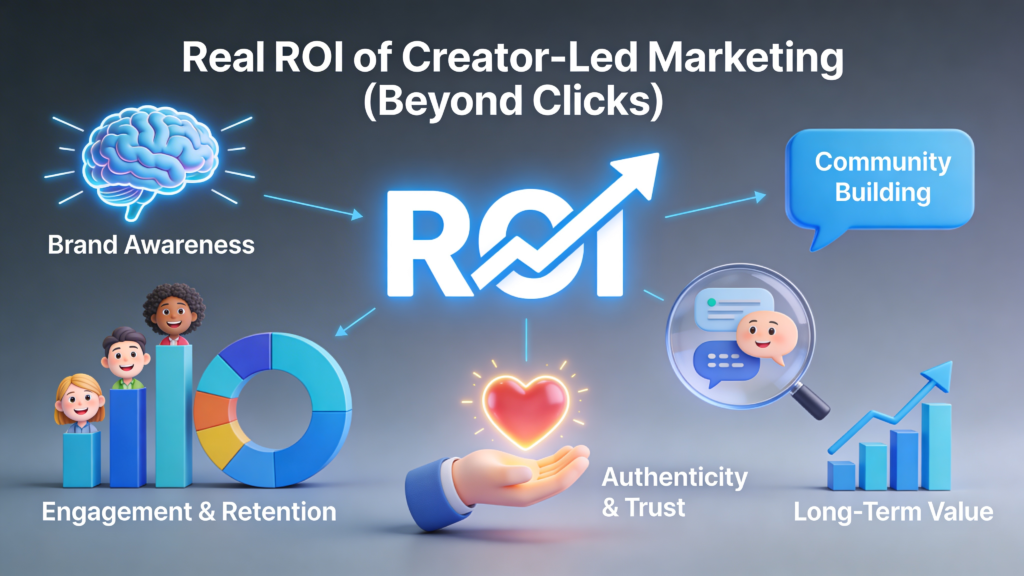
The 5 outcomes AI companies actually care about
Outcome 1: Brand search lift (the demand you can see)
Brand search lift is the increase in searches for your brand (and brand-related terms) caused by a campaign.
It matters because brand search is often the cleanest observable signal of “you entered someone’s consideration set.” People don’t Google what they don’t remember.
Why creators drive brand search lift
Creators generate curiosity with intent. After a credible demo, people don’t click the creator’s link—they often do what humans naturally do:
- search your brand
- search “brand + pricing”
- search “brand + review”
- search “brand vs competitor”
- search “brand + privacy / SOC2”
- search “brand + API”
That behavior is so common that Google has formal tooling to measure lift in search behavior after ad exposure.
In Display & Video 360, Search Lift is defined as measuring the increase in searches for your product or brand after users view your ad, using a control vs. exposed methodology.
Even outside DV360, Google Ads documents Brand Lift / Search Lift concepts as effectiveness tools that go beyond traditional click metrics.
What to measure (practical version)
Track brand-search movement in three layers:
- Direct branded terms
- Brand name
- Brand + product name
- Brand + “AI” / “agent” / key category word
- High-intent modifiers
- “pricing,” “demo,” “API,” “enterprise,” “security,” “SOC2,” “GDPR,” “docs,” “integration,” “template,” “workflow”
- Competitive framing
- “Brand vs X”
- “X alternative”
- “best AI ___ tools” where you want to rank
Then compare:
- baseline period (e.g., 28 days pre)
- campaign period
- post period (28–56 days after)
If you can, validate with a proper lift study (control/exposed). Google’s Search Lift methodology is built specifically around that comparison.
Why this is “real ROI,” not vanity
Brand search is downstream of attention and upstream of pipeline. It’s a bridge metric that doesn’t lie the way clicks do.
And there’s real-world precedent for search lift as a meaningful outcome: Google/Nielsen case study content on YouTube investment describes campaigns where increased investment contributed to large lifts in branded searches (the specifics vary by campaign and category).
The key idea: creators don’t just send traffic. They create memory that triggers search later.
Outcome 2: Demo quality (fewer tourists, more buyers)
If you sell AI, you’ve lived this pain:
- tons of demos
- low close rate
- “cool tech!” vibes
- no urgency
- wrong customer profile
- or a mismatch between the person excited and the person who signs
So the ROI question becomes:
Did the creator partnership produce better demos?
What “demo quality” actually means
A “high-quality demo” is not “someone booked time.”
It’s a demo request that arrives with:
- the right ICP attributes
- a real use case
- reasonable authority / influence
- urgency or clear trigger
- willingness to integrate / adopt
- and fewer fundamental misunderstandings
In product-led or hybrid motions, demo quality often correlates with product-qualified behavior.
OpenView defines Product Qualified Leads (PQLs) as users who signal buying intent based on product usage rather than only marketing/sales qualification, and notes PQLs often convert at high rates (they cite “often 15–30%”).
Even if you’re not pure PLG, the principle holds: quality means proof of fit and proof of intent.
Why creators drive demo quality
The best creator content does what most landing pages can’t:
- shows real workflows
- demonstrates constraints
- calls out what the tool is not good at
- frames who it’s for (and who should skip it)
- answers objections before the buyer asks
This pre-qualification effect is massive.
A large AI-focused channel like Kingy AI adds another advantage: the audience is already in “AI evaluation mode.” They aren’t randomly discovering your tool while watching cat videos. They’re actively mapping the landscape.
The ROI outcome: fewer junk demos, more “we’re already convinced—help us implement.”
What to measure (practical version)
Add a simple “demo quality score” that combines:
- ICP match (company size, role, industry)
- use-case clarity (free-text scoring or dropdown)
- technical readiness (API need? security needs?)
- buying stage (exploring / comparing / selecting)
- multi-stakeholder involvement (is this being shared internally?)
Then compare creator-sourced cohorts vs. other sources:
- show rate
- sales accepted rate
- time to next step
- close rate
- expansion likelihood (if you have data)
If you do PLG, add:
- activation rate
- “aha moment” completion
- PQL rate (or your equivalent trigger)
Outcome 3: Pipeline velocity (speed to revenue)
Pipeline velocity is basically: how fast money moves through your funnel.
There are multiple definitions, but the most common “revenue velocity” framing uses:
(Qualified opportunities × win rate × average deal size) ÷ length of sales cycle
Even if you don’t love the formula, the concept is unavoidable: speed matters—especially for AI companies with rising competition and short differentiation half-lives.
Why creators accelerate velocity
Creators reduce time spent on:
- category education
- “what is this?”
- trust-building
- proving competence
- internal alignment
They also create a shared artifact you can circulate across a buying committee.
And buying committees are real: many B2B purchases involve multiple decision-makers (often cited in the 6–10 range for complex solutions).
So your job isn’t convincing “a buyer.” It’s helping a group reach shared confidence.
A creator video acts like a portable sales engineer—available 24/7, repeatable, and consistent.
What to measure (practical version)
For creator-sourced pipeline (and “creator-influenced” pipeline), track:
- time from first touch → demo booked
- demo → SQL acceptance
- SQL → proposal
- proposal → close
- average “days in stage” reduction
- win rate changes
Then do something most teams forget:
measure velocity on deals where the creator content is used by sales.
If your reps aren’t sending the video, you’re leaving ROI on the table.

Outcome 4: CAC payback (the metric CFOs actually feel)
CAC is easy to argue about. CAC payback is harder to ignore.
OpenView describes CAC payback as a core efficiency metric and notes many people consider 12 months a “fantastic” payback benchmark (context-dependent).
In plain language:
How long until the gross profit from a customer repays what it cost to acquire them?
This is where creator-led marketing becomes very real, very fast—because it can change multiple payback inputs at once:
- lead-to-opportunity rate
- win rate
- sales cycle length
- expansion rate
- churn/retention (by setting better expectations)
Why creators improve payback (even if CAC looks higher)
Creator sponsorships can look expensive if you evaluate them like search ads.
But payback improves when:
- demos convert better
- pipeline moves faster
- customers churn less because they knew what they were buying
- and your activation campaigns become cheaper because the market already recognizes you
This is why brand work and performance work aren’t enemies. They’re complements.
LinkedIn’s B2B Institute research popularized the 95–5 idea: most of your market is not in-market right now, and marketers often overexpect immediate effects.
Creator-led content is a way to keep your brand “warm” among the 95% until they become the 5%.
What to measure (practical version)
To tie creator spend to payback, you need cohort math:
- acquisition cost per cohort (include sponsorship cost allocation)
- gross margin per customer per month
- retention curve
- expansion curve
Then compare creator cohorts vs. baseline.
If your creator cohort:
- closes faster
- retains better
- expands more
…your payback can beat “cheap CAC” channels that attract low-fit customers.
Outcome 5: Time-to-belief (the most important metric nobody tracks)
Here’s the missing metric for AI GTM:
Time-to-belief = how long it takes a serious buyer to go from first exposure to “I trust this enough to act.”
This is different from time-to-demo.
Different from time-to-close.
Different from “time on site.”
Belief is the step where the buyer stops asking “is this real?” and starts asking “how do we deploy it?”
Google’s messy middle model highlights how evaluation is driven by signals like authority and social proof.
Creators are authority + social proof, when done right.
Why time-to-belief matters more in AI than most categories
Because AI buyers worry about:
- hallucinations / reliability
- data exposure
- compliance
- integration complexity
- change management
- vendor durability (“will this exist in 18 months?”)
Belief requires evidence. Creator-led content is evidence that feels earned, not claimed.
How to measure time-to-belief (practical, non-pretend version)
Pick a belief milestone that reflects genuine intent, such as:
- demo request + completed pre-demo questionnaire
- PQL trigger
- security doc request
- “introduced to procurement”
- trial activation + team invite
- second meeting scheduled within 7 days
- solution design call booked
- signed pilot / PoC
Then measure:
- median days from first creator exposure → belief milestone
- % of audience reaching belief milestone within 7/14/30/60 days
- belief velocity by segment (SMB vs midmarket vs enterprise)
You don’t need perfect attribution.
You need directional truth.
Why large YouTube channels change the math (and why Kingy AI is structurally valuable)
Let’s talk about the difference between “a creator” and a platform-grade creator channel.
When you work with a focused YouTube channel such as Kingy AI, whose current subscriber snapshot is 2M+, you’re buying more than a placement:
1) You’re buying concentrated demand, not random reach
AI companies don’t need “everyone.” They need:
- builders
- operators
- founders
- marketers
- developers
- AI-curious teams actively evaluating tools
A niche channel with scale is rare. That combination is power.
2) You’re buying trust transfer
YouTube’s creator partnership ecosystem explicitly positions creator partnerships as a credibility amplifier.
Trust transfer is why a creator’s audience will:
- search your brand instead of clicking
- listen longer
- tolerate nuance
- and take action later
3) You’re buying evergreen compounding
A great YouTube integration keeps working after the campaign window:
- it ranks in YouTube search
- it gets recommended
- it becomes a reference link in communities
- it shows up when people research “best AI ___”
This is one reason creator sponsorships have surged: brands are reallocating toward creator-driven placements as a durable marketing asset (not just an impression).
4) You’re buying a sales enablement asset
Your team can send one video to:
- skeptical engineers
- finance
- exec stakeholders
- procurement
- internal champions who need ammo
That reduces sales friction and improves velocity.
5) You’re buying a better measurement surface
Bigger channels enable better experiments:
- stronger signal in brand search
- more measurable lift in direct traffic
- more volume for cohort analysis
- cleaner comparisons across time windows
If you want to measure beyond clicks, scale helps.
The measurement stack: how to prove ROI beyond clicks (without lying to yourself)
This is where most teams either overcomplicate… or give up.
You don’t need perfect attribution.
You need triangulation.
Step 1: Accept that “no click” does not mean “no impact”
Google Ads explicitly supports the concept of view-through conversions, where conversions happen after an impression without a click; you can set and measure view-through conversion windows.
Clicks are an interaction. Influence is a process.
Step 2: Use lift measurement when you can
If you have the setup and budget, Search Lift is designed to measure whether ads caused a change in search activity by comparing exposed vs control groups.
Even if you’re not running DV360, the concept matters: control vs exposed beats “UTM debates.”
Step 3: Use incrementality logic even without a formal experiment
Incrementality testing is fundamentally about comparing outcomes between exposed and control groups to estimate causal lift.
You can approximate this with:
- geo split tests
- holdout periods
- matched markets
- audience split (where possible)
- staggered launches (creator A week 1, creator B week 3)
Step 4: Build a “Creator ROI Dashboard” that matches how buyers behave
Here’s the dashboard I’d put in front of an AI CFO:
Demand creation (leading indicators)
- branded search volume index (baseline vs post)
- direct traffic index
- “brand + pricing” / “brand + docs” query volume
- returning visitor rate
Demand capture (mid indicators)
- demo requests
- trial starts
- PQL rate (or equivalent)
- sales accepted lead rate
- meeting show rate
Revenue outcomes (lagging indicators)
- pipeline created
- pipeline velocity changes
- win rate
- CAC payback by cohort
- retention / expansion
Belief outcomes (the missing layer)
- median days to belief milestone
- % reaching belief milestone within 30/60 days
- “self-reported influence” survey (more below)
Step 5: Add one brutally simple “source of truth” question
At demo booking (and again at closed-won), ask:
“What influenced you to reach out?”
Options: YouTube (creator name), colleague shared video, search, LinkedIn, paid ad, etc.
This won’t be perfect. But it captures the reality that buyers often attribute their own journey better than your UTM parameters do, especially for creator influence.
How creator-led marketing drives each ROI outcome (mechanically)
Let’s connect the dots.
A) Brand search lift: “memory that converts later”
Creator content triggers:
- authority bias (“this person knows what they’re doing”)
- social proof (“the comments validate it”)
- and a curiosity loop that ends in branded search
When buyers search, they’re raising their hand.
B) Demo quality: “pre-qualification at scale”
A creator can filter out low-fit leads by being honest:
- who it’s for
- what it replaces
- what it integrates with
- what pain it solves and what it doesn’t
That’s why creator cohorts often behave more like PQL cohorts than MQL cohorts.
C) Pipeline velocity: “fewer trust steps”
A creator video reduces the number of meetings spent on basics.
It creates a shared understanding across buying committees—important in complex B2B decisions.
D) CAC payback: “better cohorts, not just more leads”
If creator cohorts:
- close faster
- retain longer
- expand more
…payback improves even if upfront spend looks higher.
E) Time-to-belief: “proof you didn’t write”
In AI, belief is earned by:
- independent validation
- transparent demos
- comparisons
- real constraints
- and credible voices
Creators are the fastest “belief engine” because they can say what brands can’t.

What a “good” creator program looks like for an AI company
Most AI companies still buy creator sponsorships like they’re buying billboards:
- one integration
- one link
- one code
- done
That’s not a program. That’s a lottery ticket.
Here’s what works more reliably:
1) Build a “belief ladder” before you write a brief
Define the stages you want to accelerate:
- Awareness (they know you exist)
- Understanding (they get what you do)
- Credibility (they believe you work)
- Fit (they believe you work for them)
- Action (demo/trial/pilot)
- Advocacy (they share it internally)
Then write the creator brief to move people up that ladder.
2) Use creators like “external product educators,” not ad inventory
The best AI creator content usually includes:
- live workflow
- setup friction (and how to avoid it)
- honest limitations
- competitive context
- “who this is perfect for”
- “who should skip this”
That honesty is the conversion engine.
3) Bundle distribution so the content actually lands
A high-performing package often includes:
- a dedicated long-form video
- shorts/cutdowns
- pinned comment CTA
- community post
- a follow-up mention in a later video (“update after using it for a week”)
- optional retargeting using the creator asset (where tools allow)
YouTube’s partnership ad ecosystem is explicitly built to link creator videos into ad campaigns for performance.
4) Turn the creator video into sales collateral
Train sales to use the creator asset:
- in outbound sequences
- after first meeting
- in procurement packets
- in “why us” competitive moments
This is how you convert influence into measurable velocity.
A realistic ROI model AI teams can use
Here’s a clean way to quantify ROI without pretending attribution is perfect.
Step 1: Define “incremental outcomes” you believe the campaign influences
Pick 2–3 primary outcomes (not 12). For example:
- +X% branded search index
- +Y incremental high-quality demo requests
- -Z days median time to SQL
- +$ pipeline created
Step 2: Measure lift with pre/post + comparison where possible
- Pre vs post (time series)
- plus a comparison series (geo holdout, staggered launch, or matched cohort)
This is incrementality thinking, even if you’re not running a lab-grade experiment.
Step 3: Convert into dollars conservatively
Example conversion:
- incremental demos × demo-to-win rate × avg deal size
- then apply a discount factor (because not all influence is incremental)
Then compare to total program cost.
Step 4: Add the “efficiency multiplier”
Creator content often improves:
- retargeting performance
- search conversion rates
- sales cycle length
Even Think with Google has published research suggesting that combining YouTube with search can improve search conversion performance (exact lifts vary by advertiser and setup).
You don’t have to claim exact percentages for your brand. Just acknowledge the mechanism: video primes search.
Common mistakes that make creator ROI look “bad” (when it’s not)
Mistake 1: Measuring for 7 days when the buying cycle is 90+
If you sell into teams, belief doesn’t form in a weekend.
LinkedIn’s B2B Institute points out marketers often expect the main effect quickly—even within two weeks—which is usually unrealistic for brand effects.
Mistake 2: Treating creator work like performance ads
Creator content is closer to:
- brand building
- sales enablement
- product education
- and trust formation
Clicks are not the point.
Mistake 3: Not distinguishing “creator-sourced” vs “creator-influenced”
Creator influence often shows up as:
- direct traffic
- branded search
- “I saw this on YouTube” in demo forms
- deals that close faster because stakeholders watched
If you only count UTMs, you undercount reality.
Mistake 4: Sending low-fit offers into high-trust placements
If your pricing is confusing, onboarding is rough, or product messaging is unclear, a creator video can increase interest but expose friction.
That’s not a creator failure. That’s a funnel truth serum.
Mistake 5: Choosing creators who can’t demonstrate the product deeply
For AI, shallow hype backfires.
You want creators who can:
- show real workflows
- talk to real constraints
- and keep credibility with a skeptical audience
That’s where AI-native channels with long-form formats shine.
What AI companies should ask for when partnering with a channel like Kingy AI
If you want real ROI beyond clicks, structure the partnership around the 5 outcomes.
Ask for assets that drive brand search lift
- clear brand naming in the first 30–60 seconds
- repeat brand name naturally
- show “how to find it” (site, docs, keywords)
- strong pinned comment CTA (not just a link—tell them what to do)
Ask for content that improves demo quality
- “who this is for” section
- real example use cases
- honest limitations
- competitor comparisons (when fair/allowed)
Ask for a sequence, not a one-off
- initial video
- follow-up update
- shorts/cutdowns
- community post
- optional retargeting with the creator asset
Ask for measurement cooperation
- coordinated campaign dates
- access to view metrics and retention curves
- link placement consistency
- optional survey question in your demo form (“Did you hear about us from Kingy AI?”)
Bringing it all together: the real ROI story
Creator-led marketing is not a “traffic channel.”
For AI companies, it’s a belief channel—and belief is the thing that creates:
- branded search
- high-quality demos
- faster pipeline movement
- better payback
- and shorter time-to-belief
The reason big, focused YouTube channels matter isn’t just scale. It’s the ability to generate measurable lift in the exact outcomes that AI operators care about—especially when buyers are looping through exploration and evaluation, heavily influenced by authority and social proof.
If you want creator ROI to be obvious, don’t ask “how many clicks?”
Ask:
- Did more people search for us by name?
- Were the demos better?
- Did pipeline move faster?
- Did payback improve?
- Did belief form sooner? (your new metric)
That’s the scoreboard.
And once you start measuring like this, creator-led marketing stops feeling like a gamble—and starts looking like what it really is:
a compounding asset that accelerates trust in a market drowning in AI noise.
The Kingy Brief
Get The Kingy Brief.
AI changes, original tests and one practical thing to try. Fridays at 09:00 Vancouver time.
Free · Double opt-in · Unsubscribe anytime
Sign up for The Kingy Brief on Beehiiv.
Signup help and newsletter schedule
Signup form provided by Beehiiv. After submitting, check your inbox for "Confirm your subscription to The Kingy Brief" and open its confirmation link. Check Spam or Promotions if you cannot find it.
Fridays at 09:00 Vancouver time: source-checked AI changes, original tests and one practical thing to try. We skip a week when there is not enough verified material. Free. Unsubscribe anytime.