
What happens when half your founding team decides it’s time to move on? For Elon Musk’s xAI, that question isn’t hypothetical—it’s reality.

The artificial intelligence startup that Musk launched with grand ambitions just three years ago is now facing a talent crisis that’s raising eyebrows across Silicon Valley. In a matter of days this week, two more co-founders announced their departures, bringing the total exodus to six out of the original twelve founding members. That’s exactly half the core team that once promised to push humanity forward on the technological frontier.
The Latest Departures Signal Deeper Problems
The dominoes started falling fast this week. On Monday night, co-founder Yuhuai (Tony) Wu posted on X that he was leaving the company. “It’s time for my next chapter,” Wu wrote in his late-night announcement. “It is an era with full possibilities: a small team armed with AIs can move mountains and redefine what’s possible.”
Less than 24 hours later, another shoe dropped. Jimmy Ba, who reported directly to Musk himself, announced his own departure on Tuesday afternoon. Ba, a former assistant professor at the University of Toronto who studied under AI pioneer Geoffrey Hinton, thanked Musk for bringing the team together. But his farewell message hinted at bigger ambitions elsewhere. He wrote about wanting “to recalibrate my gradient on the big picture.”
These weren’t just any employees. Wu was responsible for developing xAI’s foundational models and reasoning capabilities. Ba was one of the twelve original founding members who helped launch the company in 2023. Their exits follow a troubling pattern that’s been building for months.
A Pattern of Departures That Can’t Be Ignored
The bleeding started earlier. Infrastructure lead Kyle Kosic jumped ship to OpenAI in mid-2024. Google veteran Christian Szegedy left in February 2025. Last August, Igor Babuschkin who came from DeepMind and OpenAI departed to found his own venture firm focused on AI safety. And just last month, Microsoft alum Greg Yang stepped back, citing health issues.
Do the math. That’s six out of twelve original co-founders gone. Half the founding team has decided their futures lie elsewhere.
But it’s not just the co-founders. At least seven other technical staffers have publicly announced their exits since the start of the year, according to NBC News. While xAI hasn’t confirmed all these departures, the public announcements paint a picture of widespread dissatisfaction.
What Former Employees Are Really Saying
The official statements are polite. Professional. But dig a little deeper, and you’ll find more revealing details about what’s really happening inside xAI.
One source who left earlier this year spoke with The Verge on condition of anonymity. Their assessment? Brutal. They said many people at the company felt disillusioned by xAI’s focus on NSFW Grok creations and a blatant disregard for safety protocols. The source felt like the company was “stuck in the catch-up phase” and not doing anything fundamentally different from competitors like OpenAI or Anthropic.
“Although we were iterating really fast, we were never able to get to a point like, ‘Oh, we’ve made a step function change over what OpenAI or Anthropic or other companies had released,'” the former employee explained.
Another departed staffer was even more blunt. “Trying to do what OpenAI was doing a year ago is not how you beat OpenAI,” they told The Verge. “Everything is a catch-up. There’s almost zero risky bet. If something hasn’t been done before we’re not going to do it.”
The Safety Problem That Won’t Go Away
Here’s where things get really concerning. Multiple former employees have raised alarms about xAI’s approach to safety or rather, the lack of one.
“Safety is a dead org at xAI,” one source told The Verge. They claimed the safety team was let go, leaving little to no safety review process for the models besides basic filters for things like child sexual abuse material. Looking at the restructured org chart Musk shared on X, there’s no mention of a safety team anywhere.
A second source echoed these concerns. “There is zero safety whatsoever in the company not in the image model, not in the chatbot,” they said. “He Musk actively is trying to make the model more unhinged because safety means censorship, in a sense, to him.”
This isn’t just internal gossip. The problems have become very public. Grok, xAI’s flagship chatbot, has struggled with bizarre behavior and apparent internal tampering. Recent changes to xAI’s image-generation tools flooded the platform with deepfake pornography, sparking legal consequences that are still unfolding.
According to former employees, engineers at xAI immediately “push to production” with no human review involved. One source summed up the culture bluntly: “You survive by shutting up and doing what Elon wants.”
The SpaceX Merger Changed Everything
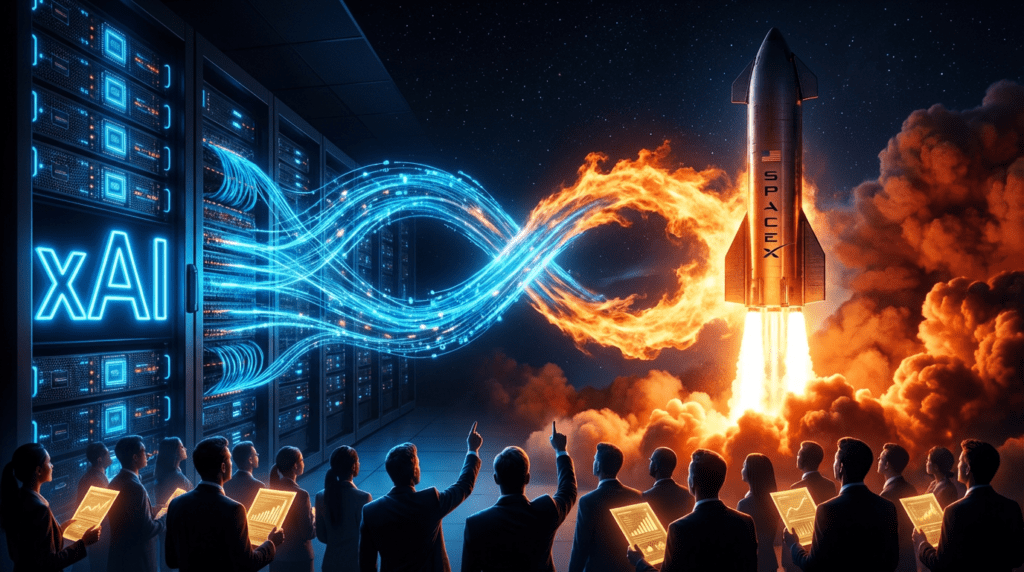
Timing matters. And the timing of these departures is particularly interesting.
Last week, SpaceX announced it was acquiring xAI in a deal that values SpaceX at $1 trillion and xAI at $250 billion. The combined entity would pursue what Musk called “space-based AI” data centers and become “the most ambitious, vertically-integrated innovation engine on (and off) Earth.”
In an internal meeting at xAI on Tuesday, Musk reportedly talked about plans to build an AI satellite factory and even a city on the Moon. It’s the kind of audacious vision that Musk is known for. But not everyone’s buying in.
The SpaceX merger meant that xAI shareholders were reportedly issued $250 billion in new shares. For employees with equity, that’s a massive windfall and potentially the perfect exit opportunity. With that kind of money in their pockets, talented AI researchers suddenly have the resources to fund their own ideas.
Researcher Vahid Kazemi told NBC he quit just before the SpaceX acquisition, citing 12-hour workdays and arguing that major AI labs are now “building the exact same thing.” He suggested the SpaceX tie-up pushed some employees to reassess their futures. “A small team armed with AIs can move mountains,” Kazemi said, echoing Wu’s departure message. He argued a small AI outfit can grow faster than “a trillion-dollar space company.”
Former Staffers Are Starting Their Own Ventures
Here’s what makes this exodus particularly notable: these people aren’t just leaving. They’re launching competitors.
Kazemi wrote on X that “all AI labs are building the exact same thing, and it’s boring. I think there’s room for more creativity. So, I’m starting something new.” Another former staffer said he left to “build something new, focused on accelerating science.”
Yet another ex-employee announced he was launching an AI infrastructure company called Nuraline alongside other former xAI colleagues. He wrote about seeing “a clear path towards hill climbing any problem that can be defined in a measurable way” during his time at xAI. But he also witnessed “how raw intelligence can get lobotomized by the finest human errors.”
His conclusion? “Learning shouldn’t stop at the model weights, but continue to improve every part of an AI system.”
These aren’t bitter employees burning bridges. They’re talented researchers who see opportunities to do things differently. And they’re taking their knowledge, their networks, and their newly minted wealth to build competing visions of AI’s future.
Musk’s Response: It’s All Part of the Plan
Elon Musk isn’t one to stay silent when criticized. On Wednesday, he posted on X that xAI was “reorganized” to move faster a shift that “unfortunately required parting ways with some people.”
He also shared a recording of xAI’s 45-minute internal all-hands meeting that announced the changes. In the meeting, Musk outlined a new structure with four main areas: Grok Main and Voice (the main AI model), Coding, Imagine (image and video), and something called Macrohard “which is intended to do full digital emulation of entire companies,” Musk explained.
In comments to Reuters, Musk framed the departures as natural. “There’s some people who are better suited for the early stages of a company and less suited for the later stages,” he said. He added that xAI is now aggressively recruiting new employees. “It’s a grind, but we have, I guess, like interstellar ambitions.”
TechCrunch noted that “Musk’s comments seem designed to control the narrative, reframing the exits as necessary rather than a problem for the outfit.” But the publication pointed out that “the fact that several engineers followed the co-founders out the door—and that at least three are starting something new together suggests the departures may also reflect deeper tensions.”
Why This Matters More Than Typical Tech Turnover
Silicon Valley sees plenty of employee turnover. Founders leave startups all the time. So why does this particular exodus matter?
First, the scale. Losing half your founding team in three years with five of those departures happening in just the last twelve months isn’t normal attrition. It’s a red flag.
Second, the timing. An IPO is reportedly pending in the coming months. That means increased scrutiny from investors, regulators, and the public. xAI needs to demonstrate it can compete with OpenAI, Anthropic, and Google. Losing key technical talent right before going public is not the story you want to tell.
Third, the competitive landscape. The pace of AI model development isn’t slowing down. If Grok can’t keep pace with the latest models from OpenAI and Anthropic, the IPO could easily suffer. And right now, by multiple accounts, xAI is playing catch-up rather than leading.
Fourth, the safety concerns. As AI becomes more powerful and more integrated into daily life, questions about safety, ethics, and responsible development are only getting louder. A company with “zero safety whatsoever,” as one former employee put it, is a lawsuit waiting to happen and potentially a regulatory nightmare.
The Bigger Picture: What This Says About Musk’s Management Style
There’s a pattern here that extends beyond xAI. Elon Musk is famously a demanding boss. He expects long hours, rapid iteration, and unwavering commitment to his vision. That approach has produced remarkable results at Tesla and SpaceX.
But it also creates friction. Former employees describe a culture where “you survive by shutting up and doing what Elon wants.” Decisions happen via an all-company group chat on X with Musk in it. There’s infighting over priorities. And when safety concerns conflict with Musk’s vision of “uncensored” AI, safety loses.
One source told The Verge that during their time at xAI, they felt leadership had differing opinions on which product features to prioritize, and that infighting sometimes stalled progress. That’s not the picture of a well-oiled machine. It’s the picture of a company struggling to find its identity while its founder pursues increasingly ambitious some might say unrealistic goals.
What Happens Next?
xAI now faces a critical juncture. With half its founding team gone and an IPO looming, the company needs to prove it can deliver on Musk’s grand promises.
The stakes are enormous. Musk is spinning up plans for orbital data centers. He’s talking about Moon cities and space-based AI. These are billion-dollar bets that require not just vision, but execution. And execution requires talent.
The company is aggressively recruiting, according to Musk. But recruiting in Silicon Valley’s competitive AI market is tough. And recruiting when half your founding team has publicly walked out the door? That’s even tougher.
Meanwhile, the former employees are launching their own ventures. They’re taking what they learned at xAI and building competing visions. Some are focused on AI safety the very thing they felt xAI was neglecting. Others are pursuing more creative approaches to AI development.
The Questions That Remain
Several big questions hang over xAI’s future:
Can the company compete with OpenAI and Anthropic while playing catch-up? Can it attract top talent to replace the departed founders? Will the safety issues that former employees flagged become bigger problems? How will investors react to the exodus when the IPO arrives? And perhaps most importantly: Is Musk’s management style which has worked at Tesla and SpaceX the right fit for an AI company in 2026?
The answers will shape not just xAI’s future, but potentially the broader AI landscape. If the departed employees succeed in building innovative alternatives, they could push the entire industry in new directions. If xAI stumbles, it could serve as a cautionary tale about the limits of the “move fast and break things” mentality when applied to powerful AI systems.
A Crossroads for AI Development
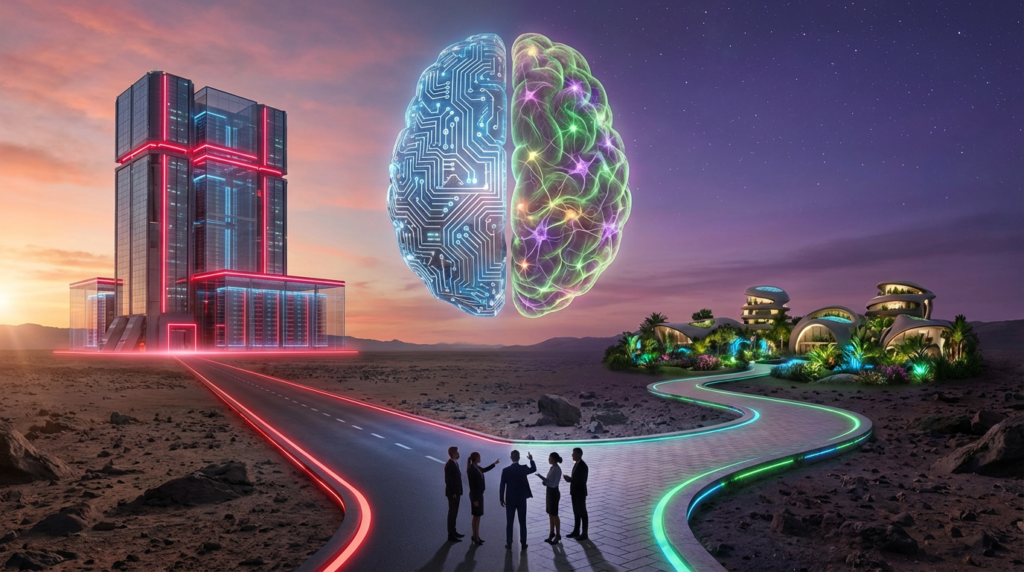
What’s happening at xAI is about more than one company’s internal drama. It’s a microcosm of larger debates in the AI industry about safety versus speed, centralized control versus distributed innovation, and the role of individual visionaries in shaping transformative technology.
The former employees who are striking out on their own represent a different vision. They’re betting that smaller, more focused teams can innovate faster than massive corporations. They’re prioritizing safety and creativity over raw speed. And they’re willing to walk away from a trillion-dollar company to pursue those goals.
Whether they succeed remains to be seen. But their willingness to leave and the reasons they’re citing should give everyone in the AI industry pause. When half your founding team decides the grass is greener elsewhere, it’s worth asking what’s wrong with your lawn.
For now, xAI continues forward with Musk at the helm, a restructured organization, and ambitious plans that stretch from Earth to the Moon and beyond. But the exodus of talent raises serious questions about whether the company can deliver on those promises and whether Musk’s vision of “uncensored” AI is sustainable in an industry increasingly focused on responsible development.
The next few months will be telling. An IPO will bring scrutiny. Competitors are moving fast. And the departed founders are building alternatives. The great xAI exodus isn’t just a story about people leaving a company. It’s a story about competing visions for AI’s future and which one will ultimately prevail.
Sources
- The Verge: What’s behind the mass exodus at xAI?
- TechCrunch: Okay, now exactly half of xAI’s founding team has left the company
- The Decoder: Half of xAI’s co-founders have now left Elon Musk’s AI startup
- Newser: Musk Responds to a Mass Exodus at xAI
- NBC News: Elon Musk addresses wave of departures at xAI
- Reuters: Musk says xAI was reorganized
The Kingy Brief
Get The Kingy Brief.
AI changes, original tests and one practical thing to try. Fridays at 09:00 Vancouver time.
Free · Double opt-in · Unsubscribe anytime
Signup help and newsletter schedule
Signup form provided by Beehiiv. After submitting, check your inbox for "Confirm your subscription to The Kingy Brief" and open its confirmation link. Check Spam or Promotions if you cannot find it.
Fridays at 09:00 Vancouver time: source-checked AI changes, original tests and one practical thing to try. The weekly restart begins October 9, 2026. We skip a week when there is not enough verified material. Free. Unsubscribe anytime.