
State Legislature Proposes Sweeping Regulations on AI-Generated News and Data Center Expansion
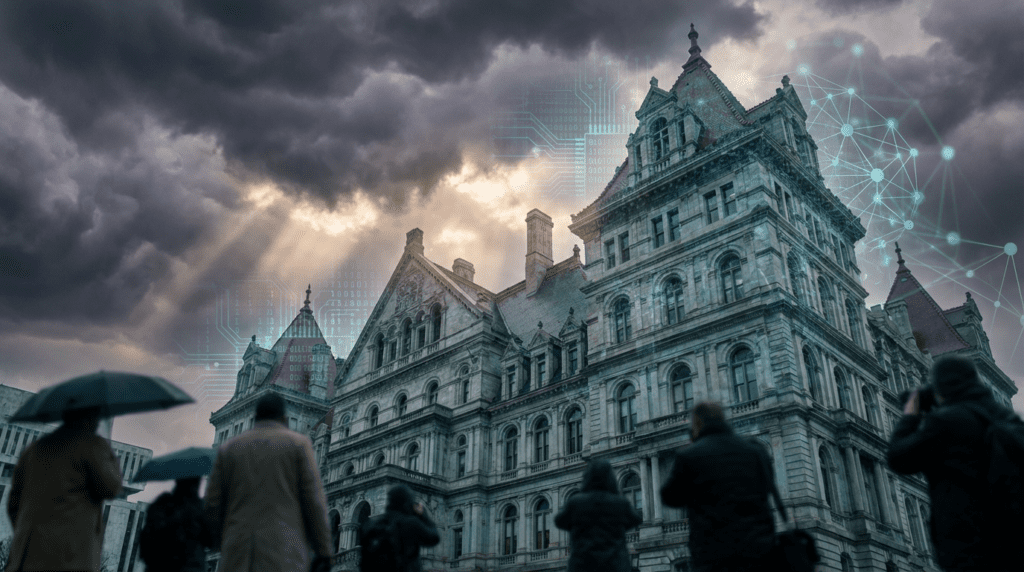
In a move that could set a national precedent for artificial intelligence regulation, New York’s state legislature is considering two ambitious bills that tackle the AI industry from dramatically different angles. One seeks to bring transparency to AI-generated news content, while the other addresses the mounting environmental and economic costs of the data centers that power these technologies. Together, they represent one of the most comprehensive state-level attempts yet to rein in an industry that has largely operated without significant oversight.
The legislative push comes at a critical moment. AI tools have become ubiquitous in newsrooms, businesses, and everyday life, yet the rules governing their use remain murky at best. As New York lawmakers prepare to debate these measures, they’re grappling with questions that extend far beyond state borders: How do we preserve trust in journalism when machines can write convincing articles? And who should pay the price when AI’s insatiable appetite for computing power drives up everyone’s electric bills?
The NY FAIR News Act: Demanding Transparency in an Age of Machine-Generated Media
The first piece of legislation, formally known as the New York Fundamental Artificial Intelligence Requirements in News Act (or NY FAIR News Act for short), takes direct aim at a practice that has quietly become commonplace: the use of generative AI to produce news content. Under the proposed law, any news article “substantially composed, authored, or created through the use of generative artificial intelligence” would be required to carry a clear disclaimer informing readers of its machine origins.
But the bill doesn’t stop at simple labeling. It also mandates that AI-generated content must be reviewed and approved by a human with “editorial control” before publication. This requirement acknowledges a fundamental concern among journalists and media critics: that AI, for all its impressive capabilities, lacks the judgment, ethical training, and accountability that human editors bring to the newsroom.
The legislation goes even further by requiring organizations to disclose to their own newsroom employees how and when AI is being used in content production. This transparency extends internally as well as externally, ensuring that journalists themselves understand the role automation plays in their workplace. Perhaps most significantly, the bill calls for safeguards to prevent AI systems from accessing confidential information, particularly details about sources a protection that strikes at the heart of journalistic ethics and the First Amendment’s protection of press freedom.
Why Now? The Erosion of Public Trust and the Rise of AI Content Farms

The timing of New York’s legislative push is no accident. Public trust in media institutions has been declining for years, with Gallup polling consistently showing that fewer than a third of Americans express significant confidence in mass media. Lawmakers worry that undisclosed AI-generated content could accelerate this erosion of trust, particularly if readers discover after the fact that articles they relied upon weren’t produced by human journalists with real-world experience and editorial judgment.
The concern isn’t purely theoretical. Researchers at Columbia University’s Tow Center for Digital Journalism have documented the proliferation of so-called “pink slime” news sites networks of websites that produce low-cost, often politically slanted content at scale. The integration of generative AI tools like ChatGPT, Google’s Gemini, and Anthropic’s Claude into these operations could dramatically increase their output and reach, flooding the information ecosystem with machine-generated content that mimics legitimate journalism.
Several major publishers have already begun experimenting with AI-generated articles, summaries, and even opinion pieces, sometimes without clear disclosure to readers. The Associated Press has used automated systems to generate corporate earnings reports for nearly a decade, though it has generally been transparent about this practice. More recently, outlets like The Washington Post and The New York Times have published detailed AI policies outlining when and how artificial intelligence tools are used in their newsrooms, typically emphasizing that AI assists human journalists rather than replacing them.
But these voluntary measures are inconsistent across the industry. Many smaller outlets and digital-native publishers have no disclosure policies whatsoever, leaving readers to guess whether the article they’re reading was crafted by an experienced reporter or assembled in seconds by a generative model. The NY FAIR News Act would eliminate this ambiguity, at least within New York’s borders, by establishing a uniform standard for disclosure.
The Constitutional Question: Compelled Speech and the First Amendment
Not everyone is enthusiastic about the proposal. Media industry groups and technology companies have raised concerns about the bill’s potential chilling effect on innovation and its compatibility with First Amendment protections. The News Media Alliance, which represents thousands of publishers nationwide, has generally supported transparency but has cautioned against overly prescriptive mandates that could create compliance burdens disproportionately affecting smaller newsrooms.
The constitutional question looms large. First Amendment scholars note that compelled speech government-mandated disclaimers on published content faces a high bar under Supreme Court precedent. The Court has historically scrutinized laws that force publishers to include specific language in their publications, and any New York law would almost certainly face legal challenges on these grounds.
However, supporters counter that the bill falls within the well-established tradition of consumer protection disclosures, similar to requiring nutritional labels on food or sponsorship disclosures in political advertising. They argue that readers deserve to know whether the news they’re consuming was written by a human being or assembled by a large language model, and that this information is essential for making informed judgments about the content’s reliability and trustworthiness.
The legal battle, should the bill pass, would likely become a landmark case in defining the boundaries of AI regulation and press freedom. The outcome could shape how states across the country approach the regulation of AI-generated content, not just in journalism but in advertising, political communications, and other domains where the distinction between human and machine authorship matters.
The Technical Challenges: How Do You Enforce an AI Disclosure Law?
One of the most significant practical hurdles facing the proposed legislation is enforcement. How would regulators determine whether a given article was AI-generated? Current AI detection tools, including those developed by OpenAI and independent researchers, remain imperfect they produce both false positives and false negatives at rates that would make reliable enforcement difficult.
Watermarking technologies, which embed invisible signals in AI-generated text, are advancing but are not yet universally adopted by AI providers. The bill may need to rely heavily on self-reporting by publishers, raising questions about how to handle bad actors who simply choose not to disclose their use of AI.
Moreover, the hybrid nature of modern content production complicates matters further. A journalist might use AI to generate a rough draft, then spend hours fact-checking, rewriting, and adding original reporting. At what point does the content cease to be “AI-generated” and become human-authored? The bill’s drafters will need to establish clear thresholds perhaps based on the percentage of text that originated from an AI system, or the degree of substantive human editorial intervention to create a workable framework.
The definition of “substantially modified” is expected to be a key point of debate. Nearly every modern newsroom uses some form of AI assistance, from automated spell-checking to algorithmic headline optimization. Lawmakers will need to draw a clear line between incidental AI use and wholesale content generation, a distinction that may prove more difficult in practice than in theory.
Bill Two: Hitting the Brakes on Data Center Expansion

While the NY FAIR News Act addresses the output of AI systems, the second bill under consideration tackles the infrastructure that makes those systems possible. S9144 proposes a three-year moratorium on issuing permits for new data centers in New York, a dramatic intervention in response to the mounting strain these facilities place on the state’s power grid.
The bill cites rising electric and gas rates for residential, commercial, and industrial customers as justification for the pause. National Grid New York reports that requests for “large load” connections have tripled in just one year, with at least 10 gigawatts of demand expected to be added over the next five years. To put that in perspective, 10 gigawatts is roughly equivalent to the output of ten large nuclear power plants.
New York already hosts more than 130 data centers, according to Data Center Map, and the state recently approved a 9-percent rate increase for Con Edison customers over the next three years. Electric bills are soaring around the country as data centers put unprecedented strain on aging power grids, and New York lawmakers are signaling that they’re not willing to let the AI industry’s infrastructure needs drive up costs for ordinary residents and businesses.
The Energy Crisis Behind the AI Boom
The proposed moratorium reflects a growing recognition that the AI revolution comes with significant environmental and economic costs. Training large language models requires enormous amounts of computing power, and running these models at scale serving millions of queries per day demands vast data centers filled with energy-hungry servers.
Tech companies have been racing to build new data centers to meet this demand, but the pace of construction has outstripped the capacity of local power grids in many regions. The result has been a surge in electricity prices, particularly in areas with high concentrations of data centers. In some cases, utilities have had to delay or deny connection requests because they simply don’t have enough power to go around.
The situation has become a bipartisan concern. While Democrats have typically focused on the environmental impact of increased energy consumption, Republicans have increasingly voiced concerns about the economic burden on constituents facing higher utility bills. New York’s proposed moratorium represents an attempt to hit the pause button and give policymakers time to develop a more sustainable approach to data center development.
Industry Pushback and Economic Concerns
The tech industry has pushed back hard against the proposed moratorium, arguing that it would stifle innovation and drive investment to other states. Data centers are significant economic engines, creating construction jobs, ongoing employment for technicians and engineers, and tax revenue for local governments. A three-year pause on new construction could mean billions of dollars in lost economic activity.
Industry representatives also argue that the solution to rising energy costs isn’t to stop building data centers, but to invest in expanding power generation and grid capacity. They point to the potential for renewable energy sources like wind and solar to power data centers sustainably, and note that many tech companies have made significant commitments to carbon neutrality.
However, critics counter that these commitments often rely on purchasing renewable energy credits rather than actually powering facilities with clean energy, and that the immediate impact of new data centers is to increase demand on existing grids that still rely heavily on fossil fuels. They argue that a temporary moratorium would give the state time to develop comprehensive energy policies that can accommodate data center growth without passing the costs on to residential and small business customers.
A National Conversation in the Making
New York is not operating in a vacuum. Across the United States, state legislatures and federal agencies have been grappling with how to regulate artificial intelligence in media, communications, and infrastructure. California has pursued its own AI transparency measures, and the Federal Trade Commission has signaled increasing interest in deceptive AI-generated content, particularly in advertising and political communications.
But New York’s dual approach addressing both the content produced by AI and the infrastructure that enables it is notable for its comprehensiveness. If both bills pass, New York would become the first state to simultaneously regulate AI disclosure in journalism and impose restrictions on the physical infrastructure of the AI industry.
The ripple effects could be substantial. As one of the nation’s largest media markets and home to many of its most influential news organizations, New York’s regulatory decisions often serve as templates for other states. A successful implementation could trigger a wave of similar bills across the country, creating a patchwork of state-level AI regulations that might eventually push Congress toward a federal standard.
Alternatively, legal challenges could result in court rulings that define the constitutional limits of AI content regulation for years to come. The outcome of New York’s legislative experiment will be watched closely by media executives, AI developers, First Amendment lawyers, energy companies, and journalists themselves.
What’s at Stake: The Future of Journalism and Infrastructure
At their core, these two bills raise fundamental questions about the kind of society we want to build in the age of artificial intelligence. The NY FAIR News Act asks whether journalism is merely the transmission of facts or an exercise of human judgment, ethical reasoning, and accountability. A machine can assemble information, but it cannot be held responsible for errors, cannot cultivate sources, and cannot exercise the kind of editorial discretion that distinguishes journalism from mere content production.
The data center moratorium, meanwhile, forces a reckoning with the physical costs of our digital ambitions. The AI revolution promises tremendous benefits, from medical breakthroughs to scientific discoveries to more efficient businesses. But those benefits come with a price tag measured in kilowatt-hours and carbon emissions, and someone has to pay it.
New York’s answer to these questions may well become the nation’s answer. As the bills move through committee hearings and floor votes in Albany, they represent more than just state-level policy experiments. They’re test cases for how democratic societies can maintain informed public discourse and sustainable infrastructure when the tools of information production and the demands of digital technology are changing faster than the rules that govern them.
Looking Ahead: The Debate Is Only Beginning

As these bills advance through the legislative process, they will undoubtedly be refined, amended, and debated extensively. The technical challenges of enforcement, the constitutional questions around compelled speech, and the economic implications of a data center moratorium all require careful consideration and thoughtful solutions.
What’s clear is that the status quo an AI industry operating with minimal regulation while reshaping journalism and straining power grids is no longer tenable for many lawmakers. Whether New York’s approach proves to be a model for other states or a cautionary tale will depend on the details of implementation and the outcomes of inevitable legal challenges.
But one thing is certain: the conversation about how to regulate AI has moved from the realm of abstract policy discussions to concrete legislative action. New York is leading the way, and the rest of the country is watching closely. The decisions made in Albany over the coming months could shape the future of artificial intelligence regulation for years to come, determining not just how we label AI-generated content or where we build data centers, but how we balance innovation with accountability, progress with sustainability, and technological advancement with human values.
Sources
- The Verge: New York is considering two bills to rein in the AI industry
- WebProNews: New York’s Bold Gambit: Inside the Legislative Push to Label AI-Generated News Before It Reshapes Public Trust
- NewsBytes: New York legislature considers 2 major bills regulating AI’s impact
The Kingy Brief
Get the next Kingy Brief.
Source-checked AI changes, original tests and one practical thing to try.
Free · Choose your subjects · Double opt-in · Unsubscribe anytime