
Mozilla’s latest update offers users unprecedented control over AI features, setting a new standard for browser transparency

The Browser Wars Get a Conscience
In an era where artificial intelligence seems to be forcefully inserted into every digital product imaginable, Mozilla Firefox is charting a different course. The company announced this week that it will introduce comprehensive AI controls in Firefox 148, rolling out February 24, giving users the power to disable all current and future generative AI features with a single toggle. It’s a move that stands in stark contrast to competitors who have made AI integration mandatory, and it signals a potential shift in how tech companies approach user autonomy.
The announcement comes at a critical juncture for Mozilla. After years of declining market share and increasing pressure from AI-native competitors, the company could have easily followed the industry playbook: integrate AI deeply, make it default, and hope users adapt. Instead, they’re betting on something different trust.
A Promise Kept
The story behind Firefox’s AI controls begins with backlash. When Mozilla CEO Anthony Enzor-DeMeo announced in late 2025 that Firefox would “evolve into a modern AI browser,” the response from the Firefox community was swift and vocal. An open letter posted on Reddit’s Firefox subreddit garnered over 5,000 upvotes from users concerned that mandatory AI features would fundamentally change the browser they’d come to trust.
What happened next was unusual in the tech world. Enzor-DeMeo didn’t dismiss the concerns or double down on the company’s AI strategy. Instead, he responded directly to the Reddit thread, promising users “a clear way” to disable AI features, including a dedicated kill switch. “Choice matters and demonstrating our commitment to choice is how we build and maintain trust,” he wrote in December.
Now, just two months later, that promise is becoming reality. The new AI controls section will appear in Firefox’s desktop settings between “Sync” and the new “AI controls” menu, offering users granular control over every AI-powered feature in the browser.
What’s Under the Hood
Firefox 148 will launch with five distinct AI features, each of which can be individually enabled or disabled. The lineup includes translations that allow users to browse the web in their preferred language, alt text generation for images in PDFs to improve accessibility, AI-enhanced tab grouping that suggests related tabs and group names, link previews showing key points before opening a link, and an AI chatbot sidebar that integrates popular services like Anthropic Claude, ChatGPT, Microsoft Copilot, Google Gemini, and Le Chat Mistral.
For users who want nothing to do with any of these features, Mozilla has created the “Block AI enhancements” toggle. When activated, this master switch doesn’t just disable current AI features it blocks all future ones as well. Users won’t see pop-ups, alerts, or reminders encouraging them to try AI tools. The features simply won’t exist in their browsing experience.
“AI is changing the web, and people want very different things from it,” wrote Ajit Varma, Firefox’s vice president of product, in the announcement. “We’ve heard from many who want nothing to do with AI. We’ve also heard from others who want AI tools that are genuinely useful. Listening to our community, alongside our ongoing commitment to offer choice, led us to build AI controls.”
The Transparency Gambit
Mozilla’s approach represents more than just good customer service. It’s a strategic bet that transparency and user control can be competitive advantages in an increasingly crowded browser market. For over a decade, Firefox and Google Chrome dominated the browser landscape. But that dominance is being challenged by a new generation of AI-forward browsers from companies like Perplexity, Arc, OpenAI, and Opera.
Rather than trying to out-AI these competitors, Firefox is leaning into what has long been its differentiator: respect for user privacy and control. It’s a philosophy that extends beyond the browser itself. According to CNBC, Mozilla President Mark Surman is building what he calls “a rebel alliance of sorts” a coalition of tech startups, developers, and public-interest technologists committed to making AI more trustworthy and accountable.
Mozilla plans to deploy approximately $1.4 billion worth of reserves to support tech businesses and nonprofits working toward AI transparency. The company is actively pursuing investments that push back against AI companies growing at historic speeds with limited oversight, positioning itself as a counterweight to the rapid, often unchecked expansion of AI technology.
A Different Kind of AI Integration
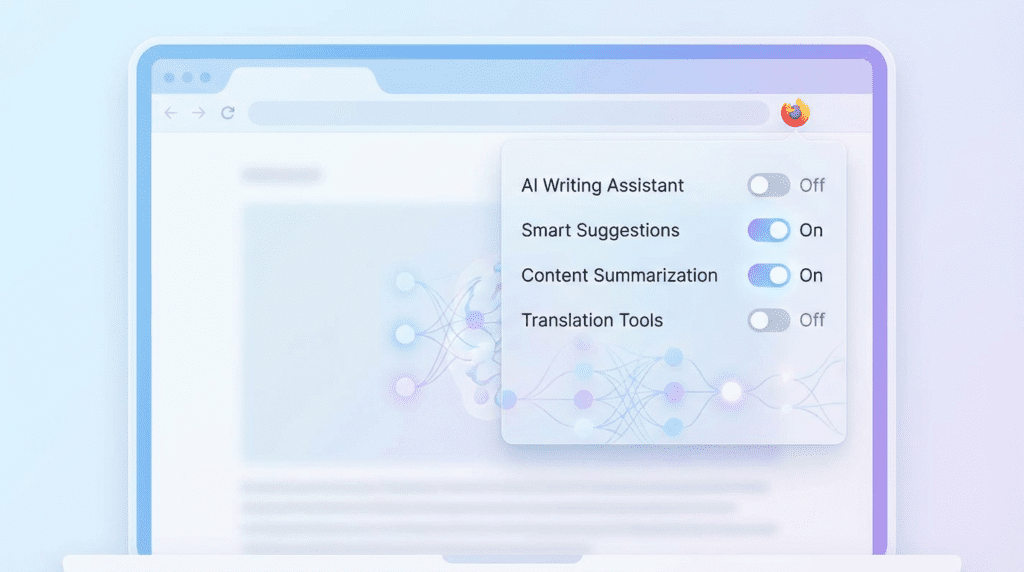
What makes Firefox’s approach particularly noteworthy is that the company isn’t rejecting AI outright. Several of the features being introduced are genuinely useful. Real-time translation can break down language barriers on the web. Alt text generation for PDFs improves accessibility for users with visual impairments. Even the AI chatbot sidebar, while potentially controversial, offers convenience for users who regularly interact with AI assistants.
The difference is in the delivery. These features are opt-in, not opt-out. They’re presented as tools that users can choose to employ, not as fundamental changes to how the browser operates. And critically, users who choose not to use them won’t be constantly reminded of their existence.
This stands in sharp contrast to how many tech companies have approached AI integration. Across the industry, AI features are increasingly being baked into core experiences by default, with limited or no options to disable them. Users who don’t want AI in their workflows often find themselves navigating complex settings menus or, in some cases, simply unable to opt out at all.
The User Perspective
For many Firefox users, the announcement has been met with relief. The browser has long attracted users who prioritize privacy, transparency, and control over their digital experiences. The prospect of mandatory AI features threatened to alienate this core user base.
“Since ChatGPT kicked off the generative AI revolution in 2022, it seems like every company under the sun has tried to stuff AI features into their products in one way or another,” noted Jake Peterson, Senior Technology Editor at Lifehacker. “Sometimes, these features can be useful; often, they’re not, only serving as proof these companies are keeping up with the times.”
Peterson’s observation captures a broader frustration among tech users. AI has become a checkbox item for companies eager to demonstrate they’re on the cutting edge, regardless of whether the integration actually improves the user experience. The result has been a proliferation of AI features that feel forced, unnecessary, or actively detrimental to how people want to use their devices and software.
Firefox’s approach acknowledges this reality. By making AI features entirely optional and providing a master switch to disable them all, Mozilla is essentially saying: we’ll build these tools, but you decide if you want to use them.
The Broader Implications
Mozilla’s decision could have ripple effects across the tech industry. If Firefox’s AI controls prove popular with users and there’s every reason to believe they will other browser makers may feel pressure to offer similar options. Already, users have been vocal about wanting more control over AI features in products ranging from operating systems to productivity software.
The move also raises questions about what “AI integration” should look like in consumer products. Is it better to deeply embed AI throughout a product’s core functionality, as many companies are doing? Or should AI be treated as a set of optional tools that users can enable as needed? Firefox is betting on the latter approach, and the market will ultimately decide if that bet pays off.
There’s also a philosophical dimension to Mozilla’s decision. In his blog post announcing his appointment as CEO, Enzor-DeMeo wrote: “AI should always be a choice something people can easily turn off. People should know why a feature works the way it does and what value they get from it.”
This framing positions AI not as an inevitable force that users must accept, but as a technology that should serve users on their terms. It’s a perspective that aligns with Mozilla’s broader mission as a non-profit-backed organization focused on keeping the internet open and accessible.
Challenges Ahead
Of course, Mozilla’s approach isn’t without risks. By making AI features opt-in rather than default, the company may see lower adoption rates than competitors who integrate AI more aggressively. This could make it harder to gather the usage data needed to improve these features over time.
There’s also the question of whether offering an AI kill switch will be enough to differentiate Firefox in an increasingly competitive market. The browser has been losing market share for years, and while privacy-conscious users appreciate Mozilla’s stance, they represent a relatively small segment of the overall browser market.
Additionally, some of Firefox’s AI features particularly translations and accessibility improvements could genuinely benefit users who might not otherwise seek them out. By making these features opt-in, Mozilla risks having useful tools go undiscovered by people who would value them.
The February 24 Rollout
When Firefox 148 launches on February 24, users will find the new AI controls section in their desktop browser settings. The interface is designed to be straightforward: a master toggle to block all AI enhancements, plus individual controls for each specific feature.
For users who want to selectively enable certain AI features while blocking others, the granular controls offer that flexibility. Someone might, for example, appreciate having translations available while having no interest in the AI chatbot sidebar. The new system accommodates both the all-or-nothing approach and the more nuanced middle ground.
Mozilla has indicated that the controls will apply to both current and future AI features, meaning users who activate the “Block AI enhancements” toggle won’t need to revisit their settings every time the company introduces new AI capabilities.
A New Standard for User Control
Mozilla’s introduction of comprehensive AI controls in Firefox represents more than just a feature update. It’s a statement about how tech companies should approach emerging technologies that fundamentally change user experiences.
In an industry increasingly characterized by “move fast and break things” mentality, Mozilla is moving deliberately and asking permission. In a market where AI is often presented as an inevitable force users must accept, Firefox is offering a choice. And in a competitive landscape where differentiation often comes through adding more features, Mozilla is differentiating by giving users the power to subtract.
Whether this approach will help Firefox regain market share remains to be seen. But for users who value control over their digital experiences, the message is clear: at least one major browser is listening.
As Enzor-DeMeo wrote in his response to concerned users: “Choice matters and demonstrating our commitment to choice is how we build and maintain trust.” With Firefox 148, Mozilla is putting that commitment into practice. The AI revolution may be inevitable, but Firefox is proving that how we integrate it into our tools doesn’t have to be.
Sources
- The Verge: “Firefox is adding a switch to turn AI features off”
- Lifehacker: “Firefox Will Soon Let You Disable All Current (and Future) AI Features”
- WeRSM: “Firefox Will Soon Let You Block All of Its Generative AI Features”
- TechCrunch: “Firefox will soon let you block all of its generative AI features”
Continue Reading
Compare
- Microsoft vs OpenAI: The AI Browser War for Internet Dominance Begins
- OpenAI’s Atlas Browser: The Future of Internet Surfing Is Here
- Meet Comet: The Free AI Browser Changing How We Surf the Internet
Latest News
Recent Launches
The Kingy Brief
Get future Kingy Brief editions.
Source-checked AI changes, original tests and one practical thing to try.
Free · Choose your subjects · Double opt-in · Unsubscribe anytime
Regular sending is paused; no restart date is set.