In a move that has sent shockwaves through Silicon Valley, Apple and Google have officially announced a multi-year partnership that will see Google’s Gemini artificial intelligence model power the next generation of Siri. The landmark deal, confirmed on January 12, 2026, marks one of the most significant strategic shifts in Apple’s history and represents a rare public acknowledgment that the Cupertino giant needed outside help to compete in the rapidly evolving AI landscape.
The Deal That Changed Everything
The announcement came through a joint statement that few industry watchers saw coming. “Apple and Google have entered into a multi-year collaboration under which the next generation of Apple Foundation Models will be based on Google’s Gemini models and cloud technology,” the companies declared. “These models will help power future Apple Intelligence features, including a more personalized Siri coming this year.”
What makes this partnership particularly noteworthy is Apple’s unusually candid admission about Google’s technological superiority. “After careful evaluation, Apple determined that Google’s AI technology provides the most capable foundation for Apple Foundation Models and is excited about the innovative new experiences it will unlock for Apple users,” the statement continued. For a company that has built its reputation on developing proprietary technology in-house, this represents a significant departure from tradition.
The financial terms of the agreement remain undisclosed, though Bloomberg reported in November 2025 that the two companies were coordinating a contract worth approximately $1 billion annually. This substantial investment underscores just how critical Apple views this partnership for its future competitiveness in the AI space.
Why Apple Needed Google
For years, Siri has been the loyal but increasingly outdated companion in millions of pockets worldwide. While the voice assistant could handle basic tasks like setting timers, sending texts, and providing weather updates, it struggled with the kind of complex, contextual conversations that newer AI assistants handled with ease. As ChatGPT, Google’s Gemini, and Anthropic’s Claude were reasoning, summarizing documents, writing code, and engaging in sophisticated dialogue, Siri remained stuck in the past.
The gap became increasingly embarrassing for Apple. While competitors were showcasing AI assistants that could understand nuanced context, execute multi-step workflows, and provide genuinely helpful responses, Siri’s limitations became more glaring with each passing month. Apple’s reputation, built on delivering polished user experiences, was taking a hit every time Siri failed to understand a simple follow-up question.
The company first unveiled its plans for an AI-upgraded Siri during the Worldwide Developers Conference in 2024, promising a revolutionary update powered by its Apple Intelligence platform. However, the ambitious project faced repeated delays. What was initially slated for a 2025 launch was pushed back to spring 2026, and even that timeline appeared uncertain as Apple grappled with the technical challenges of building a competitive large language model from scratch.
Internal reports suggest that Apple originally planned for these features to debut with iOS 18.4, but significant challenges with the legacy Siri architecture forced a complete rebuild. The engineering delays made it clear that Apple’s “build everything in-house” philosophy wasn’t going to work this time around. The AI race was moving too fast, and Apple risked falling irretrievably behind.
What Gemini Brings to the Table
Google’s Gemini isn’t just another chatbot it’s a sophisticated multi-modal reasoning system that represents the cutting edge of AI technology. According to industry reports, Google is developing a bespoke version of Gemini specifically for Apple, featuring a staggering 1.2 trillion parameters. This custom model significantly outclasses Apple’s current on-device capabilities and promises to transform what Siri can do.
The upgraded Siri, rebuilt from the ground up on a Large Language Model infrastructure, is designed to overcome the clunkiness that has plagued the assistant for years. Users can expect a dramatically different experience that includes several game-changing capabilities.
Deep personal context will allow Siri to cross-reference data from Mail, Messages, and Calendar seamlessly. Imagine asking, “When does my mother’s flight land?” and having Siri automatically find the flight number in an email and check its real-time status without any additional prompts. This kind of contextual awareness has been missing from Siri for far too long.
On-screen awareness represents another major leap forward. The new Siri will be able to “see” what’s displayed on your screen, enabling commands like “Send this photo to Suzanne” without needing to specify which photo or which messaging app to use. This natural interaction style mirrors how humans actually think and communicate.
Multi-app workflows will finally make Siri feel like a true digital assistant rather than a glorified voice command tool. Users will be able to execute complex, multi-step tasks such as finding a specific document in Files, summarizing its contents, and drafting a response in Slack all through a single conversational request.
Perhaps most importantly, Siri will move away from simply providing search links to offering direct, conversational answers to general knowledge questions. This functionality, similar to what ChatGPT users have enjoyed for years, will make Siri feel genuinely intelligent rather than just functional.
Privacy Remains a Priority
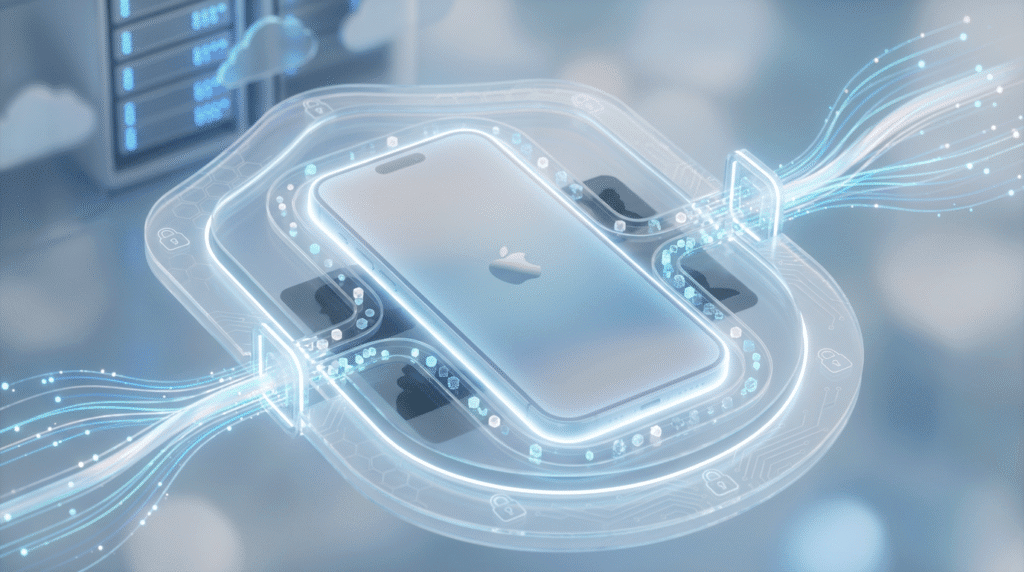
One concern that immediately arose following the announcement was how this partnership would affect Apple’s industry-leading privacy standards. Apple has spent years positioning itself as the privacy-conscious alternative to Google, making this collaboration seem potentially contradictory.
However, both companies were quick to address these concerns. “Apple Intelligence will continue to run on Apple devices and Private Cloud Compute, while maintaining Apple’s industry-leading privacy standards,” the joint statement emphasized.
The implementation will follow a hybrid approach designed to balance performance with privacy. Apple’s own models will continue to handle basic, low-latency tasks that can be processed on-device. Google’s Gemini will power the high-level “summarizer” and “planner” capabilities that require more computational power. Crucially, the Foundation Models will be hosted on Google’s cloud platform, but user queries will be processed through Apple’s Private Cloud Compute system with end-to-end encryption.
This architecture ensures that user data remains encrypted and inaccessible to Google. While Google’s intelligence powers the engine, Apple maintains control over user data protection, on-device processing priorities, encryption layers, and the overall ecosystem experience. It’s collaboration without compromise a very Apple way of doing things.
Market Impact and Industry Implications
The announcement sent immediate ripples through financial markets. Coinciding with the news, Alphabet Google’s parent company briefly surpassed Apple in market capitalization for the first time since 2019, hitting a historic $4 trillion valuation. Alphabet became the fourth company in history to surpass this milestone, joining Nvidia, Microsoft, and Apple itself.
The deal represents a massive validation of Google’s generative AI technology and positions the company to dominate the smartphone AI ecosystem. Google already powers a significant portion of Samsung Galaxy AI, and now it has secured an opportunity to enter Apple’s massive market of over 2 billion active devices. This gives Google an enormous advantage in the ongoing AI competition against OpenAI and Meta.
For Apple, the partnership is being viewed by Wall Street as a positive sign despite the implicit admission that the company’s internal AI development has fallen short. “This is what the Street has been waiting for with the elephant in the room for Cupertino revolving around its invisible AI strategy, but we believe this is an incremental positive to both” Apple and Google, noted Wedbush tech analyst Dan Ives.
Apple is betting heavily on added AI capabilities to boost device sales after several rocky years for the iPhone. The company is expected to post iPhone sales growth of around 11% year-over-year when it reports earnings for the December quarter, with total quarterly profits expected to grow by nearly 8% to more than $39 billion. The success of the new AI-powered Siri could be crucial to maintaining this growth trajectory.
A Broader AI Ecosystem Strategy
While Google is the primary partner for this rollout, Apple CEO Tim Cook has previously hinted that the company remains open to integrations with other AI firms as part of a broader “Apple Intelligence” ecosystem. Apple has already partnered with OpenAI to use ChatGPT to power some AI features, though it remains unclear how the Google deal will affect this existing integration.
The scope of the Google partnership extends beyond just Siri. According to the joint statement, Google’s Gemini models will be used for more Apple Intelligence features across the entire ecosystem. This means that the entirety of Apple Intelligence could receive significant upgrades across iPhone, iPad, Mac, Vision Pro, and Apple Watch.
This broader integration represents a fundamental shift in how Apple approaches AI. Rather than trying to build everything internally and risk falling behind, the company is now willing to partner with the best in the business to deliver superior experiences to users. It’s a pragmatic approach that prioritizes results over pride.
Public Partnership, Shared Responsibility
One interesting aspect of this deal is that Apple and Google have chosen to make it public, rather than keeping Google’s involvement behind the scenes. This transparency could actually work in Apple’s favor.
If Apple had kept the Google partnership private, as rumors initially suggested it might, then any future Siri failings would be pinned solely on Apple. Now, the success or failure of future Apple Intelligence features, including Siri’s forthcoming upgrades, will be attributed to both companies. If the new AI features fall short, Apple won’t take sole blame anymore.
Conversely, if this multi-year deal goes well, both companies can share in the success. And there’s nothing stopping Apple from quietly improving its own internal models behind the scenes in the meantime, potentially reducing its dependence on Google in future years.
Timeline and What’s Next
The Gemini-powered Siri is slated to make its public debut with iOS 26.4, currently expected to be released in March or April 2026. This represents a significant delay from Apple’s original timeline, but the company appears confident that the wait will be worth it.
Developers and early adopters won’t have to wait quite as long. Beta testing is anticipated to begin in late January 2026, providing a first look at what Apple is calling the most significant update to Siri since its introduction in 2011.
The stakes couldn’t be higher. Apple’s competitors have not been standing still. Google has made significant upgrades to Gemini for Home, Amazon has launched Alexa+ with AI capabilities, and numerous other companies are racing to integrate advanced AI into their products. Apple needs this partnership to succeed if it wants to remain competitive in an increasingly AI-driven technology landscape.
A Historic Moment in Tech
Years from now, we may look back at this announcement as a watershed moment in technology history comparable to the launch of the iPhone, the introduction of the App Store, or Apple’s transition to its own Silicon chips. Not because of flashy headlines, but because of the strategic shift it represents.
Two tech titans that have spent decades oscillating between collaboration and fierce competition have chosen to work together on one of the most important technological challenges of our time. It’s a partnership born of necessity but executed with strategic brilliance.
For Apple, this deal represents wisdom rather than weakness. When excellence is required and the mission matters, choosing the best available technology over corporate pride is the right decision. The company that revolutionized personal computing, mobile phones, and wearable technology is showing that it can still adapt and evolve.
For Google, it’s a massive win that validates years of AI research and development. Having both Samsung and Apple the two dominant smartphone manufacturers relying on Gemini technology gives Google an unprecedented position in the AI ecosystem.
And for users? This partnership promises to finally deliver the intelligent, capable, contextually aware voice assistant that we’ve been waiting for. The next time Siri responds with depth, clarity, and genuine intelligence, we’ll know exactly why.
The AI world has indeed tilted, and the reverberations will be felt for years to come.
Sources
- Apple teams up with Google Gemini for AI-powered Siri – Mercury News
- Apple’s new Google Gemini deal sounds bigger, better than expected – 9to5Mac
- Apple Chooses Google’s Gemini to Reinvent Siri – Medium
- Apple’s Siri now powered by Google’s Gemini AI model – Business Korea
- Apple gives up and lets Google take the AI wheel – TechRadar
Apple AI Partnerships
Apple Gemini Siri
Apple Siri AI
Apple AI Roadmap
The Kingy Brief
Get the next Kingy Brief.
Source-checked AI changes, original tests and one practical thing to try.
Free · Choose your subjects · Double opt-in · Unsubscribe anytime