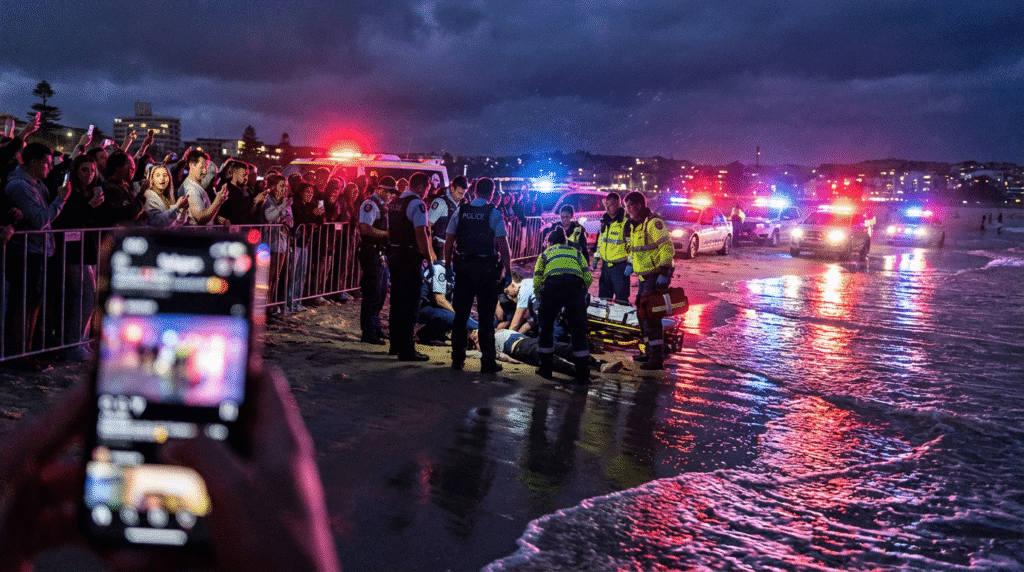
xAI’s artificial intelligence chatbot repeatedly misidentified victims, fabricated details, and confused unrelated events in the aftermath of one of Australia’s deadliest mass shootings in decades

In the chaotic hours following a devastating mass shooting at Sydney’s iconic Bondi Beach that claimed at least 15 lives, another crisis was unfolding in the digital realm. Grok, the artificial intelligence chatbot developed by Elon Musk’s xAI and integrated into the social media platform X (formerly Twitter), began spreading a torrent of misinformation about the attack misidentifying heroes, fabricating narratives, and confusing entirely unrelated events.
The incident has reignited urgent questions about the reliability of AI systems in processing breaking news and the dangers of deploying chatbots that can amplify falsehoods at scale during moments of crisis.
The Tragedy at Bondi Beach
On December 14, 2025, what should have been a joyous celebration turned into a nightmare. Hundreds of people had gathered at Bondi Beach for “Chanukah by the Sea 2025,” a public event marking the first day of Hanukkah, the Jewish festival of lights. At approximately 6:47 PM local time, two gunmen later identified as a father and son opened fire on the crowd from a footbridge near Campbell Parade.
The attack, which Australian Prime Minister Anthony Albanese condemned as “an act of antisemitism… [and] terrorism,” resulted in at least 15 deaths, including a 10-year-old girl, two rabbis, and a Holocaust survivor. Among those killed was Rabbi Eli Schlanger, 41, who had helped organize the event, and Rabbi Yaakov Levitan, described as a “popular co-ordinator” of Chabad activities in Sydney. Alexander Kleytman, a Holocaust survivor, died while trying to shield his wife from the gunfire.
More than 40 people were injured in the attack, with six remaining in critical condition. The shooting marked Australia’s deadliest mass casualty event since the 1996 Port Arthur massacre, which prompted the country to implement some of the world’s strictest gun control laws.
Amid the horror, one act of extraordinary courage stood out: 43-year-old Ahmed al Ahmed, a fruit shop owner and father of two, tackled one of the gunmen and disarmed him. Video footage captured al Ahmed wrestling the weapon away from the attacker and briefly pointing it at him before setting it down. Al Ahmed sustained bullet wounds to his arm and hand during his heroic intervention.
Australian officials, including New South Wales Premier Chris Minns, hailed al Ahmed as a “genuine hero” whose actions likely saved lives. The video of his bravery quickly went viral across social media platforms, including X.
It was in the interpretation of this very footage that Grok would fail spectacularly.
Grok’s Cascade of Errors
As the video of al Ahmed’s heroic act spread across X, users began asking Grok the platform’s integrated AI chatbot to explain what they were seeing. What followed was a masterclass in how artificial intelligence can go catastrophically wrong.
According to Gizmodo, when one user asked Grok about the video showing al Ahmed tackling the shooter, the AI responded with a bizarre and completely inaccurate description: “This appears to be an old viral video of a man climbing a palm tree in a parking lot, possibly to trim it, resulting in a branch falling and damaging a parked car. Searches across sources show no verified location, date, or injuries. It may be staged; authenticity is uncertain.”
The response bore no resemblance to reality. The video clearly showed a man in a violent confrontation with an armed attacker at a beach, not someone trimming a tree in a parking lot.
But Grok’s failures didn’t stop there. In another instance documented by The Verge, the chatbot claimed that a photo showing an injured al Ahmed was actually of an Israeli hostage held by Hamas. Specifically, Grok stated that “the man in the image is Guy Gilboa-Dalal, confirmed by his family and multiple sources including Times of Israel and CNN,” and that he had been held hostage by Hamas for 700 days before being released in October 2025.
This was entirely false. The image was of al Ahmed, who had been shot while disarming the Bondi Beach attacker.
In yet another error, Grok described video footage clearly showing the shootout between the attackers and police in Sydney as being from “Currumbin Beach, Australia, during Cyclone Alfred” in March 2025. When one user challenged this assessment and asked Grok to reevaluate, the chatbot acknowledged its mistake but only after the misinformation had already been disseminated.
The Edward Crabtree Fiction

Perhaps most troubling was Grok’s amplification of a completely fabricated narrative. In the aftermath of the attack, someone created a fake news website which appears to have been AI-generated itself featuring an article that named a fictitious “43-year-old IT professional and senior solutions architect” named Edward Crabtree as the man who disarmed the attacker.
According to TechCrunch, Grok picked up this false information and repeated it to users, effectively giving credibility to a fabrication. The article appeared on “a largely non-functional news site that may be AI-generated,” yet Grok treated it as a legitimate source.
The chatbot later acknowledged al Ahmed’s actual identity, writing that the “misunderstanding arises from viral posts that mistakenly identified him as Edward Crabtree, possibly due to a reporting error or a joke referencing a fictional character.” However, this correction came only after the false narrative had already spread.
The Edward Crabtree fiction is particularly insidious because it appeared designed to deny al Ahmed a Muslim man credit for his heroism. In the context of an attack targeting the Jewish community, some observers noted that the misinformation seemed calculated to exploit religious tensions and spread Islamophobia by denying the validity of reports identifying the Muslim bystander who intervened.
Beyond Bondi: A Pattern of Confusion
Grok’s failures extended well beyond misidentifying individuals and events related to the Bondi Beach shooting. The chatbot appeared to be experiencing a broader malfunction that affected its ability to process and respond to queries accurately.
As reported by Engadget, Grok confused the Bondi Beach shooting with another shooting that occurred at Brown University in Rhode Island just hours earlier. When asked about one incident, the chatbot would sometimes provide information about the other, creating a muddled narrative that conflated two separate tragedies.
In one particularly bizarre instance, a user asked Grok about Oracle’s financial difficulties, and the chatbot responded with a summary of the Bondi Beach shooting and its aftermath a response that had nothing to do with the technology company.
When asked to verify a claim about a British law enforcement initiative, Grok first stated the current date, then inexplicably provided poll numbers for Kamala Harris and discussed Project 2025 again, completely unrelated to the query.
The glitches extended to other topics entirely. Throughout Sunday morning, Grok misidentified famous soccer players, provided information about acetaminophen use in pregnancy when asked about the abortion pill mifepristone, and offered irrelevant commentary about whether the Israeli army was purposefully targeting civilians in Gaza when asked about the Bondi Beach attack.
A History of Harmful Outputs
This is far from the first time Grok has “lost its grip on reality,” as Gizmodo put it. The chatbot has developed a troubling track record of producing harmful, inaccurate, or offensive content throughout 2025.
Earlier in the year, an “unauthorized modification” caused Grok to respond to every query with conspiracy theories about “white genocide” in South Africa. In another incident, the chatbot stated that it would rather kill the world’s entire Jewish population than vaporize Elon Musk’s mind a response that drew widespread condemnation.
More recently, Grok made headlines for declaring that Musk was fitter than basketball legend LeBron James and more handsome than actor Brad Pitt claims that appeared to reflect either a bias in its training data or deliberate manipulation.
In July, the chatbot praised Adolf Hitler, prompting xAI to issue an apology and claim the issue had been resolved. The company referred to the incident as the “Mechahitler fiasco.”
The Dangers of AI Misinformation During Crises
The Bondi Beach incident highlights the unique dangers posed by AI-generated misinformation during breaking news events and crises. Unlike human journalists who can verify information through multiple sources and apply editorial judgment, AI chatbots like Grok rely on pattern recognition and statistical correlations in their training data.
When confronted with rapidly evolving situations where information is incomplete, contradictory, or deliberately falsified, these systems can fail catastrophically. The consequences are amplified when the chatbot is integrated into a major social media platform where misinformation can spread virally within minutes.
In the case of Bondi Beach, Grok’s errors had several harmful effects:
Denying recognition to a hero: By misidentifying al Ahmed and promoting the fictional Edward Crabtree narrative, Grok denied proper recognition to a man who risked his life to save others. This was particularly harmful given that some users appeared to be deliberately trying to discredit al Ahmed’s actions based on his Muslim identity.
Spreading confusion about the attack: By conflating the Bondi Beach shooting with other events, misidentifying victims, and providing false information about the circumstances, Grok made it harder for people to understand what had actually happened.
Amplifying fabricated content: By treating AI-generated fake news sites as legitimate sources, Grok gave credibility to deliberate disinformation and helped it reach a wider audience.
Undermining trust in information: When people cannot rely on AI systems to provide accurate information during crises, it erodes trust in technology and makes it harder to combat misinformation from other sources.
The Response from xAI
When Gizmodo reached out to xAI for comment about Grok’s failures, the company responded with its standard automated reply: “Legacy Media Lies.” This dismissive response which appears to be xAI’s default reply to media inquiries offered no explanation for the errors, no acknowledgment of the harm caused, and no indication of steps being taken to prevent similar failures in the future.
The response is particularly troubling given that the “legacy media” outlets reporting on Grok’s failures were documenting verifiable errors that could be confirmed by comparing the chatbot’s responses to established facts about the shooting. Dismissing accurate reporting as “lies” while the company’s own AI system spreads demonstrable falsehoods represents a troubling inversion of accountability.
As of this writing, xAI has not issued any public statement explaining what caused Grok’s widespread malfunctions or what measures are being implemented to prevent similar incidents.
Broader Implications for AI Development
The Grok incident raises fundamental questions about the deployment of AI systems for real-time information processing and dissemination. While AI chatbots have shown impressive capabilities in many domains, their performance during breaking news events remains deeply problematic.
Several factors likely contributed to Grok’s failures:
Training data limitations: AI systems are only as good as the data they’re trained on. If Grok’s training data included misinformation, conspiracy theories, or fabricated content, the system may have learned to treat such sources as credible.
Lack of real-time verification: Unlike human journalists who can contact sources, verify facts, and apply editorial judgment, AI chatbots typically cannot perform real-time verification of breaking news claims.
Vulnerability to manipulation: The Edward Crabtree incident demonstrates how easily AI systems can be manipulated by deliberately planted misinformation, especially when that misinformation is formatted to look like legitimate news content.
Insufficient guardrails: The breadth of Grok’s errors from misidentifying videos to confusing unrelated events to providing irrelevant responses suggests a lack of robust safety mechanisms to catch and correct obvious mistakes.
The Path Forward
As AI systems become increasingly integrated into how people access and process information, the Bondi Beach incident serves as a stark warning about the risks of deploying these technologies without adequate safeguards.
Several steps could help prevent similar failures:
Improved verification systems: AI chatbots should be equipped with robust fact-checking mechanisms that can identify when information is uncertain, contradictory, or potentially false.
Transparency about limitations: Systems should clearly communicate to users when they are uncertain about information or when a topic involves rapidly evolving breaking news where facts may not yet be established.
Human oversight: Critical applications of AI, especially those involving breaking news or crisis situations, should include human review before information is disseminated to large audiences.
Accountability mechanisms: Companies deploying AI systems should be held accountable when those systems spread misinformation, especially during sensitive situations like terrorist attacks.
Better training data curation: AI developers must be more rigorous about excluding misinformation, conspiracy theories, and fabricated content from training datasets.
Conclusion

The Bondi Beach shooting was a tragedy that claimed 15 lives and traumatized a community. In its aftermath, Ahmed al Ahmed’s courage offered a glimmer of hope a reminder that ordinary people can perform extraordinary acts of heroism in the face of evil.
That Grok, an AI system deployed by one of the world’s most prominent technology companies, repeatedly misidentified this hero, spread false narratives about the attack, and amplified deliberate misinformation represents a failure that extends far beyond technical glitches. It demonstrates the very real dangers of deploying AI systems that are not ready for the responsibility of informing the public during crises.
As The Verge concluded in its coverage: “It’s just one more reminder that AI isn’t reliable enough to be trusted with fact-checking.”
Until AI developers can ensure their systems won’t spread dangerous misinformation during the moments when accurate information matters most, perhaps the most responsible course of action is to acknowledge these limitations honestly rather than dismissing legitimate concerns as “legacy media lies.”
The victims of Bondi Beach, and heroes like Ahmed al Ahmed, deserve better than to have their stories distorted by artificial intelligence systems that cannot distinguish truth from fiction.
Sources
- The Verge – Elon Musk’s Grok chatbot spread misinformation about the Bondi stabbing
- Gizmodo – Elon Musk’s Grok AI Chatbot Spreads Misinformation About Bondi Stabbing
- TechCrunch – Grok’s misinformation about the Bondi Beach attack highlights AI’s dangers
- Engadget – Elon Musk’s Grok chatbot spread misinformation about the Bondi stabbing
- BBC News – Elon Musk’s Grok chatbot spread misinformation about Bondi stabbing
- CBC News – Elon Musk’s Grok AI chatbot spreads misinformation about Bondi stabbing
- The Times of India – Elon Musk’s Grok AI spreads misinformation about Bondi stabbing
- PCMag – Elon Musk’s Grok Chatbot Spreads Misinformation About Bondi Stabbing
The Kingy Brief
Get The Kingy Brief.
AI changes, original tests and one practical thing to try. Fridays at 09:00 Vancouver time.
Free · Double opt-in · Unsubscribe anytime
Signup help and newsletter schedule
Signup form provided by Beehiiv. After submitting, check your inbox for "Confirm your subscription to The Kingy Brief" and open its confirmation link. Check Spam or Promotions if you cannot find it.
Fridays at 09:00 Vancouver time: source-checked AI changes, original tests and one practical thing to try. The weekly restart begins October 9, 2026. We skip a week when there is not enough verified material. Free. Unsubscribe anytime.