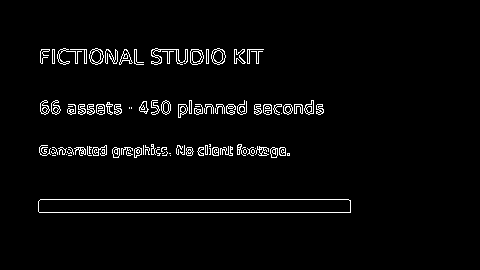
The demo resizes a generated title card to 480×270 and exports a Canny edge image, checking its dimensions and nonzero edge pixels. This fresh local test used OpenCV 5.0.0.93 on October 23, 2026. Inputs, planning counts and studio stops are fictional. It is separate from the related historical article; source, outputs and checks are downloadable.
Algorithms need input-specific settings. The test does not establish restoration quality, object-recognition accuracy or support for every codec.
Total-variation denoising is applied to seeded noise on synthetic blocks. SSIM against the known clean image improves; all three input/output images and the scores are retained. This fresh local test used scikit-image 0.26.0 on October 23, 2026. Inputs, planning counts and studio stops are fictional. It is separate from the related historical article; source, outputs and checks are downloadable.
Parameter choices matter. A score on generated shapes is not evidence of real-photo enhancement quality or universal superiority.
Twelve generated frames and a synthetic tone produce a 640×360 one-second MP4. ffprobe finds video and audio streams, and the browser decodes the exported clip. This fresh local test used MoviePy 2.2.1 on October 23, 2026. Inputs, planning counts and studio stops are fictional. It is separate from the related historical article; source, outputs and checks are downloadable.
Rendering depends on codecs, FFmpeg and available resources. The one-second test does not establish long-form editing speed, synchronization or full format coverage.
A generated two-second 440 Hz tone is written as PCM-16 FLAC and read back at 22,050 Hz with 44,100 samples, then exported to WAV. This fresh local test used SoundFile 0.14.0 on October 23, 2026. Inputs, planning counts and studio stops are fictional. It is separate from the related historical article; source, outputs and checks are downloadable.
Available formats depend on libsndfile and its build; the bundled native library has its own license. This test does not cover compressed streaming or every codec.
The demo trims a generated tone to one second, applies 100 ms fades at both ends, exports WAV and checks the resulting 1,000 ms duration. This fresh local test used pydub 0.25.1 on October 23, 2026. Inputs, planning counts and studio stops are fictional. It is separate from the related historical article; source, outputs and checks are downloadable.
Many compressed formats require FFmpeg. This test uses WAV and does not measure codec quality, loudness compliance or long-file memory use.
A title tag is added to the generated WAV, the file is saved and reopened, and the title reads back as Fictional studio tone. This fresh local test used Mutagen 1.48.1 on October 23, 2026. Inputs, planning counts and studio stops are fictional. It is separate from the related historical article; source, outputs and checks are downloadable.
It does not edit the audio waveform. Tag compatibility varies by player and format; review the GPL license before redistribution or integration.
A spectrogram of the synthetic 440 Hz tone has its strongest average frequency bin near 441.43 Hz, within the test tolerance for that known input. This fresh local test used librosa 1.0.0 on October 23, 2026. Inputs, planning counts and studio stops are fictional. It is separate from the related historical article; source, outputs and checks are downloadable.
Feature estimates depend on the signal and parameters. The test does not establish pitch-tracking quality for speech, polyphonic music or noisy recordings.
The demo writes twelve planning rows, adds total formulas and supplies cached totals of 66 assets and 450 seconds. The XLSX XML is checked for both the formula and cached value. This fresh local test used XlsxWriter 3.2.9 on October 23, 2026. Inputs, planning counts and studio stops are fictional. It is separate from the related historical article; source, outputs and checks are downloadable.
It writes new workbooks rather than editing existing files. It does not recalculate formulas; cached values in this demo are explicitly supplied.
A one-page fictional plan is created, reopened and checked for its text. PyMuPDF renders it to a 1050×750 PNG, which is visually inspected; its producer metadata is retained. This fresh local test used PyMuPDF 2.0 on October 23, 2026. Inputs, planning counts and studio stops are fictional. It is separate from the related historical article; source, outputs and checks are downloadable.
The C$0 option carries AGPL obligations. Artifex offers commercial licensing separately; no commercial quote or checkout was obtained. OCR and Office-specific capabilities were not tested.
The demo creates a 12-face box with volume 1, exports STL and GLB, reopens the STL and confirms its volume and watertight status. This fresh local test used Trimesh 5.1.1 on October 23, 2026. Inputs, planning counts and studio stops are fictional. It is separate from the related historical article; source, outputs and checks are downloadable.
Optional operations and formats may need extra dependencies. A watertight box is not evidence of general mesh repair, printability or complex asset quality.
A 4×3 planning rectangle has area 12, contains the chosen inside point, rejects an outside point and produces a checked buffer area. This fresh local test used Shapely 2.2.0 on October 23, 2026. Inputs, planning counts and studio stops are fictional. It is separate from the related historical article; source, outputs and checks are downloadable.
It does not assign geographic coordinate systems or make planar units into real-world distances. Projection choices belong to the surrounding workflow.
Three fictional Vancouver-area studio points are projected from EPSG:4326 to UTM 10N and back; coordinates match within tolerance, and GeoJSON is exported. This fresh local test used GeoPandas 1.2.0 on October 23, 2026. Inputs, planning counts and studio stops are fictional. It is separate from the related historical article; source, outputs and checks are downloadable.
Coordinate systems and data provenance need care. Real route accuracy, distance validity and every GIS format were not tested.
The map renders three fictional studio markers on an attributed OpenStreetMap basemap. Opening the Tutorial marker shows its label and 18 invented assets. This fresh local test used Folium 0.20.0 on October 23, 2026. Inputs, planning counts and studio stops are fictional. It is separate from the related historical article; source, outputs and checks are downloadable.
Tiles and browser libraries can require external network access and carry their own terms. No tile-service subscription, offline map or travel recommendation is included.
The exported view renders three fictional points. Selecting the Review point shows its name and 22 invented assets, with no paid map-service key. This fresh local test used pydeck 0.9.3 on October 23, 2026. Inputs, planning counts and studio stops are fictional. It is separate from the related historical article; source, outputs and checks are downloadable.
Rendering needs browser GPU support. Basemap services and keys are separate; the tested view deliberately uses no basemap. No large-dataset or GPU benchmark was run.
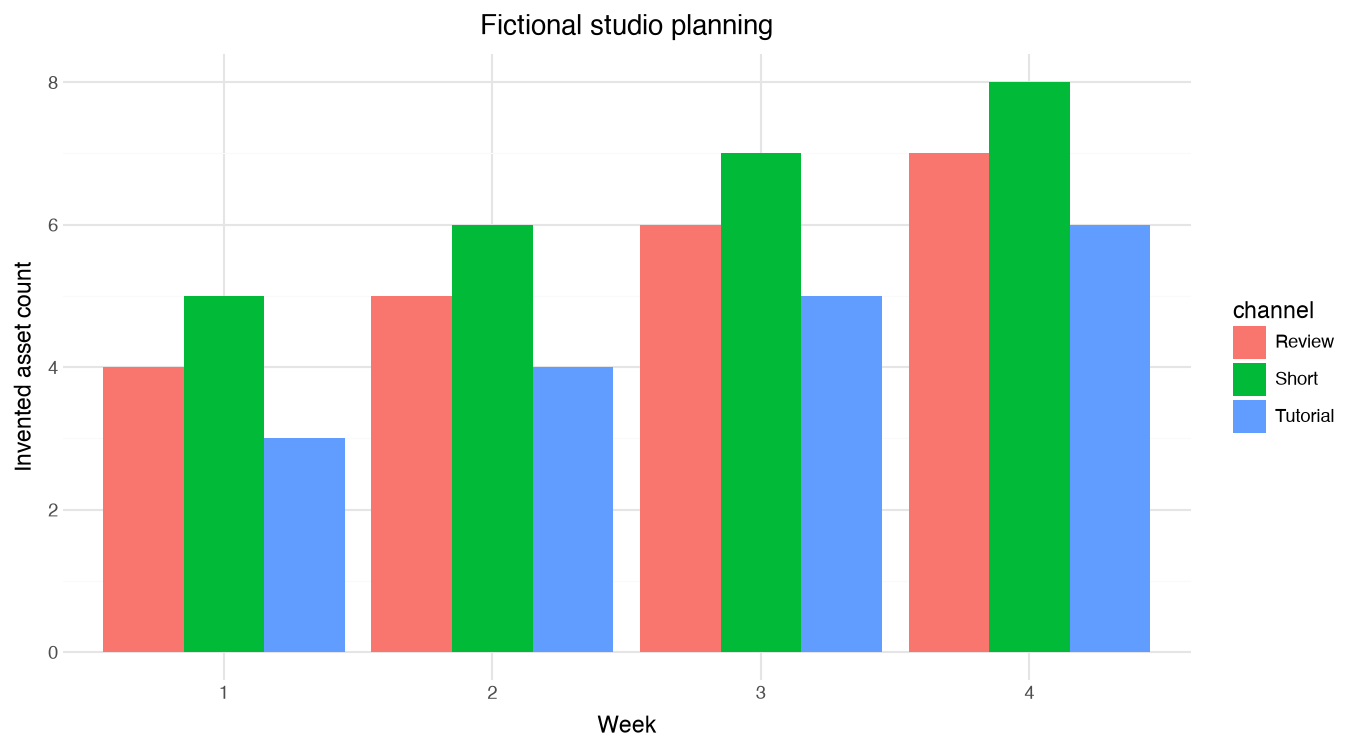
A grouped column chart shows four weeks of invented asset counts across three channels and exports as a 1350×750 PNG for visual review. This fresh local test used plotnine 0.15.8 on October 23, 2026. Inputs, planning counts and studio stops are fictional. It is separate from the related historical article; source, outputs and checks are downloadable.
Chart semantics, labels and statistical choices remain the author’s responsibility. This example does not benchmark rendering or validate a real planning model.
The demo builds and exports a three-bar asset summary through the Bokeh backend; browser review shows totals of 22, 26 and 18 by channel. This fresh local test used HoloViews 1.23.2 on October 23, 2026. Inputs, planning counts and studio stops are fictional. It is separate from the related historical article; source, outputs and checks are downloadable.
Backend capabilities and dependencies vary. The static HTML example does not establish server-side callback behavior or large-data performance.
A DataFrame plotting call produces three channel lines across four weeks, exported as an interactive HTML document and reviewed in the browser. This fresh local test used hvPlot 0.12.2 on October 23, 2026. Inputs, planning counts and studio stops are fictional. It is separate from the related historical article; source, outputs and checks are downloadable.
It adds dependencies and does not choose the right chart for you. Data size, backend behavior and server callbacks need their own checks.
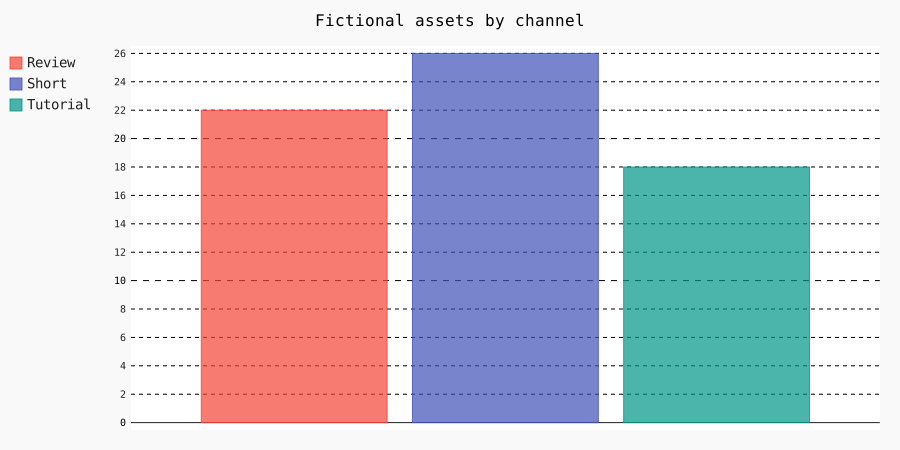
A three-series SVG bar chart displays the checked fictional totals of 22 Review, 26 Short and 18 Tutorial assets and is visually reviewed in the browser. This fresh local test used Pygal 3.1.3 on October 23, 2026. Inputs, planning counts and studio stops are fictional. It is separate from the related historical article; source, outputs and checks are downloadable.
Review the LGPL terms for your integration. Text, interaction and embedding can vary by viewer; this test does not cover every chart type or export backend.
Five supplied words generate a seeded 960×400 graphic. Story has the highest input weight and is recorded as the top normalized word. This fresh local test used WordCloud 1.9.6 on October 23, 2026. Inputs, planning counts and studio stops are fictional. It is separate from the related historical article; source, outputs and checks are downloadable.
Word size reflects supplied weights rather than importance or sentiment. Font support and readability need visual checks; text analysis is not included.
The fictional article renders headings and a list with raw HTML disabled. Its script example is escaped instead of becoming an executable script element. This fresh local test used markdown-it-py 4.2.0 on October 23, 2026. Inputs, planning counts and studio stops are fictional. It is separate from the related historical article; source, outputs and checks are downloadable.
Plugin choices and HTML settings affect the output. Disabling raw HTML is not a complete link, URL or application security policy.
The article’s status changes from draft to reviewed-demo; after serialization and reparsing, the updated metadata and unchanged body are checked. This fresh local test used python-frontmatter 1.3.0 on October 23, 2026. Inputs, planning counts and studio stops are fictional. It is separate from the related historical article; source, outputs and checks are downloadable.
It is not a CMS or metadata validator. Serialization can change metadata formatting; the test preserves the content body, not every original byte.
JupyterLab opens the executed three-cell notebook and runs both code cells through its interface. Fresh execution counts appear with the expected 66-assets/450-seconds output. This fresh local test used JupyterLab 4.6.4 on October 23, 2026. Inputs, planning counts and studio stops are fictional. It is separate from the related historical article; source, outputs and checks are downloadable.
Kernels, extensions and shared-server security need configuration. An optional Dash-extension build was declined; extension compatibility and multiuser deployment were not tested.
HTMLExporter converts the executed studio notebook to HTML containing its code and the checked 66-fictional-assets output. This fresh local test used nbconvert 7.17.2 on October 23, 2026. Inputs, planning counts and studio stops are fictional. It is separate from the related historical article; source, outputs and checks are downloadable.
Some exporters require external runtimes or document tools. This test covers HTML, not PDF, slides or preservation of every widget.
NotebookClient runs the two code cells in a dedicated local kernel with a timeout. Both complete without error and produce the expected planning totals. This fresh local test used nbclient 0.11.0 on October 23, 2026. Inputs, planning counts and studio stops are fictional. It is separate from the related historical article; source, outputs and checks are downloadable.
Notebook code runs with the kernel’s access. Inputs, environments and error policy still need control; this was a local synthetic notebook only.
The demo creates a version-4 notebook with one Markdown cell and two code cells, validates it, writes it and validates the executed result again. This fresh local test used nbformat 5.11.1 on October 23, 2026. Inputs, planning counts and studio stops are fictional. It is separate from the related historical article; source, outputs and checks are downloadable.
A valid notebook file can still contain unsafe code or wrong results. Format validation is distinct from execution and content review.
The local notebook starts at 66 fictional assets. Selecting Tutorial recomputes its output to 18 assets and 110 planned seconds. This fresh local test used marimo 0.25.2 on October 23, 2026. Inputs, planning counts and studio stops are fictional. It is separate from the related historical article; source, outputs and checks are downloadable.
Reactivity depends on cell dependencies and code design. The test does not cover collaboration, authentication, hosted deployment or every export mode.
Selecting Tutorial changes the local metrics from 66 assets to 18, shows 110 planned seconds and reduces the displayed table to four rows. This fresh local test used Panel 1.9.4 on October 23, 2026. Inputs, planning counts and studio stops are fictional. It is separate from the related historical article; source, outputs and checks are downloadable.
Live Python callbacks need a running server. Authentication, sessions and hosting require separate work; no scale test was performed.
The local channel callback changes the summary from 66 assets to 18 assets and 110 planned seconds when Tutorial is selected, alongside the filtered chart. This fresh local test used Dash 4.4.1 on October 23, 2026. Inputs, planning counts and studio stops are fictional. It is separate from the related historical article; source, outputs and checks are downloadable.
Production serving, authentication and scaling are separate. The free package is distinct from Dash Enterprise and other commercial services.
A three-partition DataFrame groups the twelve planning rows by channel using two local worker threads; every result matches the independent pandas summary. This fresh local test used Dask 2026.8.0 on October 23, 2026. Inputs, planning counts and studio stops are fictional. It is separate from the related historical article; source, outputs and checks are downloadable.
Partitioning and overhead can make small jobs slower. A local threaded calculation does not establish distributed capacity, memory limits or a speed advantage.
The exported fictional publishing graph renders five labeled nodes and five directed edges, with its JavaScript bundled in the HTML. This fresh local test used PyVis 0.3.2 on October 23, 2026. Inputs, planning counts and studio stops are fictional. It is separate from the related historical article; source, outputs and checks are downloadable.
Physics layouts can move and overlap. Large graphs, accessibility and every browser were not tested; the diagram is not an execution engine.
No paid model, account checkout, public Python-app deployment, shared-server security audit or capacity benchmark was used. Spreadsheet formulas were not recalculated in Excel. Audio and image examples use generated signals and shapes. Maps contain fictional stops and keep the map-provider attribution. The local UI captures are evidence, not live public dashboard services.